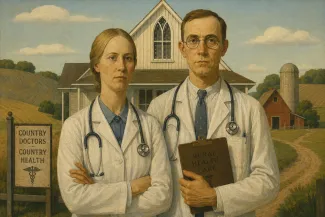
How do you keep them down on the farm?
In this case, “you” are newly minted physicians, and “the farm” stands in for working in rural areas. The question is posed and an answer attempted in a recent JAMA Network Open research letter.
The Rural Doctor Gap Is More Than Primary Care
We know rural hospitals have been in trouble, but their closures ripple through the labor market. To be blunt, our rural areas risk becoming “healthcare deserts,” so understanding which medical students choose rural careers is important. While 15% to 20% of the United States population lives in rural counties, only 9% to 11% of actively practicing physicians and 11% of primary care practitioners work in these areas, creating a significant supply gap compared with urban centers.
As you might expect, those gaps vary by physician specialty. While primary care physicians are roughly comparable between rural and metropolitan areas, you will find half as many general surgeons, a third as many psychiatrists, and nearly half as many ob/gyns. Additionally, physician shortages are something of a chicken-and-egg problem – without a hospital and labor area, it is tough to be an obstetrician. Similarly, without a general surgeon to provide surgical backup, it can be difficult to perform abdominal surgery safely; medicine is built on teamwork. Rural areas also need oncologists and cardiologists. Without them, cancer and heart care may be hours away. Take it from me, a patient on Long Island who continues to get care in New York City – it is a six-hour trip for routine care, and in an emergency, it is aspirational.
The disparity seems to keep growing and is now being worsened by an aging rural physician workforce. With roughly 5% of medical school graduates entering rural practice and 14% of rural physicians in the age range to consider retirement, replacement is increasingly difficult.
Bringing Medical Education to the Country
In response to physician shortages, approximately 60 new medical schools (graduating both MDs and DOs) have opened in the past two decades. However, only 13% are located in rural, non-metropolitan communities. Fewer are standalone programs because they lack the hospital infrastructure needed for clinical clerkships, including ICU and subspecialty experience. Workarounds include rural regional campuses, where clinical experience is farmed out to regional hubs. In some instances, medical schools offer rural training tracks that admit students with rural backgrounds, provide specialized rural primary care coursework, and place them in longitudinal rural clerkships.
Medical School Matters Less Than What Comes Next
The answer to the question I posed about staying down on the farm is that it is hard. The data comes from the Association of American Medical Schools and includes physician origin, experience as a medical student and resident in a rural area, and the percentage of time they practice in a rural area.
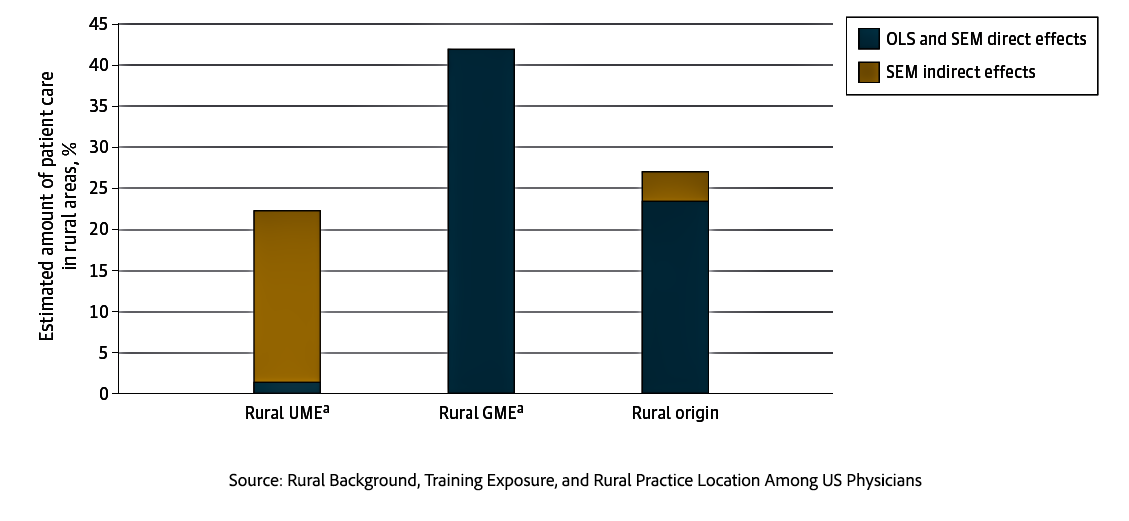 The graph shows the percentage of time spent in rural healthcare based upon undergraduate medical education, UME or medical school, as well as graduate medical education, GME or residency and fellowship training. You can ignore the differences in bar color for our purposes.
Rural upbringing was associated with a 27% increase in rural practice time on its own. The site of undergraduate medical education (medical school) had almost no direct link, about 1%. The association was significant when paired with the real driver of staying on the farm: rural graduate medical education. Rural GME alone accounted for a 42% increase in subsequent rural practice.
Roughly 80% of urban GME trainees remain within the broader geographic area. While the percentage is slightly lower for rural GME trainees, rural training tracks provide a powerful mechanism to attract physicians from both rural and urban backgrounds into underserved rural healthcare markets.
You Can Lead a Doctor to the Country…
The numbers point toward a practical answer to the old question of how to keep doctors “down on the farm.” Rural residency and fellowship programs are an important part of the solution, but training location can only do so much. Rural practice is not simply an urban medical career transplanted to a smaller town. It comes with a different professional and personal ecosystem—fewer specialists and hospitals, longer distances, and a greater dependence on a smaller healthcare team. Those differences can be either liabilities or attractions, depending on the physician.
Part of solving the rural physician shortage may be a matching problem: finding and training people who actually like what rural life and rural medicine have to offer. Rural training tracks provide that exposure and identify those for whom it is a good fit.
The other part of the solution runs in the opposite direction. Rural healthcare systems and communities may have to change the job through stronger clinical support, better professional networks, more workable schedules, and other changes that reduce the tradeoffs of practicing far from a metropolitan medical center.
Keeping doctors “down on the farm” requires more than putting a medical school there. We either have to find more physicians who want the farm or make the farm a place more physicians want to stay.
Source: Rural Background, Training Exposure, and Rural Practice Location Among US Physicians JAMA Network Open DOI: 10.1001/jamanetworkopen.2026.25481

Chuck Dinerstein, MD, MBA
Director of Medicine
Dr. Charles Dinerstein, M.D., MBA, FACS is Director of Medicine at the American Council on Science and Health. He has over 25 years of experience as a vascular surgeon.