
Drug addiction destroys lives. It leaves children orphaned, wrecks the health of users it doesn't kill and turns the downtowns of major cities into homeless encampments. Because it yields such devastating consequences, we should discourage substance use: health care providers should treat addicts with the intention of helping them quit; policies that enable public drug use should be rescinded and replaced with laws that protect public health and safety.
These strike me as common-sense public health measures—and they were widely viewed that way for decades—but they seem to diverge from an increasingly popular perspective among some drug policy experts and addiction researchers. Rather than treating addiction as an ill to be eliminated, this harm-reduction coalition views it as a habit to manage: give people a sanctioned place to use, and in some cases give them the drugs. Several major cities in the US and Canada market these programs as practical responses to inevitable substance use. As The Atlantic reported in July:
In New York City, which established two injection sites in 2021, health officials and academics point to the perceived success of Vancouver as inspiration. Rhode Island, where an injection center opened in Providence in 2024, also holds up Vancouver as a model. The Washington State legislature appointed a working group that in 2025 recommended establishing a safe supply of narcotics for addicts, and officials repeatedly cited the Vancouver program.
Medicalizing recreational drug use is often the first step in a broader case for legalizing all substance use. [1] It's usually couched in rhetoric about the need for empathy and pragmatism in medicine; appeals to individual liberty are never far behind. But to make legalization seem even plausible to the public, harm reduction advocates have to show that easing restrictions on drug use yields significant public health benefits.
This is something they can't do, because even the most favorable research turns up critical flaws in this approach to drug policy.
"Heroin Assisted Treatment"
There's probably no better example than so-called heroin-assisted treatment, or HAT, which is billed as a superior intervention to existing drug treatment programs. HAT is the supervised prescription of pharmaceutical heroin, usually injected on-site, for people with severe opioid addiction who have not stabilized on methadone or buprenorphine.
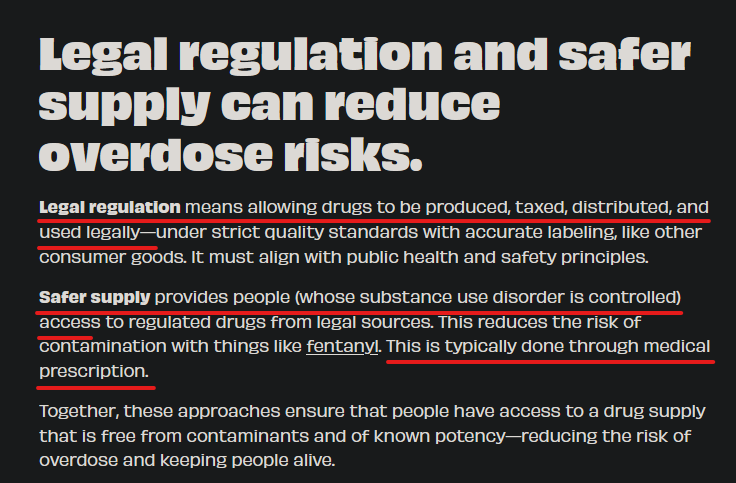
HAT is currently not considered a first-line intervention for opioid addiction, but legalization groups treat supervised heroin as proof that prescribing the drug is medicine, then fold that into “safe supply,” then into legal production and sale. The pro-legalization Drug Policy Alliance, for instance, now supports safer supply and full legal regulation on the same page:
Proponents point to European and Canadian programs, claiming HAT reduces overdose deaths, drug-related crime and disease transmission by providing clean heroin instead of forcing people into the black market or into treatment they may not want. In truth, the evidence is much messier than HAT supporters let on. This is apparent if you just read the studies they cite.
Adverse events: Heroin vs. methadone
Methadone is a full opioid agonist medication widely used to treat opioid addiction. At a stable dose it reduces withdrawal and blunts the effect of heroin; its safety and efficacy have been well documented. If HAT is a first-line treatment, it should outperform methadone on the most important outcomes: health, safety and recovery. But it doesn't. It can keep some methadone-refractory patients in clinic and reduce some street-heroin use. However, the same literature shows more serious medical events and no consistent health improvement.
A 2018 RAND Corporation review of European and Canadian trials, widely cited in support of HAT, concluded that supervised injectable heroin carries a substantially higher risk of serious adverse events than oral methadone. As the RAND authors put it:
“Evidence from all reviews supports a significantly higher risk of study medication-related adverse events among the heroin treatment arms …"
The review found the highest relative risk of serious medical adverse events in Canada’s NAOMI trials, where those events included overdoses that needed naloxone and other problems judged to be related to the study medication. Across the remaining studies, supervised injectable heroin also carried a higher risk of serious adverse events than oral methadone.
Polydrug use also remained a major problem: trial participants continued mixing heroin with benzodiazepines, methamphetamine, alcohol and other substances. "Four trials specifically assessed illicit use of non-opiate drugs," RAND reported. "For most substances, little evidence suggested a relative benefit of HAT relative to methadone." Many serious adverse events in the studies stemmed from this concurrent illicit drug use.
Giving people a safer supply of one drug does not stop them from using others, a finding confirmed in previous research on so-called "safe supply" programs. Many addicts gladly accept pharmaceutical-grade opioids from these programs and mix them with illicit drugs purchased on the street. A majority of overdose deaths in multiple studies involve a combination of drugs. If polydrug patterns continue, the overdose crisis driven by fentanyl and more potent opioids will not be solved by pharmaceutical heroin alone.
The evidence base has not grown much since RAND published its analysis in 2018. In 2023, a team of researchers re-analyzed the same small set of European and Canadian HAT trials—nine randomized trials across eight studies, 2,331 patients—minus an earlier unsupervised UK experiment. They are not opposed to HAT, yet their conclusion still leaves a lot to be desired, with a majority of studies reporting no health improvements in the treatment groups:
"Evidence of improved health in participants receiving supervised HAT compared to other OSTs [opioid substitution treatments] was inconsistent; positive effects were observed in only three of the eight included studies.”
The authors also found that HAT reduced illicit drug use anywhere from 13 percent to 47 percent more than methadone maintenance, though later in the review they outlined the critical limitations surrounding that result. There was so much variation in how the reviewed studies measured a reduction in illicit drug use, the results could not be combined. More specifically, "five studies relied on self-report data from participants at different points in the intervention, and two studies used urinalysis to capture patients’ street drug use." In other words, the headline reduction cannot be pooled, and most of it rests on what patients said they used, not on drug tests.
Crime reduction, but for a price
Some studies report reductions in property crime with HAT, but results are inconsistent and often not statistically significant when compared directly to optimized methadone. As RAND noted, “the relative benefits of HAT versus oral methadone for reduced criminal activity have been less marked in the most recent RCTs.” On violent crime— the metric that matters most for public safety—the same review found “little indication that HAT produced greater benefits than oral methadone in reducing patient participation in violent crime.”
The deeper issue with HAT's impact on criminal activity is philosophical: this approach essentially asks taxpayers to buy high-quality narcotics for users so they won’t steal to fund their drug habit. Here's my counterproposal as a law-abiding citizen: no.
The law must protect citizens from theft regardless of the thief’s addiction status. Effective deterrence and accountability work when we employ them. When addicts are held to account for crimes they commit to support their habit, through drug courts for example, they're less likely to use or reoffend. "Studies show that this approach—call it 'tough love' if you like—reduces substance use and recidivism," says addiction expert Dr. Sally Satel.
Reliable data?
The HAT literature faces familiar methodological challenges like self-reported outcomes, small samples and difficulty recruiting participants. Some trials also counted switches to methadone as “successful” retention in HAT, which inflates its apparent effectiveness. Harm-reduction advocates will insist that more money and better study designs can fix these issues, but RAND’s account of the Belgian TADAM trial cuts the other way: the study wanted 200 people but was able to recruit just 74. Critically, those who declined to participate often cited a “desire to reduce or cease use of heroin” or “fear of exacerbating their reliance on heroin.” In other words, a large share of the people this policy is supposedly built for did not want it.
The McNair 2023 review and RAND both acknowledge these issues. RAND ultimately frames HAT as a potential strategy “for stabilizing difficult-to-treat patients” before transitioning them to more conventional treatment, a far more limited claim than the broad policy reform many drug legalization advocates promote.
The better path forward
Contrary to the popular mythology that existing drug use is largely inevitable, thus necessitating harm reduction, the evidence shows that it actually increases with cultural acceptance and reduced legal restrictions. The Vietnam GI data is probably the best example from decades of epidemiology showing that most people stop using when removed from drug-saturated environments.
A tightly supervised clinic for a few hundred people who have already failed methadone is not the same policy as making pharmaceutical heroin widely available. The risk lies in scaling up a policy that has already yielded disappointing results on a limited basis. Once HAT is sold as proof that “safe supply” works, the barriers that keep more people from chronic use start to come down.
Some experts say heroin-assisted treatment may have a narrow role for the most severe cases. But the evidence, even from its strongest reviews, does not support it as a first-line or broadly applicable solution. The goal of drug policy should be to discourage use, reduce harms where possible and help people recover. By contrast, managed addiction is a surrender to the problem we need to solve.
[1] I don't count pain patients who take opioids under medical supervision as recreational drug users. They are generally two separate populations. See this story for more on that.

Cameron English
Executive Vice President
Cameron English is a writer, editor and co-host of the Science Facts and Fallacies Podcast. Before joining ACSH, he was managing editor at the Genetic Literacy Project.