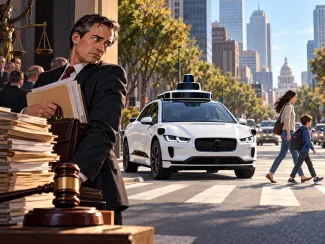
Self-driving cars promise fewer accidents, fewer injuries, and potentially thousands of lives saved. That sounds like good news for everyone—except perhaps the personal-injury lawyers whose livelihoods depend on crashes and harm. A proposed federal law governing autonomous vehicles raises an uncomfortable question: When technological progress promises safer travel for pedestrians and drivers but threatens an established business, whose interests come first?
Between 1913 and 2024, motor vehicle deaths in the US increased by over 900%. This was not only due to more cars on the road, but complacency, complexity, carelessness, and other driver-related issues. But as the National Highway Traffic Safety Administration (NHTSA) ramped up its vigilance, manufacturers built safer cars, roads were built with safety in mind, and driver attitudes improved, the dangers of motor vehicle travel decreased dramatically. In 1913, 33.38 people died for every 10,000 vehicles on the road. In 2024, the death rate was 1.44 per 10,000 vehicles, a 96% improvement. Recently, however, we’ve seen an upsurge in deaths from car accidents. In 2019:
- crashes killed an estimated 36,500 people,
- injured 4.5 million, and
- damaged 23 million vehicles.
And it’s gotten worse. Over the last 10 years, motor-vehicle deaths increased 13%, with 37,000 to 40,000 Americans killed annually. Over the last five years (2019 to 2024), vehicular death rates increased by 2.1%, the mileage death rate increased by 8.3%, and the population death rate increased by 5.9%.
But one person’s tragedy is another’s bonanza; in this case, the beneficiaries are the trial lawyers. Car accidents are the staple of the ordinary Personal Injury [PI] lawyers’ practice. These cases are relatively simple to litigate, without the complex science or technological knowledge required of the lawyer, and discovery is easy and cheap; in short, the perfect product to generate impressive legal income without hard work: collectively, insurance payouts total between $180 and $220 billion annually. At the usual one-third contingency fee, some $60 to $70 billion finds its way into the pockets of PI lawyers. [1]
Look out—Safety Ahead!
The good news, or maybe not, depending on one’s perspective, is that autonomous vehicles seem to be a godsend in terms of promoting safety and avoiding accidents. Evidence from Waymo’s record, analyzing over 220,000 million miles driven, indicates driverless cars have:
- 94% fewer serious injuries,
- 82% fewer airbag deployments
- 93% fewer pedestrian injuries
- the potential to save 30,000 lives per year.
Tesla’s statistics aren’t as promising, and although it claims its “full Self-Driving software is up to 10 times safer than human drivers,” its boasts about its safety features may be overstated. Company technologists say it still has a way to go to back up that bravado. Nevertheless, the potential for safer driving and fewer accidents caused by cars without human drivers has surely been demonstrated.
Yet rather than championing laws that would foster development and safe use of autonomous vehicles, our PI lawyers, apparently feeling threatened, have been lobbying against bipartisan legislation that would set regulations for self-driving cars.
The SELF DRIVE Act: Threat or Promise?
The angst centers on a proposed bill titled the Safely Ensuring Lives Future Deployment and Research in Vehicle Evolution (SELF DRIVE) Act of 2026, “dedicated to the safety of autonomous vehicles, [and] promulgating a new federal motor vehicle safety standard very different from any of its predecessors.” [2]
The Act requires manufacturers of vehicles equipped with automated driving systems (ADS) to develop a safety case for regulatory review and authorizes the National Highway Traffic Safety Administration (NHTSA) to promulgate regulations that prescribe objective requirements and procedures for manufacturers to certify completion of a safety case. In addition to requiring attention to cybersecurity issues and assurances that vehicles allow passengers to stop and escape if necessary, the legislation requires the establishment of a “National Automated Vehicle Safety Data Repository,” where manufacturers would report data on serious crashes involving ADS, enabling further analysis that could lead to improved safety measures.
Similar to other laws designed to foster and encourage research and development of a societally useful product, such as drugs and vaccines regulated under the FDA, or pesticide warnings regulated by the EPA, if the manufacturer complies with these new rules, the auto-driving law would also preempt states from enacting contrary or more stringent laws.
Why is the Plaintiffs’ Bar So Opposed?
Preemption is the bane of the plaintiffs’ bar, because it bars cases predicated on more stringent state statutes. Not surprisingly, the plaintiffs’ bar has formally objected. Unsurprisingly, their public position sounds well-reasoned and public-friendly. It doesn’t even mention the preemption objection by name.
The official policy statement of the American Association of Justice (AAJ), which represents the plaintiffs’ bar, advances arguments that mirror its position in Monsanto v. Durnell, in which the Supreme Court ruled that federal pesticide-labeling law preempts state failure-to-warn lawsuits when EPA regulations are complied with.
Without basis and, in some cases, outright falsely, the AAJ also claims the proposed law:
- eliminates all legal accountability for AV failures and collisions
- strips away victims’ fundamental rights, limiting their right to seek justice, claiming “the bill allows AV companies to push Americans into forced arbitration, a secretive, behind-closed-doors process that stacks the deck against individuals in favor of corporations.”
- eliminates public safety and transparency measures
- fails to establish critical data requirements
- could create dangerous gaps between state and federal law and render thousands of traffic laws unenforceable
Voices in the public health community disagree, championing the development of safer autonomous vehicles, with the caveat that, now, in the design stages, attention should focus on developing rules for handling the ethical issues triggered by driving.
“With the potential to save nearly 30 000 lives per year in the United States, autonomous vehicles portend the most significant advance in auto safety history by shifting the focus from minimization of post-crash injury to collision prevention.”- Janet Fleetwood, PhD, MPH, Professor, Department of Community Health & Prevention, Drexel University
Because the proposed statute does not bar lawsuits and the public health community supports the technology, the AAJ’s vehemence in opposing the legislation warrants scrutiny. It also raises concerns about special interest groups elevating self-interest over public safety.
In truth, litigating cases against an autonomous vehicle (via its manufacturer) would be far more difficult, time-consuming, and expensive than slam-dunk auto cases based on simple negligence, which require only proof that the driver was careless and caused the plaintiff’s injury. In autonomous vehicle litigation, when there is no human driver to sue, the defendant would be the manufacturer, and the primary theory would be product liability (SLT). Implementation of SLT in the early 1900s was believed to favor plaintiffs, since negligence or carelessness need not be proven. Instead, plaintiffs only need to establish a causal connection between the plaintiff’s injury and a defective product.
In most cases, however, the autonomous vehicle would be presumed non-defective if it complies with DOT and NHTSA standards. Claiming negligence in software design would be almost impossible without access to, and an understanding of, the software used to develop the AI decision-maker. This would require the plaintiff’s lawyer to retain (expensive) independent experts, learn software development and coding, and conduct time-consuming and costly discovery of corporate records and design logs. To make matters worse, rather than your run-of-the-mill insurance defense lawyer representing the manufacturer, the plaintiff would be going against the richest companies with the deepest pockets to spend on defense.
To be sure, the SELF DRIVE Act needs tweaking and clarification to ensure safety, and its bugs must be addressed. Specifically, the legislation expands testing exemptions and may create pathways for manufacturers to introduce ADS-equipped vehicles that don't comply with all regulations. But it’s a start.
Perhaps we are facing the law of diminishing returns as we try to improve safety statistics and reduce human-caused auto accidents. However, we are on the precipice of developing a new technology that enhances safety. New technology always begets new problems alongside its advances. The question becomes: whose interests govern how far we should encourage the new, or how long we should vitrify the old and protect a segment of society at everyone else's expense?
[2] This is the third iteration. Two previous bills introduced in 2017 and 2021 failed.
Category

Barbara Pfeffer Billauer JD MA (Occ. Health) PhD
Professor Barbara Pfeffer Billauer is an internationally recognized scholar of public health law, bioethics, and the laws of medical care, focusing on the integration of science and law and its impact on day-to-day policy and legal outcomes. She has lectured and published extensively, in scholarly journals and law reviews, and has written and edited seven books for lay and academic audiences.