On August 27, a graduate student at Hokkaido University in Japan was splashed with hydrofluoric acid (aqueous HF) while working in a Faculty of Science building. The student suffered severe injuries and later died at the hospital. Two other students who attempted to help were also exposed but suffered only minor injuries. The cause and circumstances of the accident remain under investigation, but given the toxicity of hydrogen fluoride, I don't expect any surprises.
For a chemist, just two letters in that paragraph are enough to induce a shudder: HF.
Hydrofluoric acid is one of the nastiest chemicals found in a lab. But what makes it so dangerous is also chemically fascinating. HF behaves very differently from the other hydrogen halides (HCl, HBr, HI), and the same property that makes it a relatively weak acid also makes it more dangerous.
Weak acids don't feel weak
This sounds like crazy talk until you realize what the term means (it's not at all obvious).
If you've forgotten freshman chemistry, intentionally or otherwise, “weak” refers to the extent to which an acid ionizes in water (providing protons, H+). It does not mean harmless, dilute, or something you'd want spilled on your hand.
When dissolved in water, hydrogen chloride fully dissociates (the ions separate readily), forming hydrochloric acid.
Hydrogen fluoride doesn't. The bond between hydrogen and fluorine is unusually strong [1], so in aqueous solution most of it remains as undissociated HF. [2] That makes hydrofluoric acid a weak acid by the conventional Brønsted–Lowry definition – a term you will need to use roughly zero times in your life.
Figure 1 illustrates this.
HCl → H⁺ + Cl⁻ (100%)
HF → H⁺ + F- (~5%)
Figure 1. Hydrogen chloride is fully ionized while hydrogen fluoride is only partially ionized.
In fact, HF is a gruesome demonstration of how badly ordinary English and chemical terminology can differ.
Fluoride makes it worse.
All of the halide (H-X) acids are highly corrosive, but much of the damage occurs where the acid contacts tissue; hydrochloric, hydrobromic, and hydroiodic acids will burn you, but HF adds another nasty trick.
Because undissociated HF is less ionic, it can penetrate tissue, so exposure isn't necessarily confined to the surface. Once HF penetrates deeper into tissue and later dissociates, it releases fluoride ions. And, for reasons that are beyond the scope of this article, fluoride has an enormous appetite for calcium.
Calcium isn't merely something that keeps your bones from turning into linguine. Calcium ions are essential for nerve function, muscle contraction, cellular signaling, and normal electrical activity of the heart. Fluoride can bind calcium, producing insoluble calcium fluoride and disrupting normal calcium balance.
F⁻ + Ca²⁺ → CaF₂
With a sufficiently serious HF exposure, the consequences can therefore extend far beyond a chemical burn. Fluoride can also interfere with magnesium and other physiological processes. Severe poisoning can cause profound electrolyte disturbances and potentially fatal cardiac arrhythmias.
While a whiff of any of these acids is enough to make you feel like you've been kicked in the face by a mule, HF exposure is also a medical emergency rather than simply an especially unpleasant acid burn.
And, in case this doesn't sound scary enough, hydrofluoric acid is one of the very few chemicals that cannot be stored in glass bottles; it eats them. (Anyone know why?)
Calcium gluconate for fluoride poisoning: Why?
The standard treatment for many dermal HF exposures includes calcium gluconate (Figure 2). There's a simple bit of chemistry behind this: it gives the fluoride ions some extra calcium to go after instead of yours. Depending on the severity of the exposure, calcium gluconate may be applied as a gel, injected into and around the affected tissue, or given intravenously.
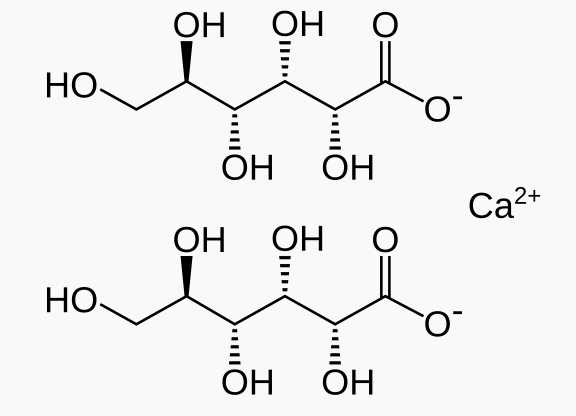
Figure 2. Calcium gluconate is the salt formed from two molecules of gluconic acid (harmless) and Ca+2.
This is also why laboratories that work with HF commonly keep calcium gluconate gel immediately available. An article featured in Chemical & Engineering News notes that several Japanese universities recommend keeping it on hand, although topical treatment may be inadequate after extensive exposure. Hokkaido University subsequently confirmed that calcium gluconate was available in the laboratory.
The danger may not be immediately obvious
Another reason HF is so dangerous is that injury and pain can sometimes be delayed, particularly with more dilute solutions. Someone can be exposed without immediately appreciating the seriousness of what has happened.
That's a particularly ugly combination: a chemical capable of penetrating tissue while the victim may initially underestimate the danger.
Concentrated HF can, of course, cause immediate and devastating injury. The concentration and amount involved in the Hokkaido accident have not been publicly reported, so it would be inappropriate to speculate about precisely what happened.
Bottom line
Some chemicals are dangerous because they're toxic; others because they're corrosive. Unfortunately, hydrogen fluoride checks both boxes. It's one of the chemicals I never had to handle during my career.
Just as well.
NOTES:
[1] The H–F bond is unusually strong because fluorine is a very small atom, allowing it and hydrogen to form a very short, tightly held bond. In fact, H–F is the strongest of the hydrogen-halogen bonds.
[2] The degree of dissociation depends on the concentration of the HF solution. The more dilute the solution, the greater the degree of dissociation.

Josh Bloom
Dr. Jonathan (Josh) Bloom, ACSH's Director of Chemical and Pharmaceutical Sciences, earned his Ph.D. at the University of Virginia and completed postdoctoral training at the University of Pennsylvania. During his 20-plus years in drug discovery at Wyeth, his research group discovered the antibiotic Tygacil®, approved in 2005. He holds 25 issued patents and has authored 35 academic papers. Since joining ACSH in 2010, he has written more than 2,000 articles and dozens of op-eds for major newspapers, including The Wall Street Journal and Chicago Tribune.