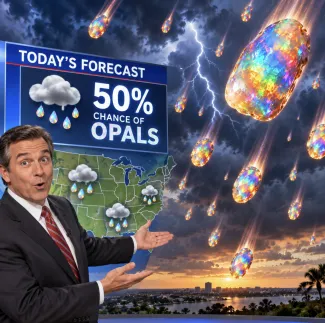
All of my readers seem to enjoy the monthly birthstone series, so let's keep it going. Unfortunately, those of you born in October may feel cheated; the month has two birthstones, but I'm only going to discuss one of them: opal. It's more interesting (and cooler-looking) than tourmaline, which has tried to horn its way into the month: an abject violation of the rules. Call me an anti-tourmalite if you wish. (Actually, tourmaline can be exceptionally beautiful, but opal is a bit more interesting scientifically.)
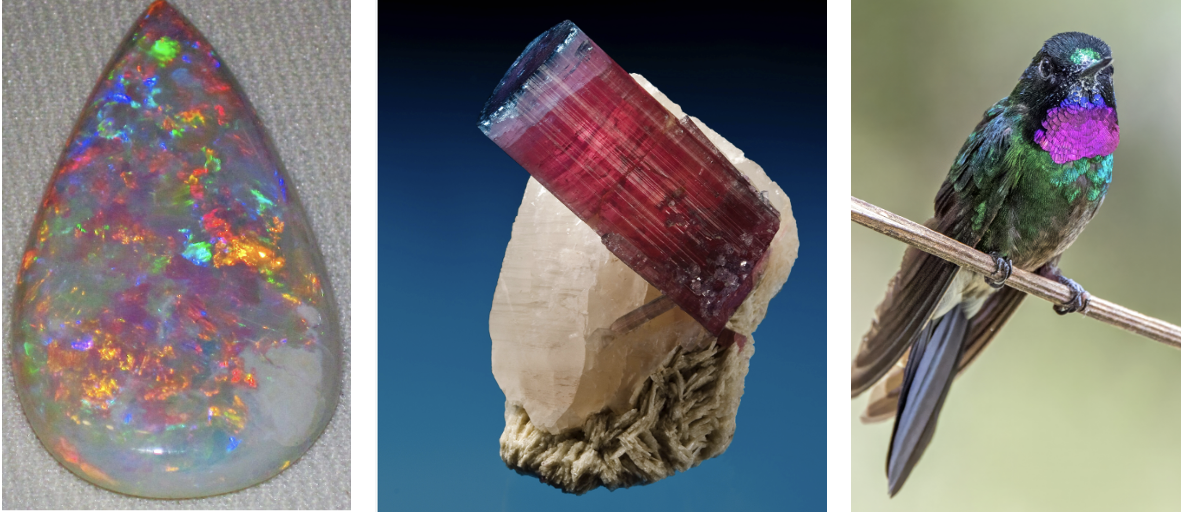
(Left) Precious opal from South Australia (Center) Blue-capped tourmaline from California (Right) Tourmaline sunangel from Colombia. All images were sourced from Wikimedia Commons.
Most birthstones are minerals. Opal isn't. At least not technically.
Here's an oddball fact: Opal is made mostly of silica (just like sand), yet technically it isn't a mineral. Other birthstones containing silicon and oxygen, including peridot, emerald, aquamarine, topaz, and zircon, most certainly are. So, what's going on?
It's not what opal is made of; it's how the stuff is put together. Minerals have their atoms arranged in a regular, repeating structure. Opal doesn't. Its silicon and oxygen atoms are non-conformists and don't follow the repeating pattern required to form a crystal. Instead, opal belongs to a loosely defined group called mineraloids. I suppose you could call opal the "juvenile delinquent of the gemstone world," to resurrect a term that hasn't been in use since the 1960s.
Same kinds of atoms. Different arrangement. And apparently mineralogists are picky about such things.
But opal has another structural oddity: It's made up of tiny balls of silica. So where do these things come from?
"Tiny Balls" – Almost, but not quite a Don Ho song
Over time, water moving through cracks and spaces in rocks can dissolve small amounts of silica from the surrounding rock and carry it along. As the water moves, evaporates, or as conditions change, the dissolved silica can precipitate out of solution, forming tiny particles. These particles can grow and eventually become roughly spherical balls of amorphous hydrated silica.
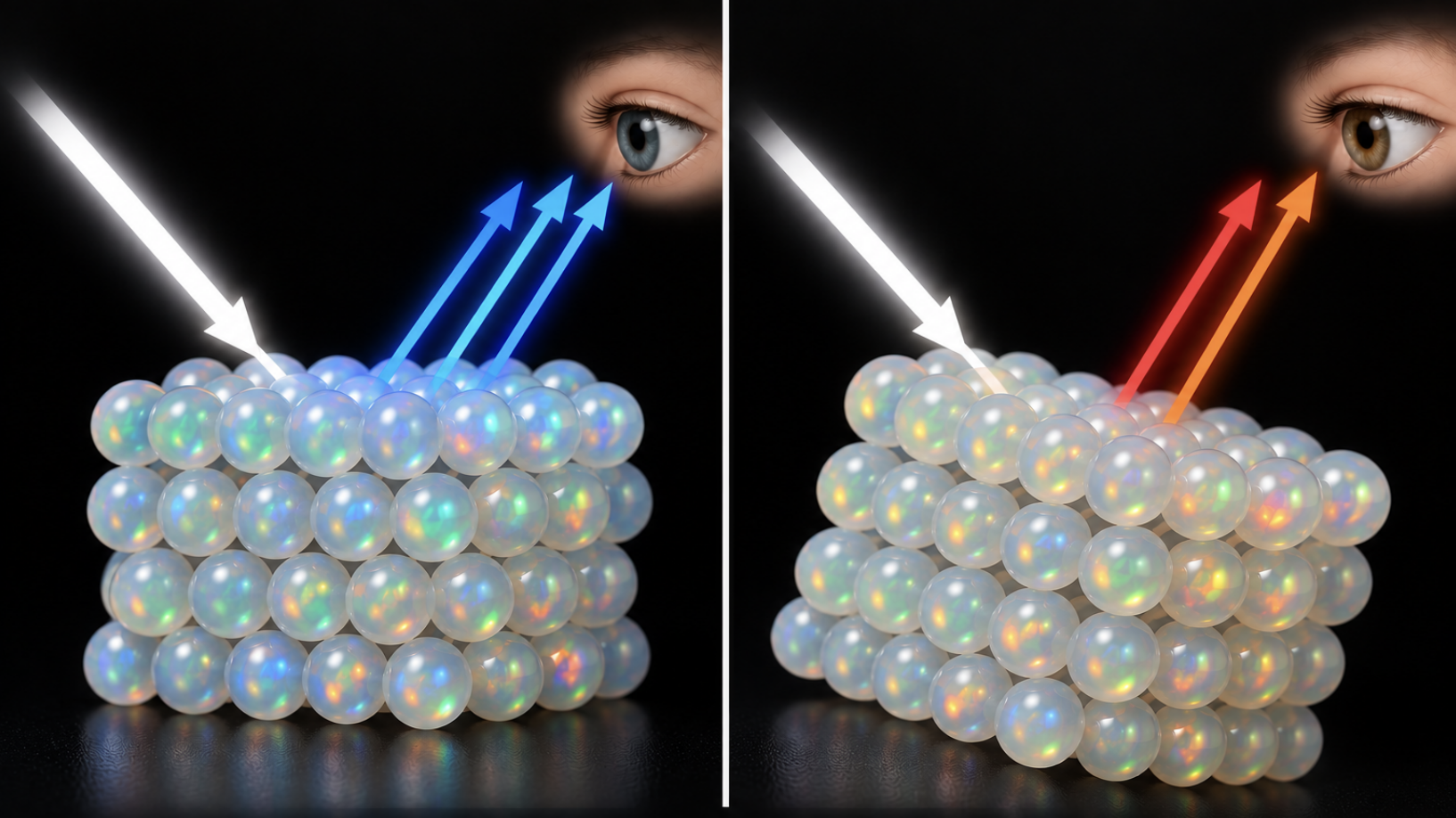
As more and more of these silica balls accumulate, similarly sized ones can settle into tightly packed, orderly layers, much like oranges stacked at a grocery store. In some parts of the opal, the balls are remarkably uniform in size and neatly organized. Elsewhere, they're different sizes and jumbled together.
The disorderly regions can't get their shit together enough to do much. But the orderly ones can. And that's when they start doing weird stuff with light.
Light scattered by the regularly spaced layers doesn't all behave uniformly. Some wavelengths reinforce each other while others largely cancel out. The winners are the colors that make it back to your eye.
And here's the really strange part. Which wavelengths win depends partly on the viewing angle. Tilt the opal and a different wavelength—and therefore a different color—will (if the spirits are with you) reach your eye.
Pretty crazy. But so was Don Ho's popularity.
You've seen this before
Perhaps this phenomenon seems vaguely familiar.
Opal isn't the only thing in nature that pulls off this optical trick. I've written before about blue feathers that aren't really blue. Many contain no blue pigment at all. Their microscopic structure interacts with light in such a way that blue wavelengths make it back to our eyes. Opal uses a different structure, but the scam is essentially the same.
As if opals weren't weird enough
Opals also come with some pretty strange baggage.
For starters, there are opalized dinosaurs. Australia has produced dinosaur bones and other fossils in which opal filled spaces in the fossil or replaced some of the original material while preserving its shape. In other words, nature figured out how to turn part of a dinosaur into a gemstone.
Opals have also acquired a reputation for bringing bad luck, although they weren't always viewed that way. The ancient Romans prized them, but centuries later the stone became associated with misfortune and death. Sir Walter Scott's 1829 novel Anne of Geierstein, which featured a mysterious opal with supernatural overtones, helped reinforce the superstition.
But my favorite comes from an old Bedouin legend: opals supposedly fell from the heavens during thunderstorms and contained flashes of lightning.
Nonsense, of course. But look at a good opal, and you can understand how someone came up with it.
Gems of knowledge, or the lack thereof
A thousand years ago, people believed that gems brought good luck or bad luck, and that they fell from the sky during storms (or did not). Silly stuff, right? Or maybe not.
Today, disordered clusters of knuckleheads think that chemtrails are pouring from the sky to poison humans, that crystals have magical powers, and that the Moon rocks brought back by Apollo astronauts were fakes because we never went there in the first place.
Progress.

Josh Bloom
Dr. Jonathan (Josh) Bloom, ACSH's Director of Chemical and Pharmaceutical Sciences, earned his Ph.D. at the University of Virginia and completed postdoctoral training at the University of Pennsylvania. During his 20-plus years in drug discovery at Wyeth, his research group discovered the antibiotic Tygacil®, approved in 2005. He holds 25 issued patents and has authored 35 academic papers. Since joining ACSH in 2010, he has written more than 2,000 articles and dozens of op-eds for major newspapers, including The Wall Street Journal and Chicago Tribune.