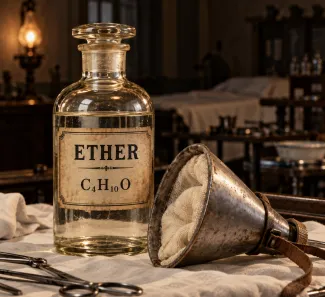
In case you didn't know, October 16th is National Ether Day. Let's start with a short but pertinent review of one of my all-time favorite shows.
By the late 1870s – when Lonesome Dove takes place – general anesthesia had already been in widespread use for decades. Gus was "lucky" in that he was unconscious for the amputation, although we aren't told what, if anything, was used to put him under. For most of human history, if your leg had to come off, you were awake for the festivities. You might get a bottle of whiskey or some opium and a leather strap to bite on. And then came the saw.
Gus was also unlucky. The infection spread to his other leg, which also required amputation, but he refused, threatening to shoot the surgeon if he tried it. Or perhaps United Health denied it. Either way, he died shortly thereafter.
October 16, 1846: Ether changes medicine forever
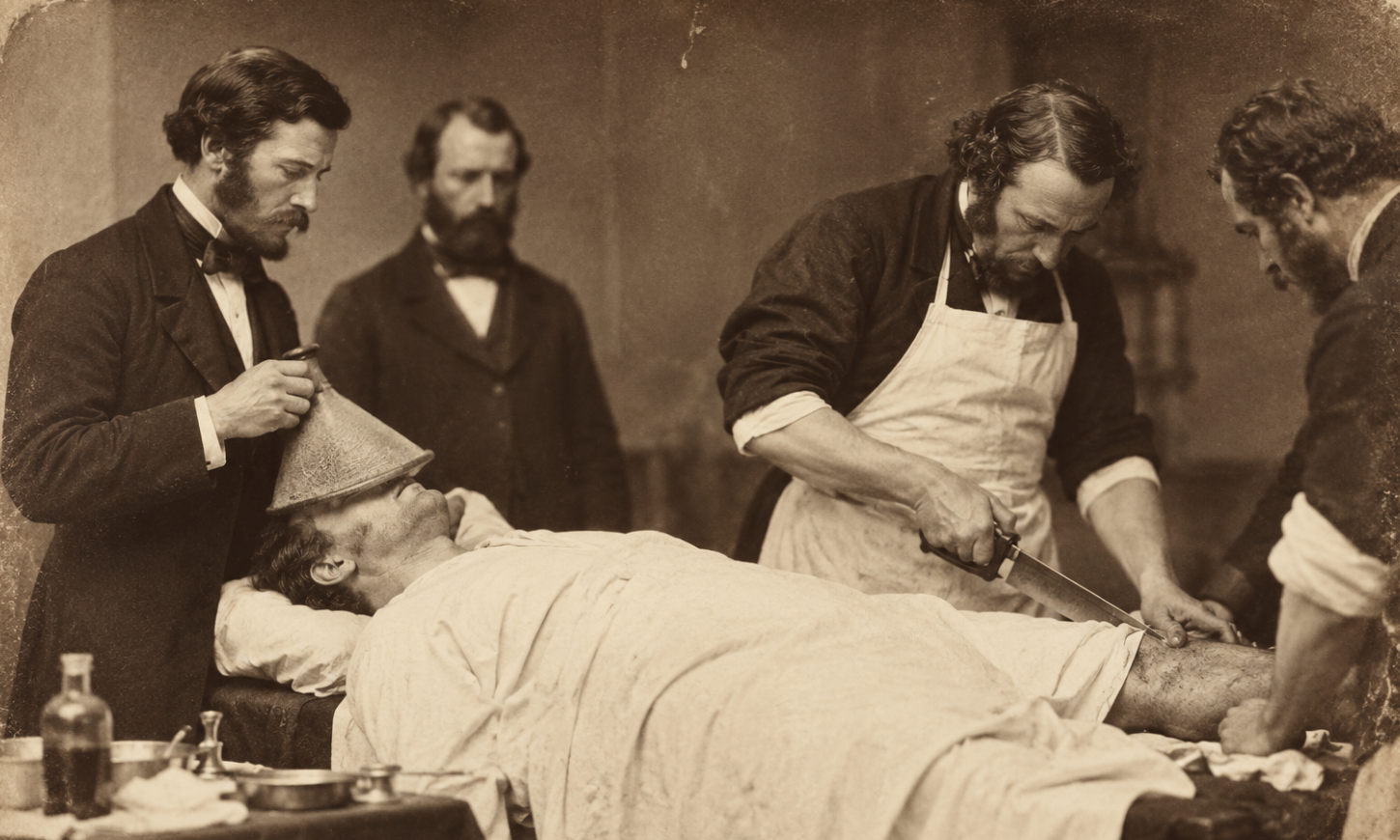
The beginning of the end of unanesthetized surgery took place at Massachusetts General Hospital in Boston. William T. G. Morton, a dentist, administered ether to Edward Gilbert Abbott while surgeon John Collins Warren removed a tumor from his neck. Abbott felt little or no pain, and the demonstration was a stunning success.
Although ether, aka diethyl ether, was far from a perfect general anesthetic, its shortcomings paled in comparison with the alternative. October 16, 1846, marked one of the most important advances in medical history. More on this below.
Ether in all its glory, and chemistry
It would be difficult to pick a simpler chemical for the task. It's so easy to make and is used in huge quantities in organic chemistry labs. I must have used thousands of cans during my lab days. [2]
Here are some marginally useful facts about the stuff.
-
Although the correct name for ether is diethyl ether, its early name was "sulfuric ether." This is because it was made by heating ethanol with a catalytic amount of sulfuric acid. Here's the reaction.

The sulfuric acid acts as a catalyst and doesn't become part of the product. There isn't a sulfur atom anywhere in diethyl ether. The name referred to how it was made, not its composition.
- As if extreme flammability weren't enough, ether has another nasty habit. Once oxygen gets into the container, ether can slowly form a hideous collection of beasts collectively known as ether peroxides. And these bad boys can explode.
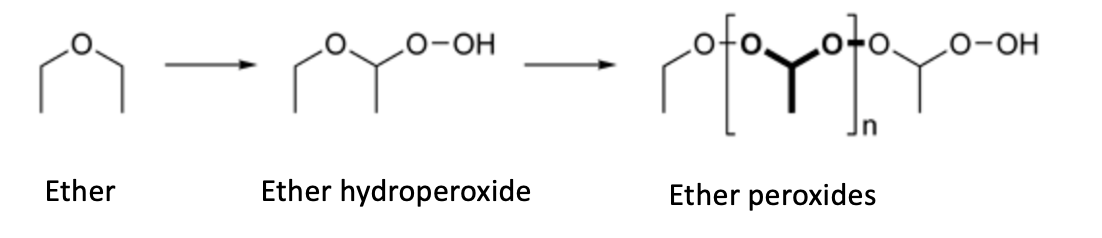
This is why we dated cans of ether when we opened them and didn't keep the stuff around for more than a year. This threat isn't theoretical. Ether peroxides have caused real laboratory explosions and serious injuries. And diisopropyl ether, an especially nasty peroxide former, has killed a chemist who simply tried to open an old bottle.
- Ether is really "cold." Pour a little ether on your hand, and it feels freezing cold immediately. That's because ether boils at only 34.6°C (94°F) and evaporates quickly, drawing heat from your skin in the process.
- This property also gives rise to an unrecommended practical joke in chemistry labs: Sneak up behind an unsuspecting colleague and pour some ether down the back of his shirt. The response will be immediate. Don't try this at home. Or in a lab. Or anywhere else.
The mother of invention: The ether cone
The ether cone was about as sophisticated as it looks. A cone or mask containing absorbent material was placed over the patient's nose and mouth, and ether was dripped onto it. The ether evaporated, the patient inhaled the vapor, and eventually went under. More ether kept him there.
No vaporizer precisely controlled the concentration, and no electronic monitor displayed oxygen saturation, blood pressure, heart rate, or anything else. The anesthetist watched the patient, monitored breathing and pulse, and adjusted the ether accordingly. By today's standards, this seems somewhere between primitive and insane. But it worked. And ether had an important advantage: it was relatively forgiving. It had a substantially wider margin of safety than some of the anesthetics that followed, especially chloroform.
So why don't we use ether in medicine anymore?
Ether's virtues couldn't make its problems disappear. Induction was slow and unpleasant; it irritated the airways, and patients frequently woke up nauseated and vomiting. Better anesthetics eventually came along.
And then there was that little flammability problem. Ether vapor forms highly flammable mixtures with air and oxygen. This became an increasingly serious liability as operating rooms filled with electrical equipment and, especially, electrocautery devices capable of providing an ignition source. A room containing an unconscious patient, a surgeon, oxygen, ether vapor, and something that makes sparks is not an especially desirable combination. By the middle of the 20th century, newer anesthetics were increasingly replacing ether, and eventually it largely disappeared from modern operating rooms.
Happy Ether Day
It's easy to look at an ether cone today and wonder how anyone could possibly have considered it advanced medical technology. But compare it with what came before it. For most of human history, surgery and agony were essentially inseparable. Then ether changed the equation. Doctors discovered that a simple chemical containing four carbon atoms, ten hydrogen atoms, and one oxygen atom could make a patient unconscious while a surgeon cut into him.
Not bad for a liquid I used to pour down people's shirts.
NOTES:
[1] The original series has a 98% rating on Rotten Tomatoes. Good luck beating that. Duvall won the Golden Globe for Best Actor. The show also won the Golden Globe. Netflix recently announced that it is developing a new adaptation of Lonesome Dove. That's a high bar indeed.
[2] Ether is routinely used to extract organic compounds from water.

Josh Bloom
Dr. Jonathan (Josh) Bloom, ACSH's Director of Chemical and Pharmaceutical Sciences, earned his Ph.D. at the University of Virginia and completed postdoctoral training at the University of Pennsylvania. During his 20-plus years in drug discovery at Wyeth, his research group discovered the antibiotic Tygacil®, approved in 2005. He holds 25 issued patents and has authored 35 academic papers. Since joining ACSH in 2010, he has written more than 2,000 articles and dozens of op-eds for major newspapers, including The Wall Street Journal and Chicago Tribune.