A decision made in the first 24 hours of life may have consequences that remain invisible for decades. New research suggests that abandoning universal hepatitis B vaccination at birth could produce relatively few additional childhood infections while leaving millions more young adults vulnerable to a potentially lifelong disease. As vaccination becomes a shared decision, what does a parent need to know to share that decision equally with their physician?
A Silent Infection With Lifelong Consequences
Approximately two million Americans are living with chronic hepatitis B virus (HBV) infection, an illness without a cure, and, without treatment, 25% of infected individuals develop potentially life-threatening complications, including cirrhosis and liver cancer. HBV is diagnosed primarily from abnormal laboratory tests, not symptoms, driving us to see physicians, making it a stealthy disease.
HBV is transmitted through exposure to infected blood and other body fluids, between adults and children in households and communities. Transmission from mother to infant during pregnancy or childbirth is especially concerning, as 90% of newborns without immune protection, infected perinatally, develop chronic HBV infection.
Layering Protection, Closing the Gaps
Universal screening during pregnancy began in 1988, followed by programs that provided hepatitis B immune globulin to at-risk newborns, universal infant vaccination in 1991, and a strengthened recommendation in 2018 that newborns receive their first vaccine dose within 24 hours of birth.
As I have discussed previously, the rationale for this layered response comes from the “Swiss Cheese” model of protection: because all preventive measures have gaps (holes), multiple layers, like additional slices of Swiss cheese, each with its own holes, fill those gaps. As a result, perinatal and early-childhood HBV infections decreased from more than 25,000 annually in 1985 to fewer than 100 reported cases in 2024.
When Universal Protection Becomes an Individual Choice
In December 2025, federal vaccine advisers recommended replacing universal hepatitis B vaccination at birth with individualized decision-making for infants whose mothers tested negative for infection. A January 2026 federal revision moved further toward risk-based and shared clinical decision-making. However, a federal court stayed those changes in March, leaving the earlier universal birth-dose recommendation in effect. The proposed changes nevertheless raise an important question: What would happen if vaccination became a choice requiring individualized assessment rather than a routine safeguard?
In the new era, where shared clinical decision-making might be rephrased as “make your own disease trajectory,” making an informed decision is crucial. A new study offers information for those choosing their own pathway.
Three Strategies, Three Possible Futures
The study reported in the Annals of Internal Medicine models three strategic approaches to prevention and is based on disease trajectory data. [1] It follows a hypothetical 3.6 million American children from birth through age 20. The principal outcomes were the number of children developing chronic hepatitis B and the number entering adulthood susceptible to infection. One further note: this is a model, and its conclusions depend on assumptions about vaccination uptake and transmission risk, which we will consider shortly.
The three strategies were:
-
Universal birth-dose vaccination: The older recommendation that all newborns receive their first hepatitis B vaccine dose within 24 hours of birth, regardless of maternal infection status. The model assumes 91.1% complete the vaccine series by 24 months.
-
Deferred vaccination: A component of the newer recommendation in which infants begin vaccination at 2 months rather than at birth, delaying protection. The model assumes 87.1% complete the series.
- Shared decision-making: The second component of the newer recommendation, in which vaccination is no longer universally recommended and instead depends on discussions between parents and clinicians or on identification of elevated risk. The model assumes only 50% complete vaccination. In all three strategies, vaccination at birth remains recommended for infants whose mothers have hepatitis B or whose infection status is unknown.
Small Numbers, Large Consequences
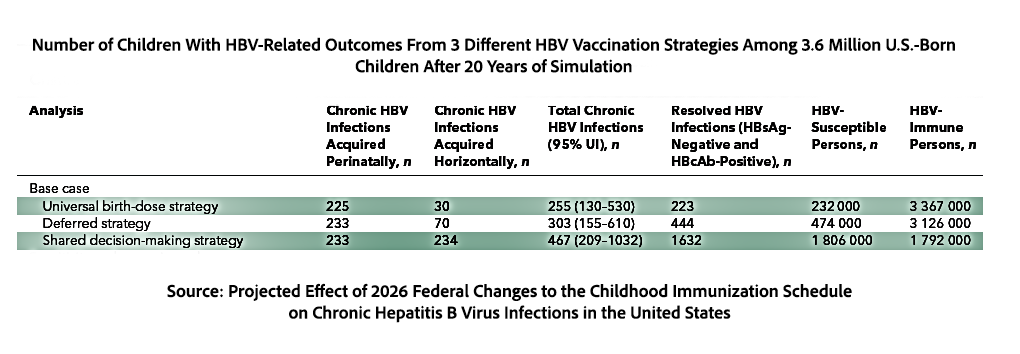
Under the former universal birth-dose strategy, the model projects 255 chronic HBV infections among 3.6 million children followed through age 20. Delaying vaccination until two months increases that number to 303, while shared decision-making raises it to 467. The more striking difference is in those entering adulthood still susceptible to infection: 232,000 with universal birth-dose vaccination, 474,000 with delayed vaccination, and 1.8 million with shared decision-making.
Stay curious. Stay informed. Free, independent writing delivered weekly
— no ads, no sponsored fluff.
Join Now
Donate
Horizontal infections refer to cases in which another household member, or the mother after the perinatal period, was the source. In each instance, because we continue to protect the children most at risk, those born to known HBV-infected mothers have perinatally acquired infections that remain essentially unchanged. The increases in HBV infections are driven by horizontal infection and by the decision not to vaccinate at all.
While the number of infected individuals remains small, at less than 0.05% of the entire 3.6 million cohort, susceptibility rises steadily under each strategy until it reaches slightly more than 50% of that cohort. Although susceptibility is not infection, this increasingly large, unprotected population becomes a source of adult HBV infections that can generate more infected individuals. The take-away message is that the newer recommendations yield a modest absolute increase in infections. Still, the long-term impacts, which may seem less salient at the time of decision-making, can be substantial.
What Happens When the Assumptions Change?
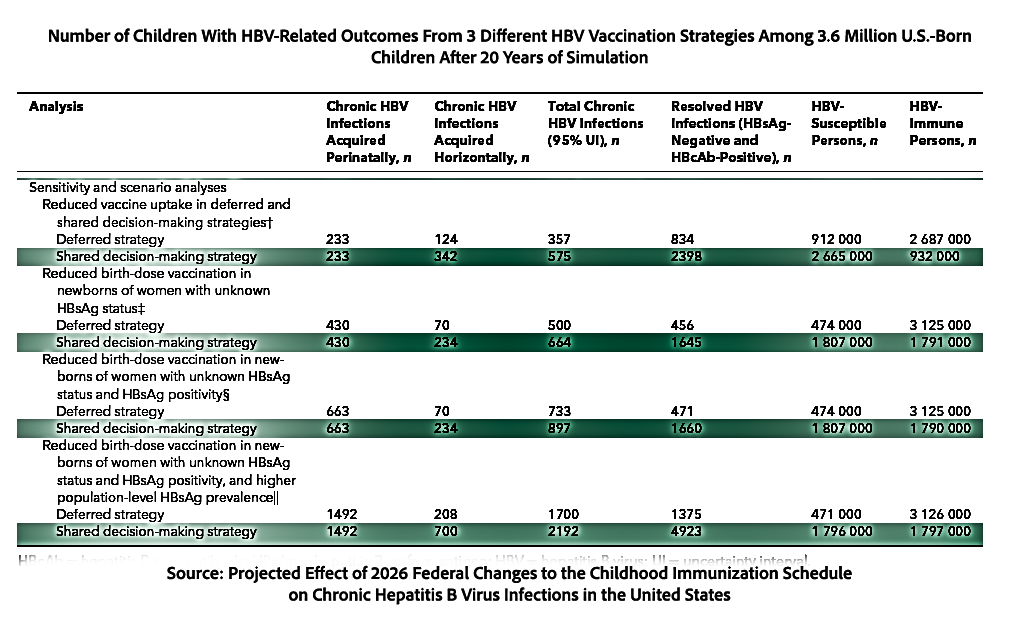
Here is the data for scenarios in which vaccination completion or newborn vaccination rates fall, maternal prevalence and horizontal exposure risk rise, and vaccination is deferred for the first two months of life.
The study's most consequential public health finding may be the distinction between the relatively small absolute number of additional childhood infections and the much larger population entering adulthood unprotected.
This additional data reinforces two drivers of infection in the model. Delaying vaccination increases risk through two reinforcing mechanisms: it prolongs the period during which children remain vulnerable to infection through horizontal, household, and community exposure, and later vaccination also reduces the likelihood of completing the three-dose series, leaving more individuals susceptible into adulthood.
Second, when declining vaccination extends to infants whose mothers are infected or whose infection status is unknown, the model projects nearly three times as many infections acquired at birth compared with universal birth-dose vaccination. The key distinction is that delaying vaccination mainly lengthens the period without protection, whereas replacing universal vaccination with shared decision-making may leave a substantial proportion of children unvaccinated altogether.
The results, especially those around shared decision-making, depend heavily on assumptions. The investigators estimated that vaccine completion would decline to 50% because it is too early to measure outcomes after implementation. The researchers also assumed that the monthly probability of horizontal HBV exposure varied by age, ranging from 25 to 300 exposures per 100,000 individuals per month. Much of the projected increase in susceptibility reflects these assumptions.
Two other studies strengthen the “direction” of their conclusions, though they do not fully replicate the model’s quantification.
Does Missing the First Dose Mean Missing the Rest?
A retrospective study published in JAMA Network Open examined more than one million children in the Vaccine Safety Datalink, which includes electronic health records from nine geographically separate sites, focusing on those who received the hepatitis B vaccine. Children were divided into two groups based on whether they received the hepatitis B vaccine within three days of birth, with the outcome being completion of the full three-dose vaccination series by 18 months.
Among those receiving a birth dose, 97% completed the full series by 18 months and were therefore the most fully protected. Of the remaining almost 19%, only 67.5% completed the series within 18 months, and slightly more than a quarter had no vaccination at all. The study examined results from 2014 to 2023. While the percentage fully vaccinated in the birth-dose cohort remained unchanged, completion fell in the delayed-dose group, with only 55% of the 2023 cohort fully immunized by 18 months.
In the real world, the association between the birth dose and series completion is substantial, and delaying vaccination increased the rate of incomplete treatment even before the new guidelines were promulgated. The JAMA data support the model’s estimate of completed doses among birth-dose recipients and suggest the model's deferred vaccination completion rate was overly optimistic: the model posited 87% completion, while the real-world rate was 67.5%. Finally, the 55% of the 2023 cohort that delayed vaccination but completed the series lends some support to the model’s 50% assumption.
On balance, the JAMA study strengthens the model’s directional conclusions while introducing uncertainty about the magnitude of its predictions.
The Risks Beyond the Birth Mother
One of the model's most striking findings is the role of horizontal transmission. Under universal birth-dose vaccination, approximately 12% of projected chronic childhood infections result from horizontal transmission. With shared decision-making, that proportion increases to approximately 50%. In absolute terms, the model projects nearly eight times as many horizontally acquired chronic infections under shared decision-making compared with universal birth-dose vaccination.
The investigators explicitly acknowledge that horizontal transmission is one of their model's greatest uncertainties. For real-world data, we turn to an abstract from a recent infectious disease conference from Kaiser Permanente’s research division. Their data come from a retrospective review of health records that documented diagnoses of horizontal sources within a household, not measured transmission.
Kaiser identified approximately 1,280 per 100,000 children living with an infected household member at any one point in time. While household prevalence is not exposure events, those numbers certainly suggest that the model’s horizontal exposure risk from 25 to 300 per 100,000 children is biologically plausible. The findings strengthen the argument that hepatitis B prevention cannot rely exclusively on identifying infected mothers.
What About the Risks of Vaccination?
The CDC identifies injection-site soreness, fatigue, and fever among recognized adverse effects. Serious allergic reactions are rare, and available safety monitoring has not identified unexpected major safety concerns. A 2026 review in Pediatrics found strong evidence for the safety and effectiveness of birth-dose vaccination and no demonstrated safety advantage to delaying vaccination.
An Informed Choice Requires More Than Permission to Choose
Informed consent is more than asking parents whether they want their newborn vaccinated. It requires giving them the information needed to weigh the benefits, risks, and uncertainties of their decision. For hepatitis B, the immediate risk of infection for most newborns is small, particularly when their mothers have tested negative. The vaccine has a long record of safety and effectiveness, although, like any medical intervention, it is not entirely without risk. What is less predictable is a child's exposure to hepatitis B over the next several decades, or whether postponing the first dose will mean never completing the series.
Parents should be free to ask questions, challenge recommendations, and participate meaningfully in medical decisions affecting their children. But choice without an understanding of its consequences is not truly informed consent. If we expect parents to make these decisions, we owe them more than reassurance or rhetoric. We owe them the evidence, including what we know, what we do not know, and what their children may have to live with.
[1] It incorporated five possible states of the disease: newborn, susceptible to hepatitis B, immune through vaccination, recovered from a previous infection, and chronically infected; and perinatal infection from mother to infant around childbirth, and horizontal transmission through subsequent household or community exposure.
Source: Projected Effect of 2026 Federal Changes to the Childhood Immunization Schedule on Chronic Hepatitis B Virus Infections in the United States Annals of Internal Medicine DOI: 10.7326/ANNALS-26-02135