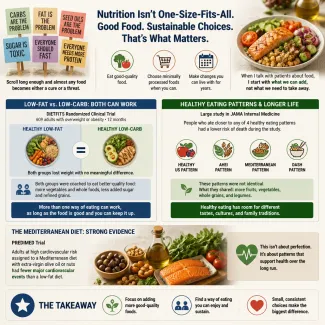
Nutrition advice can sound very certain. Carbs are the problem. Fat is the problem. Seed oils are the problem. Sugar is toxic. Everyone should fast. Everyone needs more protein. Scroll long enough and almost any food becomes either a cure or a threat.
I studied Food Science and Human Nutrition before I became an internal medicine physician, and both taught me the same thing: nutrition rarely works in absolutes. Food matters enormously for health. But no single diet is perfect, and the research keeps pointing to a few simple ideas. Eat good-quality food. Choose minimally processed foods when you can. Make changes you can live with for years.
So when I talk with patients about food, I start with what we can add, not what we need to take away.
Take the old argument over low-fat versus low-carb. In the DIETFITS randomized clinical trial, researchers followed 609 adults with overweight or obesity on a healthy low-fat or healthy low-carbohydrate diet for 12 months. Both groups lost weight, with no meaningful difference between them. Both were also coached to eat better-quality food: more vegetables and whole foods, less added sugar and refined grains. What I take from that is that more than one way of eating can work, as long as the food is good and you can keep it up.
The same theme shows up beyond weight. A large study in JAMA Internal Medicine followed people over time and looked at four healthy eating patterns. People who ate closer to any of the four had a lower risk of death during the study. A study like this cannot prove cause and effect, but I find it reassuring. The patterns were not identical. What they shared was more fruits, vegetables, whole grains, and legumes. Healthy eating has room for different tastes, cultures, and family traditions.
The Mediterranean diet is a good example. In the PREDIMED trial, adults at high cardiovascular risk who were assigned to a Mediterranean diet with extra-virgin olive oil or nuts had fewer major cardiovascular events than those advised to cut back on fat. The study had to be reanalyzed and republished after problems with how some participants were randomized, and the result held. I also love what that trial did: it gave people olive oil and nuts.
Then there is how food is made. Food science is, in part, the study of how to make food people want to keep eating. Texture, salt, sweetness, and how quickly a food goes down are all designed. In a tightly controlled National Institutes of Health study, 20 adults ate an ultra-processed diet for two weeks and an unprocessed diet for two weeks. The meals were matched for calories, macronutrients, sugar, sodium, and fiber, and people could eat as much or as little as they wanted. On the ultra-processed diet, they ate about 500 more calories a day and gained weight. On the unprocessed diet, they ate less and lost weight. It was a small, short study, but it has stayed with me.
Interestingly, Hall, the study's author, has since shifted his thinking about what drives overeating, moving away from food processing itself as the primary explanation and focusing more on palatability, or how appealing and rewarding food is to eat. That distinction matters because it suggests that the problem may not be processing alone, but the qualities of food that encourage us to keep eating.
A recent randomized crossover trial published in Nature Medicine compared minimally processed and ultra-processed diets, both of which met national dietary guidelines. People lost weight on both, but those on the minimally processed diet lost roughly two pounds more by the end of the study.
Larger studies also link diets high in ultra-processed foods with more cardiometabolic disease and earlier death. Most of that research is observational, and “ultra-processed” covers very different foods, so I don’t want anyone to fear every packaged food or chase a perfect diet. Let minimally processed foods be the usual foundation, and let convenience foods have their place in real life.
This is where the conversation in my exam room changes. Instead of handing someone a long list of forbidden foods, I ask what we can add. Can we add vegetables to dinner? More protein or fiber at breakfast? One more home-cooked meal each week? Could one highly processed snack become fruit, nuts, yogurt, or something else you truly enjoy?
These changes sound less exciting than a 30-day transformation or a diet that promises to fix inflammation, hormones, and metabolism all at once. But small changes are easier to keep. And this is not all-or-nothing. One meal, one snack, or one hard week doesn't undo the choices that came before.
Good nutrition advice should survive contact with a person’s actual life. It should also fit the person. Diabetes, kidney disease, heart disease, gastrointestinal conditions, food allergies, medications, age, and activity level all change what makes sense. The same recommendation does not belong on every patient’s plate.
Patients deserve nutrition advice that is honest about what we know, what we still don’t, and what can fit into everyday life. For most people, a better place to start than “What food must I never eat again?” is this:
What can I add today that makes the way I eat a little healthier tomorrow?

Irene “Rosie” Muratides
Irene “Rosie” Muratides, DO, is a board-certified internal medicine physician and the founder of Bayshore Rose Concierge Medicine in Tampa.