Talk of peptides is all over social media these days. “Wellness influencers” push to “legalize peptides” as if peptides were one entity. Given that these molecules consist of chains of amino acids, and that there are twenty or so common amino acids that can be linked in a virtually infinite variety of ways, it is obvious that any discussion of peptides must specify which peptides are being talked about.
Peptides are produced by numerous living systems, and these can therefore be termed “natural.” Insulin, for example, is produced by the pancreas and is essential for life, since without it the glucose needed for energy production cannot enter certain cells. Injection of insulin makes life possible for type 1 diabetics, but an overdose of insulin can be lethal even though it is a “natural substance.” A single bite of the death cap mushroom contains enough of the peptide, alpha-amanitin, to kill a person, and the cone snail does away with its predators by injecting toxic peptides known as conotoxins. And you sure do not want to be bitten by a Black mamba that will paralyze you with dendrotoxin or a Russell’s viper that will cause you to bleed to death because its toxins disrupt blood coagulation.
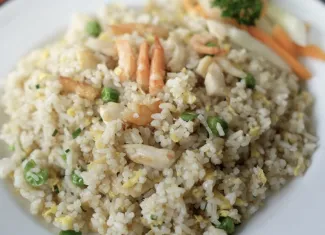
Of course, you are not likely to accidentally swallow a death cap mushroom or be bitten by a Black mamba or a Russell’s viper. But you might very well encounter cereulide, a peptide that can contaminate rice and send you on many excursions to the bathroom. Becoming a victim of “fried rice syndrome” is not a pleasant experience. The condition is a misnomer because it is not limited to rice; it can happen with other foods, particularly those rich in carbohydrates.
Let me introduce you to Bacillus cereus, a bacterium you cannot help encountering. Bacteria are everywhere, in soil, water, air and in everything grown in soil. Our food can contain bacteria that can be harmful in one of two ways. They can cause an infection by invading and multiplying in body tissues, resulting in damage to healthy cells. Streptococcus pyogenes, for example, can cause a strep throat, and infection with Mycobacterium tuberculosis results in tuberculosis. Some bacteria can also produce toxins that interfere with normal cellular function.
Botulinum toxin, a toxic protein, is produced by Clostridium botulinum and is so potent that a few micrograms can be lethal. However, this toxin is sensitive to heat and is destroyed by heating to 85°C for five minutes. But there is another catch with this bacterium. It can form inactive “spores” that can come to life under the right conditions and release their toxin. Unlike the toxin, the spores are heat-resistant, and their destruction requires heating to about 120°C, which is possible under pressure as in the production of canned foods.
Bacillus cereus, which was first identified by British chemist Percy Frankland in 1887 from a gelatin plate he had left in a cow shed, has features similar to Clostridium botulinum in that it can release a toxin and can also form heat-resistant spores. The toxin in this case is a peptide, cereulide, that, unlike botulinum toxin, is extremely heat-resistant, and while living bacteria can be destroyed by heat, the dormant spores of Bacillus cereus can survive ordinary cooking. Cereulide is a nasty peptide and, within 1–3 hours of ingestion, causes nausea, vomiting, and abdominal cramps. This happens because cereulide stimulates pathways involving the vagus nerve, which carries signals from the digestive tract to the brain's vomiting center. Most cases of cereulide intoxication resolve in a day, but there have been rare cases of kidney and liver failure. Luckily, proper cooling of cooked foods can greatly reduce the risk.
Now let’s get down to rice, the food most frequently associated with cereulide toxicity. This grain, like others, frequently contains spores of Bacillus cereus bacteria, accumulated from the soil. Cooking does not reliably destroy the spores, which can then germinate to become live bacteria that proceed to spew out cereulide. That germination, though, happens only under specific conditions, such as the food being left at room temperature for more than two hours before being refrigerated. If this happens, sufficient cereulide may form to cause illness, and because the toxin is heat-stable, reheating the rice will not eliminate it.
If the boiled rice is subsequently turned into fried rice by stir-frying, any live bacteria may be destroyed, but not the heat-stable toxin they have produced. Furthermore, the toxin will not announce its presence by any hint of smell or taste, since it has none. Cooked rice, or indeed any leftovers, should not be allowed to linger at room temperature, certainly not for more than two hours. These foods should be cooled quickly by placing them in shallow containers and then refrigerating. If the container is large, then even refrigeration doesn’t solve the problem because the center of the food will not cool quickly enough to prevent toxin formation.
Fried rice made from previously boiled rice is not a villain as long as the boiled rice has not been mishandled. Although “fried rice syndrome” has been a term popularized by the media, the fact is that the condition is not limited to rice, or even starchy foods. One of the worst outbreaks of emetic syndrome due to cereulide was in a British prison and was traced to improper cooling of beef stew.
The takeaway message here is not that fried rice should be avoided, but that reheating of leftovers, even to a temperature that kills live bacteria, is not a guarantee of safety. When it comes to preventing fried rice syndrome, proper cooling is more important than reheating, because once cereulide has formed, ordinary cooking won't destroy it.
# Reprinted with permission. Dr. Schwarcz’s original article can be found on the OSS website
May be lightly edited for clarity and accuracy

Joe Schwarcz
Dr. Joe Schwarcz is Director of McGill University's “Office for Science and Society” which has the mission of separating sense from nonsense. He is well known for his informative and entertaining public lectures on topics ranging from the chemistry of food to the connection between the body and the mind.