Anytime there is a major chemical release — for example, the vinyl chloride train derailment in East Palestine, Ohio — people are understandably terrified. Although vinyl chloride, especially when it burns, deserves respect, it was never the apocalyptic scenario some portrayed. In fact, at that time, I told the Wall Street Journal that vinyl chloride itself is not extraordinarily toxic, even though chronic exposure can increase cancer risk [1]. Indeed, it was once used as a general anesthetic in the early-to-mid 20th century before being replaced by safer and more effective agents.
Still, the East Palestine incident was serious. Burning vinyl chloride can generate hydrogen chloride gas and, under some combustion conditions, phosgene — a notorious World War I chemical warfare agent. That alone justified evacuation orders and public anxiety.
There are both similarities and important differences between what happened last year in Ohio and the tense situation now unfolding in California.
What is methyl methacrylate
At the center of the Garden Grove incident is methyl methacrylate (MMA), the monomer used to manufacture acrylic plastics such as Plexiglas and Lucite.
It is also used in dentistry, and you've probably tasted it. That does not mean MMA is harmless, but it does tell us that the chemical is not extraordinarily toxic under ordinary exposure conditions. In fact, it is generally considered less toxic than vinyl chloride. Coincidentally, both chemicals are derivatives of ethylene (Figure 1).
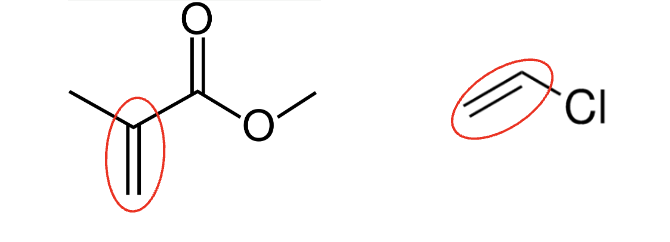
Figure 1. (Left) Methyl methacrylate, and (Right) vinyl chloride, are derivatives of ethylene (red oval).
Unlike vinyl chloride, whose danger largely stemmed from fire and combustion byproducts, MMA is a different beast. Under the right (wrong, actually) conditions, it reacts with itself to form acrylic plastic, one of the world's most useful plastics.
Chemical manufacturers know perfectly well that MMA likes to react with itself, which is why the stuff is shipped with inhibitors added to it — chemicals that mop up free radicals before the reaction can get going. Normally, these stabilizers work just fine. But if the tank gets too hot, contaminants get in, or the inhibitors are overwhelmed, the chemistry can start running ahead of the safeguards.
The molecule readily polymerizes into polymethyl methacrylate (PMMA), a reaction that releases substantial heat:
It may be useful, but this is NOT the way you want to make PMMA. Why? As is evident in Garden Grove, when MMA reacts with itself to make PMMA, the reaction is both highly exothermic and self-accelerating – hardly the experiment you'd want to run with 7,000 gallons of the chemical in a 34,000 gallon sealed tank. If this thing goes off, it's not going to be subtle.
Why does MMA react with itself?
It's sort of a coincidence that vinyl chloride and methyl methacrylate have both been involved in major accidents. Both chemicals are primarily used to make their polymers – PVC and PMMA, respectively, and they do this in a similar way in a process called free radical polymerization. The difference is that MMA is much more willing to undergo the reaction under accident conditions.
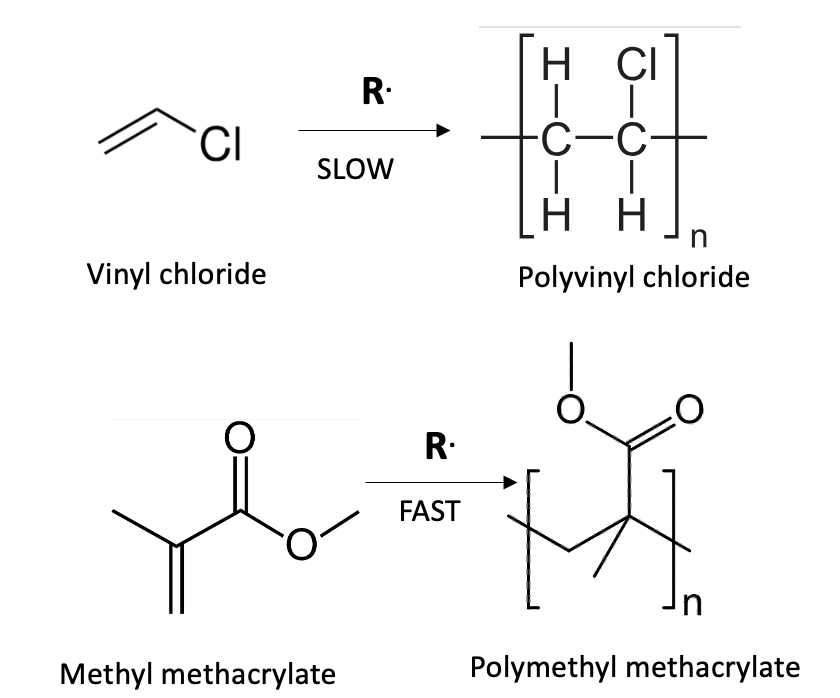
Figure 2. Self-polymerization of vinyl chloride (Top) and methyl methacrylate (Bottom). While both reactions require initiation, MMA polymerizes far more readily under ordinary conditions than vinyl chloride. In fact, inhibitors must be added to MMA during storage to prevent spontaneous polymerization. In this figure, R. is a radical initiator, and n = a large number.