
An article in Discover Magazine has summarized "Safety and efficacy of mRNA vaccines: a mechanistic and public health perspective, " a new review in The Lancet that rebuts many of the concerns about the safety and efficacy of mRNA COVID-19 vaccines. Could there be a better reason to get people yelling at each other (again)?
So I'm going to stay (more or less) out of that argument and instead explain the science behind two of the review's strongest rebuttals. If you still want to yell, go ahead. I have an Italian wife, so I'm more or less immune to it by now.
Does mRNA from vaccines persist in the body after vaccination?
Multiple studies have tracked vaccine mRNA after vaccination and found that intact mRNA declines rapidly rather than persisting indefinitely. The new Lancet review reaches the same conclusion after evaluating the accumulated evidence. To a chemist, however, the more interesting question is why.
The answer can be found in some rather simple organic chemistry, which I will mercifully keep to an absolute minimum.
Chemically, RNA and DNA are very different.
The difference between a molecule that lasts hours (RNA) and one that can survive for centuries comes down to changing just one of the roughly 30–35 atoms in an RNA nucleotide: replacing an oxygen atom with a hydrogen atom. This seemingly insignificant change (Figures 1 and 2) is anything but.
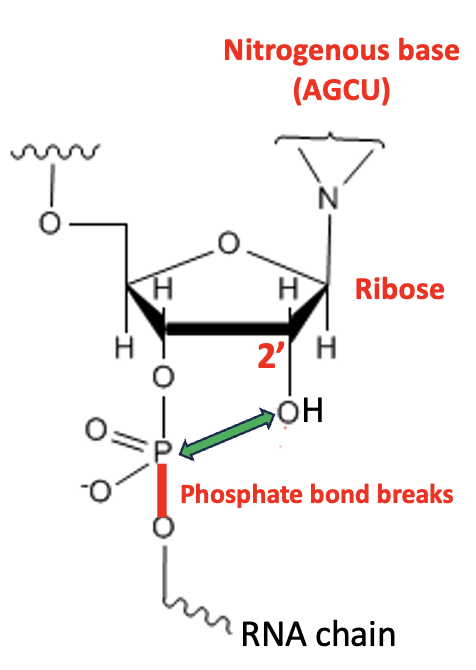
Figure 1. RNA consists of repeating nucleotides composed of a nitrogenous base, ribose, and phosphate. Unlike DNA, RNA contains a hydroxyl (-OH) group at the 2' position of the ribose sugar. The oxygen atom of this hydroxyl group is ideally positioned (green arrow) to attack the adjacent phosphorus atom (don't ask), triggering cleavage of the phosphodiester bond (red) and ultimately breaking the RNA chain. This built-in chemical instability is one reason RNA is naturally short-lived. [1,2]
By contrast, DNA lacks this hydroxyl group (Figure 2).
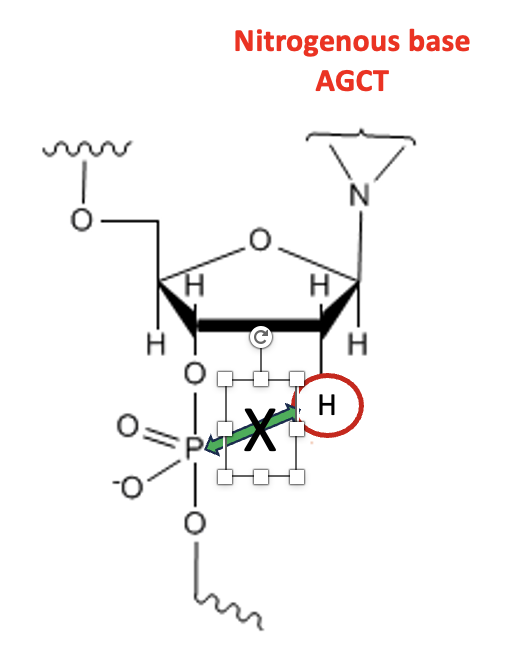
Figure 2. DNA has a hydrogen atom (red circle) instead of a hydroxyl group. This makes it much more stable. The X indicates the lack of an interaction with the phosphorus atom. One little atom can make a big difference.
Can vaccine mRNA become part of your DNA?
The amount of mRNA hanging around after vaccination is minuscule, but not zero. So, someone might argue that it does find its way into our own DNA and then maybe we start growing antlers. Fortunately, molecular biology provides a straightforward answer.
For vaccine mRNA to become part of our genome, two things must happen. First, it must be converted into DNA. Then that DNA must be inserted into a chromosome. The vaccine contains neither of the specialized enzymes needed to accomplish these steps: reverse transcriptase and integrase. If these sound familiar, it's because HIV has both of them. Once you're infected, you aren't you anymore. The virus converts its RNA genome into DNA and inserts that DNA into one of your chromosomes. Infected cells are now programmed to become "virus factories." This is one of the reasons that HIV/AIDS hasn't been cured, even after 45 years of research.
Reverse transcriptase
Reverse transcriptase (RT) belongs to a family of enzymes called polymerases, which build DNA or RNA one nucleotide at a time (think of stringing beads together, one at a time, to make a long necklace). Normally, an enzyme called RNA polymerase copies the information stored in DNA into messenger RNA, which cells then use to make proteins. Reverse transcriptase gets its name because it does the opposite, using RNA as a template to build DNA. HIV and other retroviruses rely on this enzyme to reproduce. Without reverse transcriptase, an RNA molecule cannot become DNA. Because mRNA vaccines contain no reverse transcriptase, there is no mechanism for turning the vaccine's RNA into DNA.
Integrase
Even if RT magically appeared in the vaccine or in your body, your DNA would still not be modified by the mRNA in the vaccine. A second step is required to enable this process. Your DNA would have to be cut, and the foreign DNA stitched into the gap. Retroviruses carry both RT and integrase; the enzyme responsible for the second step is called integrase.
Integrase inserts that DNA into one of the host cell's chromosomes. Once this happens, the viral DNA becomes part of the cell's own genetic material and is copied every time the infected cell divides. The infected cell is now permanently programmed to produce new viruses. Like reverse transcriptase, integrase is completely absent from mRNA vaccines, leaving vaccine mRNA with no pathway to become a permanent part of our genome.
Bottom line
Neither the Lancet review nor the Discover article is likely to change the minds of people who remain convinced that COVID-19 mRNA vaccines somehow rewrite our DNA and eventually turn us into Dracula. I doubt this article will either.
But the chemistry and molecular biology behind these questions are not new. RNA instability, reverse transcriptase, and integrase have been understood for decades and are fundamental concepts taught in biochemistry, molecular biology, and medical schools.
Nothing discussed here required new science. The chemistry of RNA and the biology of reverse transcriptase and integrase have pointed in the same direction for decades. There is nothing to argue about.
NOTES:
[1] The reaction shown in Figure 1 can occur spontaneously, although slowly under physiological conditions. RNases, which function within cells, simply catalyze the same reaction by accelerating the attack of the 2'-hydroxyl group on the adjacent phosphate. In other words, they exploit a chemical vulnerability that is already built into RNA. This is a way of saying that chemistry came first, then biology.
[2] I've heard people argue that the vaccine doesn't contain "real" mRNA because its nucleobases have been chemically modified. Fair enough—the uridine bases have been replaced by N1-methylpseudouridine for reasons that are beyond the scope of this article. But that's a modification of the base, not the sugar. The critical 2'-hydroxyl group is untouched, so modified RNA is still RNA as far as the chemistry that breaks it down is concerned.

Josh Bloom
Dr. Jonathan (Josh) Bloom, ACSH's Director of Chemical and Pharmaceutical Sciences, earned his Ph.D. at the University of Virginia and completed postdoctoral training at the University of Pennsylvania. During his 20-plus years in drug discovery at Wyeth, his research group discovered the antibiotic Tygacil®, approved in 2005. He holds 25 issued patents and has authored 35 academic papers. Since joining ACSH in 2010, he has written more than 2,000 articles and dozens of op-eds for major newspapers, including The Wall Street Journal and Chicago Tribune.