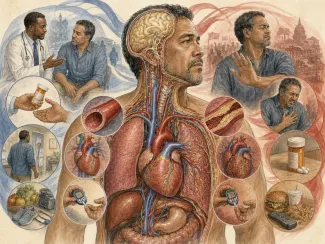
I am not one to consider a 1% shift in mortality particularly meaningful, but deaths in our middle years are rare, so a six-fold increase in premature deaths gets my attention. A new study in Nature Human Behavior finds that for a generation somewhere between Gen X and early Millennials (Xennials?), this is not a rounding error, but a sign that the canaries have stopped singing in the mines.
The Data Engine: Following a Generation into Midlife
The study draws on the National Longitudinal Study of Adolescent to Adult Health, a nationally representative cohort of Americans born between 1974 and 1983 and followed from adolescence in the 1990s through 2022. These participants are now in middle adulthood, when chronic disease becomes more salient and small differences in risk can accumulate into large differences in survival.
The dataset includes standard demographic and social determinant measures, along with five broad markers of physical health: body mass index, cholesterol, HbA1c, blood pressure, and C-reactive protein. Together, these biomarkers capture major pathways to chronic disease, including metabolic health, cardiovascular risk, and inflammation. In later survey waves, respondents were also asked to place themselves on a political spectrum from “very liberal” to “very conservative.”
Political ideology has increasingly become entangled with health behavior, from vaccination to trust in public-health agencies to attitudes toward medical expertise. That makes one long-standing paradox especially important: self-described conservatives often rate their own health favorably in surveys, yet county-level data have shown higher mortality in more conservative communities. The question is whether objective individual-level health data tell a similar story. Let’s look at five graphs.
A Health Gap Appears in Midlife
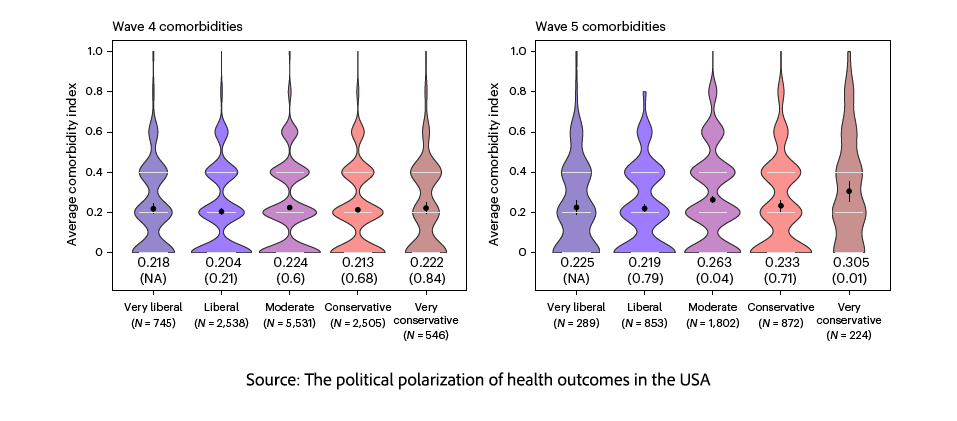
The comorbidity index combines the five biomarkers into a single measure of overall health risk, with higher values indicating worse health. The black points show each group’s average, while the spread of points shows how many individuals fall at each level. The key question is whether health risk rises consistently as respondents move from very liberal to very conservative.
In Wave 4 (2008-2009), there was no statistically meaningful relationship between an individual's political ideology and biological health. By 2016-18 (Wave 5), the most conservative individuals were less healthy than their liberal peers. The gap appears just as this cohort enters the stage of life when chronic disease risk begins to accelerate.
Political identity is not fixed for everyone. Neither is health. The next question is whether people whose political views changed over time also showed different health trajectories.
Shifting Beliefs, Shifting Health
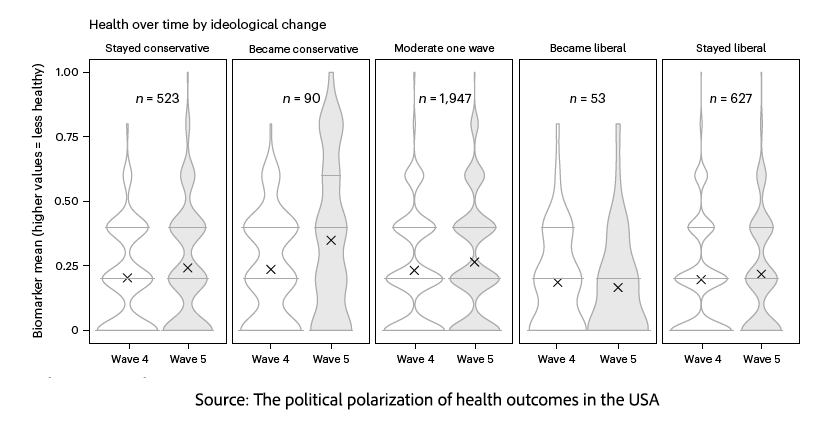
The same visual approach now compares shifts in ideology with shifting biomarker risk. Nearly every group showed some deterioration over time, as expected with age. But those who became more conservative experienced the steepest decline in health, while those who became or remained liberal tended to maintain healthier biomarker profiles. The pattern does not prove that political change caused the change in health, but it does suggest that ideology and health risk were moving together.
The Mortality Gap
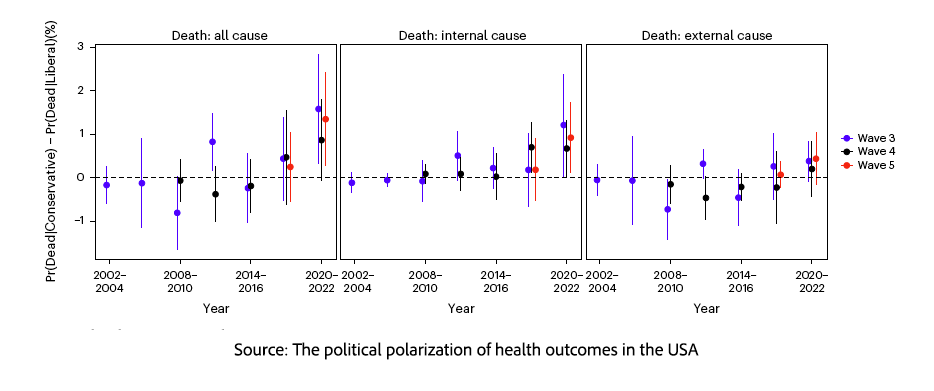
The health gap appears to be reflected in premature deaths. In this figure, the vertical axis represents the probability of death among conservatives minus the probability of death among liberals. Dots above the horizontal line indicate conservatives were more likely to die; dots below it indicate liberals were. The study then separates deaths from disease (internal causes) from deaths due to accidents and other external causes.
By looking at how the positions of the dots change from left to right along the timeline, the study reveals a profound historical shift. In the early 2000s, liberals died a bit more often than conservatives, although the differences were not statistically significant. But by the late 2010s to 2022, mortality for the conservatives rises sharply and is primarily attributed to deaths from disease, not accidents.
Breaking Down the Divide: What Does and Does Not Explain the Gap
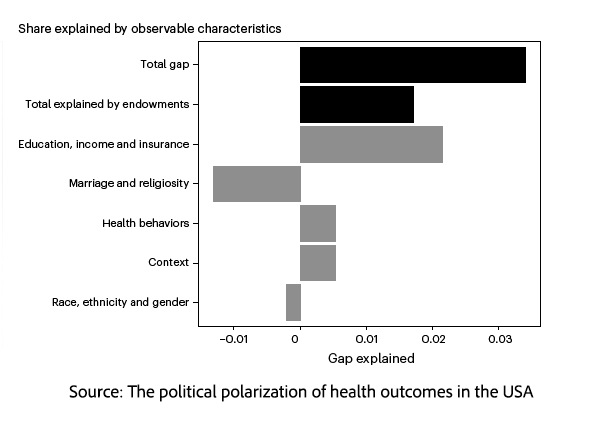
The previous graphs revealed a health gap and its real-world consequences between the most liberal and most conservative members of the “Xennials.” The researchers then asked how much of that gap could be explained by measurable differences between the two groups—an individual’s “endowments,” such as income, education, marital status, religiosity, race, gender, and other social factors. In the figure, bars to the right represent factors that help explain the liberal health advantage; bars to the left represent factors that appear to protect conservatives from falling even further behind.
The largest explained contributor to the gap was socioeconomic sorting: healthier and wealthier individuals were more likely to be in the liberal group. At the same time, several traditional social factors, including marriage, religiosity, race, and gender, partly offset the disadvantage among conservatives. In other words, some social structures still appeared to provide protection, even as other forces widened the divide.
However, and this is critical, only half of the disparity is explained by objective measures. What unmeasured behavioral changes are actively driving the two camps apart? Is ideology itself doing independent work, or is it merely standing in for income, education, geography, and other familiar risks?
Disentangling Ideology from Other Social Determinants
Right- and left-leaning Americans differ across many traditional social determinants, making it difficult to determine whether ideology itself is associated with rising mortality or whether political identity merely stands in for more familiar risks.
The authors present several models for determining mortality. When considering unadjusted mortality by itself, identifying as "very conservative" was associated with a 1.1 percentage point higher probability of death than identifying as "very liberal." When deaths from COVID are factored in, that likelihood drops to 0.8% - still 4 times higher than that for the “very liberal.” When they adjust for all traditional social determinants except geography, the rate rises to 1%, and when living in the same locale, with the same local policy “landscape,” a very conservative individual remains 1.4 percentage points more likely to die of internal diseases than a very liberal neighbor.
That pattern suggests political ideology may be acting like an independent social determinant of health. But what pathways could turn political identity into biological risk?
Inside the Doctor's Office
To examine the underlying behavior, the researchers turned to another survey, the Civic Health and Institutions Project (CHIP), a 50-state public opinion survey of 21,751 Americans conducted in the spring of 2024. This allowed them to overlay more specific measures of clinical trust, willingness to follow advice, and health behaviors directly onto political orientation. Before looking at the data, let’s acknowledge that because this survey was conducted separately from and after the primary dataset was completed, we are looking at association, not necessarily causation.
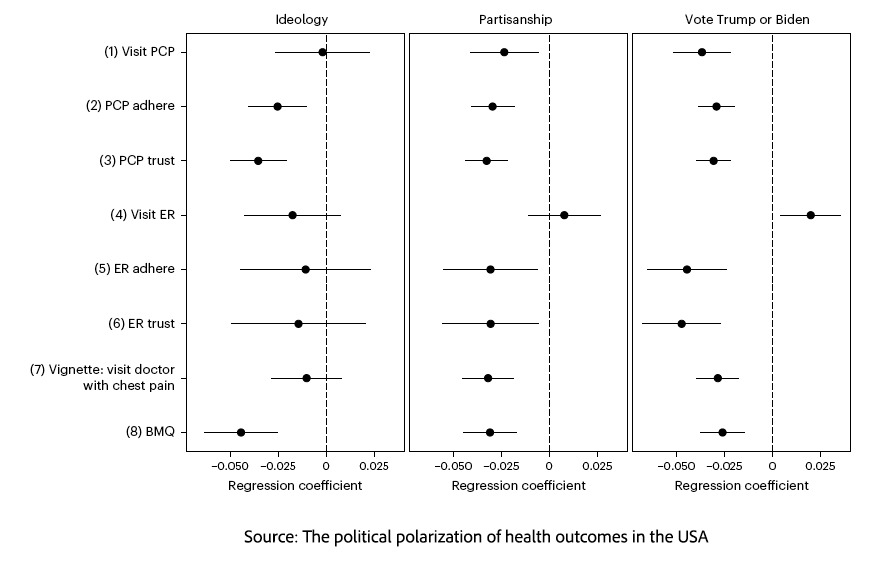
The CHIP asked individuals whether they saw their primary physician, sought care in an Emergency Room (ER), and would seek medical attention after a brief episode of chest pain. For people with chronic illnesses requiring medication, the researchers also used a beliefs-about-medicines questionnaire to assess respondents' trust in the safety, usefulness, and effectiveness of their prescriptions.
The dashed vertical zero-line indicates no difference in the behavior of the two political groups. Dots to the right of the dashed vertical line indicate that the behavior is more likely among conservatives; dots to the left indicate it is more likely among liberals. A quick reminder, horizontal lines that touch the vertical axis represent confidence intervals and indicate no statistical significance.
Across political groups, most respondents had seen a primary care physician. The sharpest differences emerged in what happened next. Conservatives were more likely to distrust medical advice and less likely to report following it. Emergency department results were mixed, but the pattern regarding urgent symptoms was more concerning: conservatives were more likely than liberals to say they would ignore a brief episode of chest pain. Among respondents with chronic illness, conservatives also reported lower trust in their medications and lower adherence.
Physicians Speak
This study suggests that political identity is a new social determinant. Before accepting this conclusion, it might be valuable to consider the lived experience of the other player in this health duet, the physicians. A Medscape survey of 400 physicians offers supporting, though less definitive, context.
- 44% of physicians report that patient trust in their treatment recommendations has declined over the past several years. [1]
- 88% of physicians say their patients still trust them personally, yet they also report that trust in their treatment advice is fading. This suggests that the breakdown in compliance is not necessarily a failure of the doctor-patient relationship but rather growing distrust of medical expertise itself.
Those findings align with the broader pattern in the Nature study: some patients appear to be pulling away from institutions and practices designed to protect their health. In practical terms, that may mean discounting medical advice, delaying care, or questioning medications that prevent chronic disease from becoming fatal.
Skepticism as a Health Risk
Public health has long assumed that people will seek out and follow medical expertise when their physical welfare is at stake. This study suggests that the assumption may be weakening. For at least some patients, political identity and institutional mistrust appear to shape decisions about care, medication, and symptoms that should normally prompt medical attention. This is not a normal consequence of growing older.
Among Xennials, the widening mortality gap is not fully explained by income, education, insurance, geography, marriage, or religiosity; roughly half of the divergence lies outside the usual social-determinant playbook, leaving room for unmeasured variables. Skepticism toward medical systems has established its own authority, primarily, although not exclusively, on the political right, fundamentally reshaping individual behaviors and physical outcomes.
The data do not prove that conservatism itself kills or that liberals possess an inherent health advantage. But they do suggest that political identity, institutional mistrust, and medical skepticism have begun to alter the everyday decisions that keep chronic disease from becoming fatal.
That is the deeper warning. When distrust of institutions spreads from policy debates to the management of blood pressure, diabetes, chest pain, vaccines, and daily medication, skepticism ceases to be merely a political posture and becomes a health risk. The canary's silence in the mine of healthcare warns that some Americans are dying earlier because the institutions designed to keep them alive have become politically suspect. This leaves right-leaning individuals with life-threatening chronic illnesses, who are significantly more likely to question the basic safety and usefulness of their daily, lifesaving prescriptions, uniquely vulnerable to entirely preventable deaths.
[1] Like their patients, 70% of physicians distrust insurance companies in making fair, evidence-based reimbursement decisions, and slightly fewer than 50% believe their employers prioritize patient safety over profits. 72% distrust federal regulatory bodies to design health policies grounded in solid science.
Sources: The political polarization of health outcomes in the USA Nature Human Behaviour DOI: 10.1038/s41562-026-02474-9
Doctors Say Patients Are Losing Trust in Their Treatment Advice: Medscape Survey Medscape

Chuck Dinerstein, MD, MBA
Director of Medicine
Charles Dinerstein, MD, MBA, is the Medical Director of the American Council on Science and Health. A vascular surgeon with more than 25 years of clinical experience, he brings a physician's understanding of medical decision-making, an appreciation for scientific uncertainty, and a broader perspective on healthcare economics and policy to his writing.