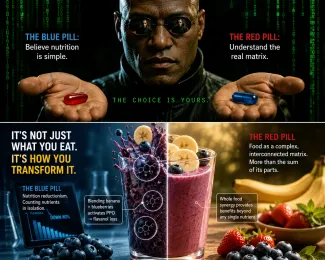
“The banana is killing the benefits of the [blueberry smoothie].”
The Instagram Medical group reports that adding bananas to your berry-filled smoothie reduces polyphenols – nutrients associated with lowering cardiovascular risk. But before we give up hope on a beloved smoothie, let’s look at the underlying study.
The Biochemical Evidence Is Clear
Flavanols, a class of polyphenolic, metabolically active compounds found in cocoa, green tea, and berries, like any other “supplement,” help support cardiovascular health and cognition. Bananas’ potassium also supports cardiovascular health and cognition alongside flavanols by promoting arterial flexibility and a “healthy” blood pressure, ensuring consistent oxygen delivery to the brain and less strain on the heart. Combining the two in a smoothie should be a win-win. A study reported in Food and Function points out that we are wrong. Mixing a banana with berries may be tasty, but for the Instagram Medical group, it is a no-no.
It seems that bananas, which contain high levels of the enzyme polyphenol oxidase (PPO), responsible for the browning seen in bruised fruit, are involved. When a banana and berries, in this instance blueberries, are processed in a blender, the banana and blueberries are torn apart, allowing the banana’s PPO, now free to mingle with the berries’ flavanols, greatly reducing the flavanols found in the now-blended smoothie.
The study involving 8 male volunteers found that the flavanols were rapidly degraded, losing 80% of their total concentration compared with a control smoothie. The longer the two fruits mingled, the greater the flavanol loss. Even when the banana and flavanols were consumed without prior mixing, flavanol levels in the stomach declined by about 40%. But let your heart not be troubled. You can still get your daily flavanols by leaving out the banana and adding another low-PPO fruit, such as strawberries.
When Food Becomes More Than the Sum of Its Parts
Often, for me, the most interesting idea in a study is not in its conclusion. PPOs in bananas reduce flavanols, but it raises a larger question. If something as simple as blending fruit fundamentally changes its nutritional profile, what exactly do we mean by classifying foods as "processed"?
The static nutritional model banana (good) + blueberries (good) = great does not hold. What we eat is not the mathematical sum of its parts. Processing, the mechanical blending that breaks apart the cell walls, results in a chemical transformation – no artificial additives, chemical preservatives, or industrial extrusions are necessary, just a blender. How does this fit with the NOVA processing algorithm? That question leads directly to one of nutrition's most influential classification systems.
The Limits of Processing Labels
NOVA rightly celebrates fresh, home-prepared meals and simple raw fruit blends as ideal. That smoothie is, in fact, a NOVA group 1–minimally processed–yet, as the science says, the blender has rendered nutritional carnage upon the delicate flavanols we were counting on to support our cardiovascular health and, if I remember correctly from just a moment ago, cognition.
As the authors note, commercial food manufacturers routinely use techniques, including chemical acidification, to prevent enzymatic browning by destroying the PPO enzyme and may preserve flavanols far better than we can at home. Those high-heat industrial treatments fall under NOVA groups 3 and 4, which are classified as industrial ultra-processing. NOVA tells us little about a food’s nutritional value, only its processing history, and, as the study demonstrates, processing is a poor indicator of nutrition. Yet the study exposes an even deeper problem than NOVA’s shortcomings.
Welcome to the Matrix
The limitation of this study, and of Instagram amplification, is that food is treated as a delivery vehicle for nutrients. This is the Matrix’s Blue Pill of nutritionism, trapping us in the comfortable illusion that health can be reduced to a spreadsheet of individual milligrams. While these kinds of scientific studies can tell us that a banana-berry smoothie is lower in flavanol than a mixed berry smoothie, they miss the bigger picture, failing to see the meal because of an overfocus on the ingredient.
Taking the Red Pill means waking up.
Food is a multidimensional, interconnected matrix in which ingredients, nutrients, human behavior, and shared cultural meaning interact. Altering or isolating any single component changes how the matrix behaves, from how our bodies receive it to how we experience food’s consumption, intellectually or emotionally. Beyond bioaccessibility, energy, and synergy, food is always transformed (processed) in our kitchens or culture to provide us with sensory, psychological, and physiologic nourishment. Stripping a food down to a single molecular metric (like counting milligrams of a flavanol) ignores the physical structure that controls its digestion, the culinary art that makes it digestible, the sensory pleasure that signals satiety, and the human table around which it is enjoyed.
Does adding a banana reduce the flavanols in a blueberry smoothie? Yes. But that fact alone tells us little about whether a smoothie is a wise dietary choice. A banana smoothie remains rich in fiber, potassium, vitamin B6, and countless interactions that no laboratory assay fully captures. If more flavanols are your goal, drink a cup of tea or add a spoonful of cocoa tomorrow. [1] Real health is not achieved by optimizing a single molecule in a single meal; it emerges from the cumulative pattern of thousands of food choices made over a lifetime. The banana smoothie was never the problem. Nutritional reductionism was.
[1] For the truly adventurous in need of that flavanol fix, skip the blueberries entirely and use an ounce of dark chocolate; it has nearly 10 times as many flavanols as a cup of fruit.

Chuck Dinerstein, MD, MBA
Director of Medicine
Charles Dinerstein, MD, MBA, is the Medical Director of the American Council on Science and Health. A vascular surgeon with more than 25 years of clinical experience, he brings a physician's understanding of medical decision-making, an appreciation for scientific uncertainty, and a broader perspective on healthcare economics and policy to his writing.