Neuroscience suggests the way we consume information can reshape how we pay attention, think, and learn.
“Passive scrolling — the thing most people do for three, four, five hours every single day — trains your brain into a state called low cognitive load. Your eyes track content. Your thumb moves. But your prefrontal cortex — the part responsible for deep thought, planning, and sustained attention — goes dormant.”
Four Ways to Rebuild Your Brain
1 Daily Deep Reading — The Brain Habit Researchers Swear By
2 Learn Something Completely New — Build a Neural Highway From Scratch
3 Exercise + Sleep — The Non-Negotiable Foundation
4 Digital Boundaries — Reclaim Your Attention Span
Read the entire article and the neuroscience behind those recommendations. From Better Within, Harvard Scientists Studied 200 Aging Brains for a Decade — One Daily Habit Made All the Difference
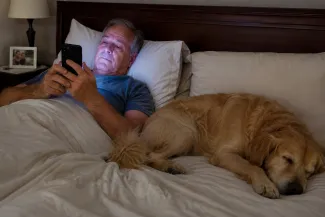
We often explain our dogs' behavior in human terms—they're seeking warmth, comfort, or affection. But evolution offers a richer story.
“We tell ourselves a small story. We say the dog sleeps next to us because the bed is warm. Because she loves the pillow. Because she has separation anxiety and does not want to be alone. All of that is partially true. But it misses the grander, more beautiful reality.”
Our two dogs, Juno and Loki, alternate who gets the big bed and who is consigned, at least momentarily, to the dog bed (although a heated bathroom floor is becoming favored). Like Cats and Dogs explains the evolutionary reasons behind dogs sleeping in the big bed, namely to rest and protect. Why Your Dog Sleeps Next to You (It's Not What You Think)
The biggest challenge of retirement isn't usually financial. Consider the quiet psychological transition that accompanies one of life's most celebrated milestones.
Retirement – “People walk into it with the emotional preparation of a Labrador walking into a buffet. They get a card, a bottle of something, a slightly awkward speech from someone who used to do their job badly, and then they’re shoved out into the sunlit uplands of “the rest of our lives” with absolutely no map, no compass, and a watch they’ll never wear.
What’s actually coming is a series of small, mostly invisible losses that stack on top of each other over about five years, eventually producing the grim realisation that you don’t quite know who you are anymore and that nobody around you seems to think this is a problem worth taking seriously.”
While I am retired from clinical medicine, I continue to pursue a secondary “career,” so I guess I am only semi-retired. The Substack Humans vs. Retirement often addresses the usual financial concerns, but this piece, What You Will Lose When You Retire, strikes at issues that have affected me and many of those around me – some successful in navigating the stages of vocational grief, others washing up on the shores of alternatives, and others against the rocks. Highly recommended to the retired, retiring and those who feel themselves years away.

Chuck Dinerstein, MD, MBA
Director of Medicine
Charles Dinerstein, MD, MBA, is the Medical Director of the American Council on Science and Health. A vascular surgeon with more than 25 years of clinical experience, he brings a physician's understanding of medical decision-making, an appreciation for scientific uncertainty, and a broader perspective on healthcare economics and policy to his writing.