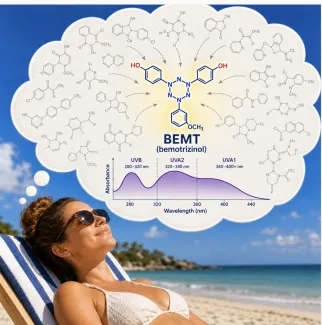
Given sufficient time, Lucy will mistime yanking the football away, and Charlie Brown will finally kick the damn thing. A gerbil will eventually write Beethoven's Tenth Symphony. And the Environmental Working Group (EWG) will endorse a synthetic chemical sunscreen. Bemotrizinol (BEMT), a sunscreen ingredient recently approved by the FDA, appears to be one such case.
But BEMT isn't even close to new. Europeans have been using it safely for more than 20 years, and the FDA is only now giving it the nod. So neither the FDA nor EWG can claim to be ahead of the curve. They're simply catching up to it.
To me, the most interesting thing about BEMT is neither its FDA approval nor EWG's endorsement. Rather, it demonstrates that sunscreen chemistry and drug discovery often follow similar paths. Contrary to popular belief, chemists don't simply dream up a molecule, synthesize it, and change the world. We're not that smart. More often, discovery is an exercise in trial, error, and optimization.
What Does Sunscreen Have to Do With Fentanyl?
The principle behind the two is surprisingly similar. When the DEA restricted access to key fentanyl precursor chemicals, clandestine chemists did not abandon fentanyl synthesis. They simply switched to different starting materials and synthetic routes, producing new analogs, some of which turned out to be even more potent than fentanyl itself. Chemistry, legal or otherwise, often follows the path of least resistance. Dr. Jeff Singer, my frequent writing partner, and I have written repeatedly about the unintended consequences of cracking down on fentanyl precursors.
Drug discovery works in much the same way. Chemists rarely begin with the perfect molecule. Instead, they identify a promising chemical scaffold and then systematically modify it, hoping to improve the properties they care about. One change may improve potency but worsen toxicity. Another may improve stability but reduce solubility. Success usually comes not from finding the best molecule, but from finding the best compromise.
BEMT Is a Similar Story
Researchers explored a class of compounds called hydroxyphenyl triazines, synthesizing and screening more than 500 related molecules while trying to optimize three different properties simultaneously: ultraviolet absorption, photostability, and oil solubility.
That may sound like a lot of work for a sunscreen ingredient. It was.
The challenge was not simply finding a molecule that absorbed ultraviolet light. Chemists already knew how to do that. The challenge was finding one that absorbed the right wavelengths, remained stable in sunlight, dissolved in cosmetic formulations, and stayed on the skin rather than penetrating it.
BEMT excelled in all of these areas. Figure 1 shows one reason why.
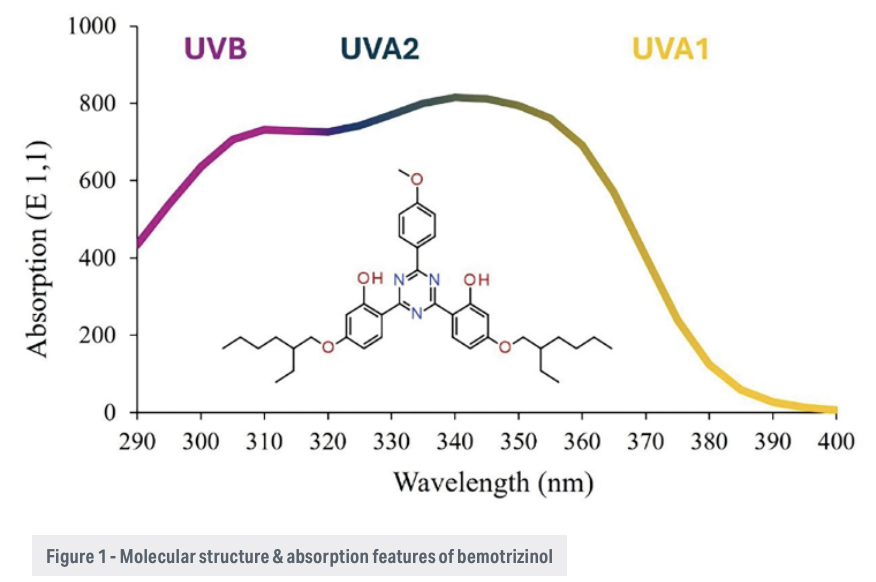
Figure 1. Ultraviolet absorption spectrum of bemotrizinol (BEMT), showing broad coverage across UVB, UVA2, and much of the UVA1 region. Source: Adapted from Sohn M, Low V. Bemotrizinol: Key Driver of Modern Broad-Spectrum Sun Protection. Specialty Chemicals Magazine. March/April 2026. BASF.
The figure helps explain why. Unlike many sunscreen ingredients that absorb strongly over a relatively narrow range of wavelengths, BEMT provides broad coverage across UVB, UVA2, and much of the UVA1 region. The result is protection against nearly the entire ultraviolet spectrum associated with sunburn, photoaging, and other forms of skin damage.
Broad UV coverage alone, however, is not enough. A sunscreen ingredient must also survive repeated exposure to sunlight.
This presents a surprisingly difficult challenge. Many sunscreen molecules contain networks of alternating double and single bonds, known as conjugated systems. These structures are especially good at absorbing ultraviolet light because the electrons are shared across much of the molecule rather than being confined to a single bond.
But there is a catch. Every time a sunscreen molecule absorbs a UV photon, some of its electrons are promoted from their normal low-energy arrangement (the ground state) to a higher-energy excited state. The molecule must then safely dispose of that excess energy.
Many sunscreen ingredients fail this test. Repeated cycles of excitation can break chemical bonds, rearrange atoms, or trigger other reactions that gradually destroy the molecule. As the molecule degrades, so does its ability to protect the skin.
This Is Why BEMT Is in the Bottle
A sunscreen ingredient that destroys itself after absorbing sunlight is of little use.
Many sunscreen ingredients absorb ultraviolet light effectively but gradually degrade while doing so. BEMT avoids this problem through a clever bit of molecular engineering. Two strategically placed hydroxyl groups form internal hydrogen bonds with the triazine ring. When BEMT absorbs ultraviolet light, these groups participate in something called an ultrafast proton-transfer process that safely converts the absorbed energy into harmless heat. The entire cycle takes less than a trillionth of a second, allowing the molecule to return to its original state, ready to absorb another UV photon.
In something resembling plain English, BEMT doesn't just absorb sunlight. It survives the experience.
And BEMT has another important property. The molecule is unusually large (Figure 1) and highly lipophilic, characteristics that make it poorly absorbed through the skin; most studies have found little or no systemic exposure after topical use, which is one reason regulators and toxicologists have generally viewed it favorably.
(Skin permeability is a function of lipophilicity and size. Moderate lipophilicity is good for absorption. Too much, like Vaseline, is not. Regarding size, the smaller the better.)
Bottom line
The FDA approval is, therefore, welcome, even if it arrived years late. Americans will finally gain access to products containing a sunscreen ingredient that much of the rest of the world has enjoyed for decades.
Scientific breakthroughs are often portrayed as flashes of genius. More often, they are the result of systematically exploring hundreds of possibilities and gradually improving on what came before. Whether the goal is a new drug, a new sunscreen, or, unfortunately, a new fentanyl analog, chemistry is usually an exercise in optimization.
BEMT is a reminder that successful molecules are rarely born perfect. They are discovered the same way good ideas are discovered: by generating many candidates, discarding most of them, and fishing out the survivors.

Josh Bloom
Dr. Jonathan (Josh) Bloom, ACSH's Director of Chemical and Pharmaceutical Sciences, earned his Ph.D. at the University of Virginia and completed postdoctoral training at the University of Pennsylvania. During his 20-plus years in drug discovery at Wyeth, his research group discovered the antibiotic Tygacil®, approved in 2005. He holds 25 issued patents and has authored 35 academic papers. Since joining ACSH in 2010, he has written more than 2,000 articles and dozens of op-eds for major newspapers, including The Wall Street Journal and Chicago Tribune.