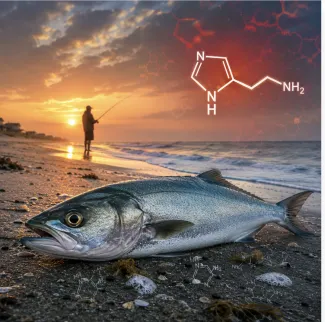
It's summer, and on Fire Island, that means fishing. Specifically, surfcasting.
And the maniacs who get up at 4 AM to obsessively cast their lures into the Atlantic will tell you that if they catch anything, it's usually a bluefish. The damn things are ferocious, but the bigger problem is when it's time to eat them. [1]
If you can get over the tractor oil pan-like flavor, you may face a worse problem: Scombroid poisoning.
If you've ever gotten sick from eating bluefish, you may have assumed that it happened because the fish wasn't fresh enough or wasn't cooked thoroughly. But that's probably not the case. A specific type of food poisoning from bluefish (and certain other fish) can occur even when the fish is well-cooked. And it's not only food poisoning. It can also mimic an allergic reaction.
Confused? Here's a brief, painless biochemistry lesson that explains what's going on.
Wheezing? Vomiting? Blame a simple biochemical reaction
The science behind histamine fish poisoning is surprisingly interesting. Although the illness was once commonly called scombroid poisoning, it is now more often referred to simply as histamine poisoning. The culprit is histamine, a compound formed in certain fish, especially those naturally rich in the amino acid histidine, when they are not kept cold soon after being caught.
Histamine poisoning differs from the "typical" food poisoning you might get from eating contaminated chicken or an undercooked hamburger. Unlike the bacteria that produce it, histamine survives cooking, freezing, smoking, and even canning. So whether a bluefish is grilled, baked, fried, or served raw, once histamine has formed, the damage is already done.
When bluefish are not properly refrigerated after they're caught, naturally occurring bacteria multiply and produce an enzyme called histidine decarboxylase. The enzyme removes carbon dioxide (CO₂) from the amino acid histidine, converting it into histamine (see Figure 1). Once formed, histamine is remarkably heat-stable. Cooking destroys the bacteria, but it does not destroy the histamine they have already produced. Ironically, by the time you eat the fish, the bacteria themselves may no longer matter. They have already left behind enough histamine to do the damage.
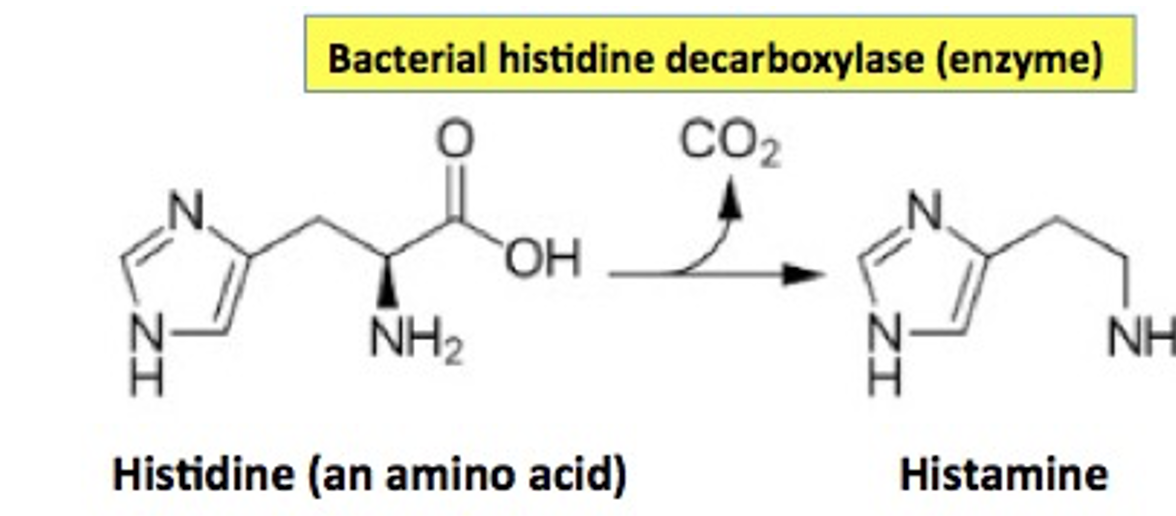
Figure 1. Bacterial histidine decarboxylase removes carbon dioxide (CO₂) from histidine, producing histamine.
Symptoms of histamine poisoning are lovely. They include tingling or burning in or around the mouth or throat, flushing of the face, rash or hives on the upper body, headache, dizziness, itching, nausea, vomiting, diarrhea, rapid heartbeat, wheezing, and, in severe cases, difficulty breathing. Asthmatics are even more susceptible. Symptoms can begin within minutes to a few hours after eating the fish and usually last 12 to 24 hours, although they can occasionally last longer, curing you of any lingering desire to eat bluefish again.
Bluefish are not the only fish capable of causing histamine poisoning. Tuna, mackerel, bonito, mahi-mahi, sardines, anchovies, and several other species that naturally contain high levels of histidine can also cause illness if they are not chilled promptly after being caught.
Although histamine poisoning has a strange-sounding name, it is far from rare. It accounts for a substantial proportion of seafood-related food poisoning worldwide. Unfortunately, there is little a consumer can do to detect it. Fish containing dangerous amounts of histamine may look, smell, and taste perfectly normal. Your safety depends largely on how quickly the fish was chilled after it left the water.
Fortunately, histamine poisoning is usually short-lived and responds well to antihistamines such as diphenhydramine (Benadryl). Antibiotics are useless because the bacteria have already done their job. The culprit is the histamine they left behind, not an ongoing infection. Most people recover completely within a day or two, although symptoms can be more severe in people with asthma.
So, when my crazy neighbor dangles one of these foul creatures in front of me and asks if I'd some, I'll have to refuse. For the 20th time. Apparently neither fishing nor histamine does much to improve memory.
NOTE:
[1] I have an unspeakably foul joke about eating bluefish, but I'm not gonna say a word. Feel free to guess.

Josh Bloom
Dr. Jonathan (Josh) Bloom, ACSH's Director of Chemical and Pharmaceutical Sciences, earned his Ph.D. at the University of Virginia and completed postdoctoral training at the University of Pennsylvania. During his 20-plus years in drug discovery at Wyeth, his research group discovered the antibiotic Tygacil®, approved in 2005. He holds 25 issued patents and has authored 35 academic papers. Since joining ACSH in 2010, he has written more than 2,000 articles and dozens of op-eds for major newspapers, including The Wall Street Journal and Chicago Tribune.