
The ketogenic diet is often promoted online as a solution for everything from brain fog and depression to serious psychiatric illness. The evidence is far more nuanced. Although this high-fat, very low-carbohydrate diet has been used for decades to treat certain forms of epilepsy, its potential role in conditions such as bipolar disorder, schizophrenia, depression, and cognitive decline is still being investigated.
Early studies, including a small Stanford-led pilot trial, have produced promising results, and the proposed biological mechanisms are plausible. However, the research remains preliminary. The ketogenic diet may eventually become a useful clinical tool for some brain-related conditions, but current evidence supports careful investigation, not confident claims of a cure.
The Question That Started This
A patient of mine, stable on medication for bipolar disorder for years, came in convinced she should stop everything and manage her illness with diet alone. She had watched video after video of people crediting keto, a ketogenic diet, with lifting their depression and clearing their brain fog. She wanted to know if she should throw out her prescriptions.
I hear a version of this weekly, and it puts me in an awkward spot. I do not want to dismiss a question that has real science behind it. Still, I also do not want a patient with a serious, treatable illness to trade an effective medication for a hopeful anecdote. So I gave her the honest answer, longer and less satisfying than a testimonial: the science is genuinely interesting, and nowhere near ready to do what those videos promised.
A Century-Old Treatment, Not a New Fad
The ketogenic diet is not a wellness invention. Physicians developed it in the 1920s to treat drug-resistant epilepsy in children, and it remains a standard option for certain seizure disorders today. That history is the best reason to take the newer research seriously, because it shows that what you eat can measurably affect how the brain behaves electrically.
The emerging field of “metabolic psychiatry” examines how factors such as the brain’s energy use, mitochondrial function, insulin signaling, and nutrition may influence mental health. It raises a logical follow-up question: if a ketogenic diet can help calm abnormal electrical activity in a seizing brain, could some of the same metabolic changes also benefit other neurological or psychiatric conditions? That possibility is a reason to conduct rigorous experiments, not to assume the answer in advance.
The Mechanism: Why Ketones Might Matter
A ketogenic diet is simple to describe and hard to live by: very high in fat, very low in carbohydrates, with moderate protein. Starving the body of carbs forces a metabolic switch.
The energy-hungry brain runs almost entirely on glucose. When you sharply restrict carbohydrates, the liver converts fat into ketone bodies, mainly beta-hydroxybutyrate (BHB), which cross the blood-brain barrier and serve as an alternative fuel. That switch may matter for two reasons. In certain conditions, including Alzheimer’s disease, the brain struggles to use glucose properly, and ketones may provide an alternative energy source for neurons. BHB is more than fuel. It acts as a signaling molecule that may reduce oxidative stress and calm inflammation in the brain, potentially helping protect brain cells from damage.
It is a plausible, even elegant, mechanism. However, a good story about how something might work is not evidence that it does; caution applies.
Beyond Anecdote: The Stanford Pilot Study
The study drawing the most attention is a 2024 Stanford-led pilot trial, published in Psychiatry Research. Researchers enrolled adults with schizophrenia or bipolar disorder who were receiving psychiatric medication and had existing metabolic problems. After four months on a ketogenic diet, participants showed improvements in weight, blood pressure, insulin resistance, and psychiatric symptoms. The findings were encouraging, but because this was a small study without a control group, they cannot establish that the diet caused these improvements.
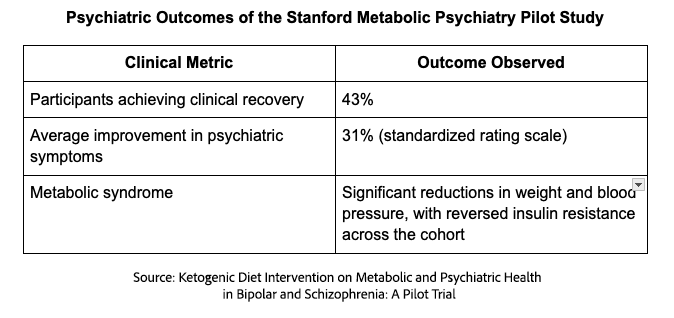
Those numbers are real and worth taking seriously. But notice the design: single-arm, no comparison group, no blinding. That means you cannot separate the diet from a placebo effect, the natural ups and downs of these illnesses, or the intensive clinical attention every participant got for four months. Pilot studies exist to show a bigger trial is worth running. This one did that job well; it did not prove the diet works, and the researchers say so themselves.
Where the Evidence Actually Sits
This is the part that testimonials skip. Not all evidence carries the same weight, and knowing where a finding sits in that hierarchy is the difference between informed hope and being sold something.
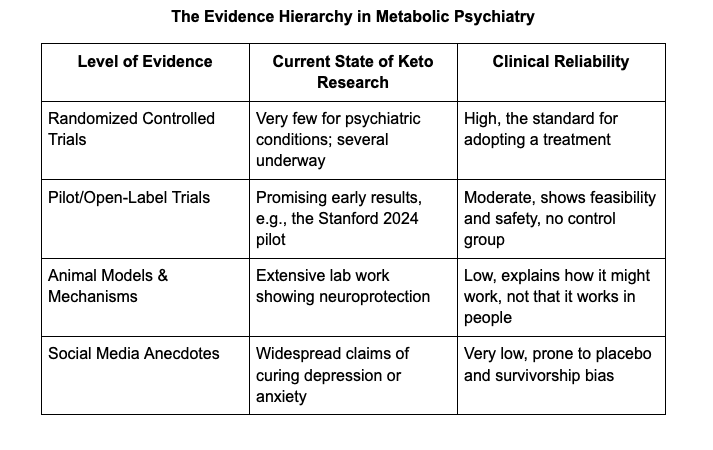
Systematic reviews of keto for depression and cognitive impairment keep landing on the same caveats: small samples, inconsistent designs, and high dropout rates, because keto’s strict high-fat diet is hard to sustain. The risks are real too, especially for cardiovascular health and cholesterol, and some people should not attempt it without supervision. An intervention this demanding is not something to start because of a video.
What I Tell Patients Who Ask
Here is the practical version I offer, whether the interest is mood, memory, or metabolic health.
- Do not stop your current treatment. Medication and therapy are the evidence-based foundation, and stopping abruptly can be dangerous.
- Separate the goals. Keto has good evidence for weight loss and some metabolic markers. Its evidence for treating depression, bipolar disorder, or dementia is early and unproven.
- Bring your concerns and interests to your clinician, not to the comment section. This is a real conversation to have with someone who knows your history, labs, and medications.
- Be honest about practicality; trial participants had dietitians and structure. Ask yourself whether you can realistically sustain this and what happens if you cannot.
- Watch for the tell. Anyone selling a single diet as a cure for serious mental illness is ahead of the evidence. Good science does not need to oversell.
The Verdict
The link between metabolic health and brain function is one of the most exciting frontiers in medicine, and I do not want to oversell or undersell it. The ketogenic diet clearly does more than shed pounds; it changes how the brain fuels itself, and metabolic psychiatry has earned the randomized trials now underway.
What it has not earned is a place at the front of the treatment line. The honest answer for the brain is the one I gave my patient: for epilepsy, the evidence is settled. For everything else, we are still finding out, and anyone who says the question is answered is selling certainty the science has not yet produced.
My patient kept her prescriptions. We are talking with her primary care team separately about her metabolic health, which is exactly where that conversation belongs.
Source: Ketogenic Diet Intervention on Metabolic and Psychiatric Health in Bipolar and Schizophrenia Psychiatry Research DOI: 10.1016/j.psychres.2024.115866

Shebna Osanmoh
Shebna N. Osanmoh I, PMHNP-BC, is a board-certified psychiatric-mental health nurse practitioner.