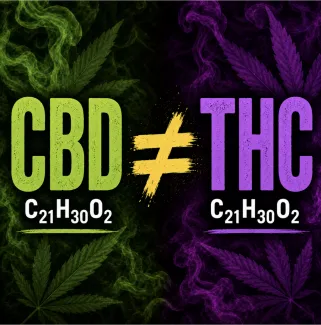
CBD and THC have been studied to death, but chemists are still finding new things to say about the surprisingly simple reaction that connects them.
A new study published in Organic & Biomolecular Chemistry takes a close look at the acid-catalyzed conversion of CBD into THC, examining why different reaction conditions produce different THC isomers. The details get complicated, but the basic chemistry isn't: CBD and THC have the same molecular formula, C₂₁H₃₀O₂, and converting one into the other involves coaxing CBD into closing a six-membered ring. To an organic chemist, this might seem trivial, but here it is anything but.
For all you stoners who didn't pay attention in organic chemistry, here's a second chance to learn how to do something that you would have already known if you'd stayed awake. I'm not recommending you do this, nor is it top secret like the Manhattan Project; this information is online in various forms. Rather, it's simple organic chemistry that is called a cyclization, where a molecule of CBD oil, aka cannabidiol, under certain sets of conditions, can be coaxed to form something different — THC, one of the psychotropic chemicals in marijuana.
Admit it, the only reason that you guys are all reading this is that you think I'm going to tell you how to convert CBD oil, which is not illegal or psychotropic [1,2] and can pretty much be obtained in every store in Manhattan, into THC, which is psychotropic and either legal or illegal depending on a complex set of often contradictory state and federal laws. Perhaps those of you who haven't already nuked every brain cell are thinking, "Hmm, why can't I just get a whole bunch of CBD and make my own THC?"
Well, you can, and that's where organic synthesis [3] – the art of converting one molecule into another by one or more chemical reactions – comes in handy. Anyone in the mood for a lesson? I hope so because here's a doozie: The Dreaded Chemistry Lesson From Hell®.
Steve and Irving have done their share of doobies, but for this particular lesson, they decided to recruit outside experts. Please welcome our guest lecturers, Cheech and Chong, both of whom have inhaled enough smoke to qualify as ashtrays. Somehow, both are still alive, as evidenced by Cheech & Chong's Last Movie, which is now streaming on Paramount Plus, the "plus" standing for your endlessly rising cable bill.
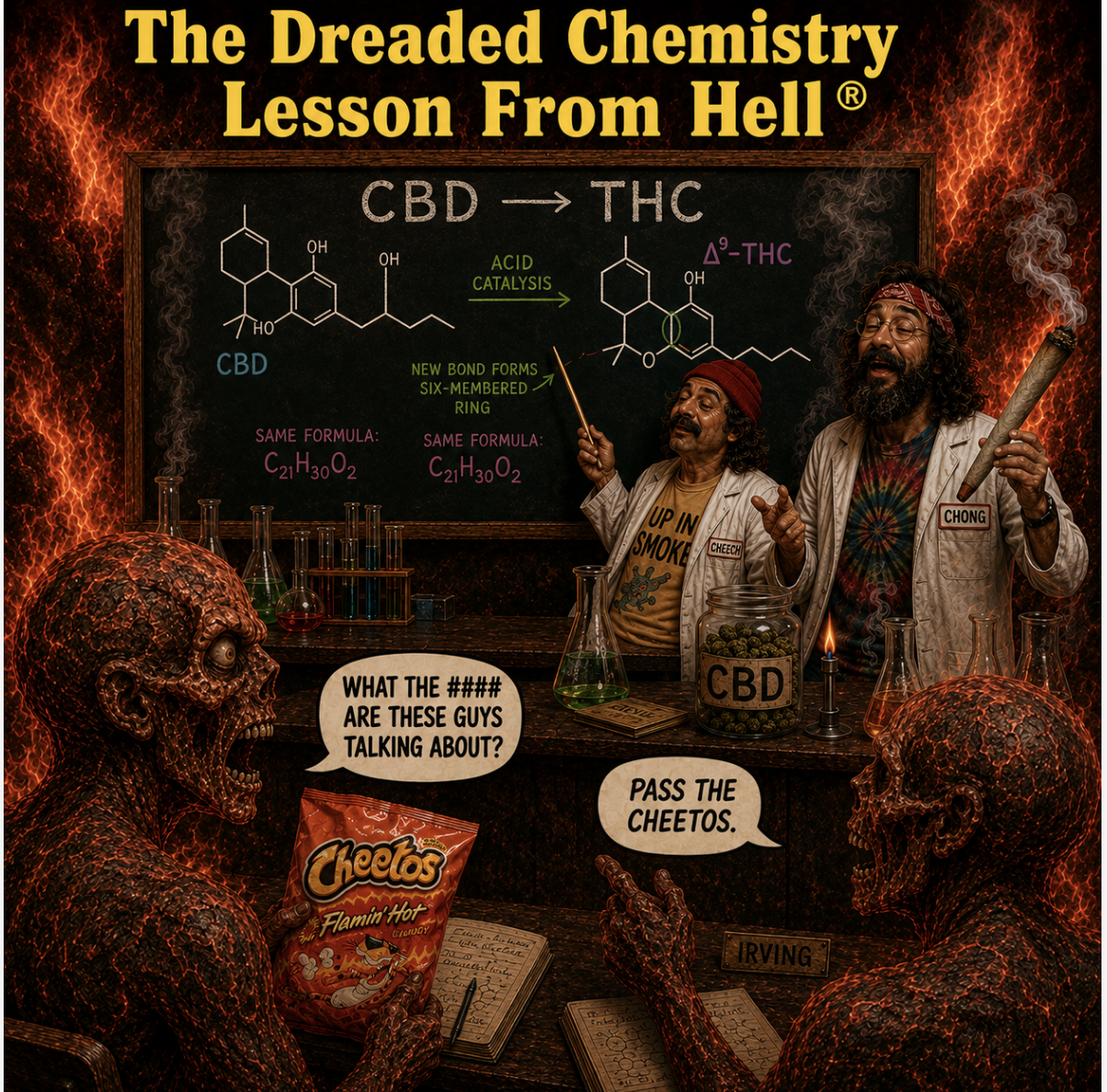
Steve (left) is too busy stuffing his face with Cheetos while Irving, who is stoned out of his gourd, gazes longingly at the bag.
LESSON 1 - NATURE LOVES 6-MEMBERED RINGS
Organic compounds that contain 6-membered rings are exceedingly common, both in nature and synthetically. The atoms most commonly found in 6-membered ring compounds are carbon, nitrogen, and oxygen. Six is a magic number in organic chemistry. You don't want to know why. Here are a few examples (Figure 1).
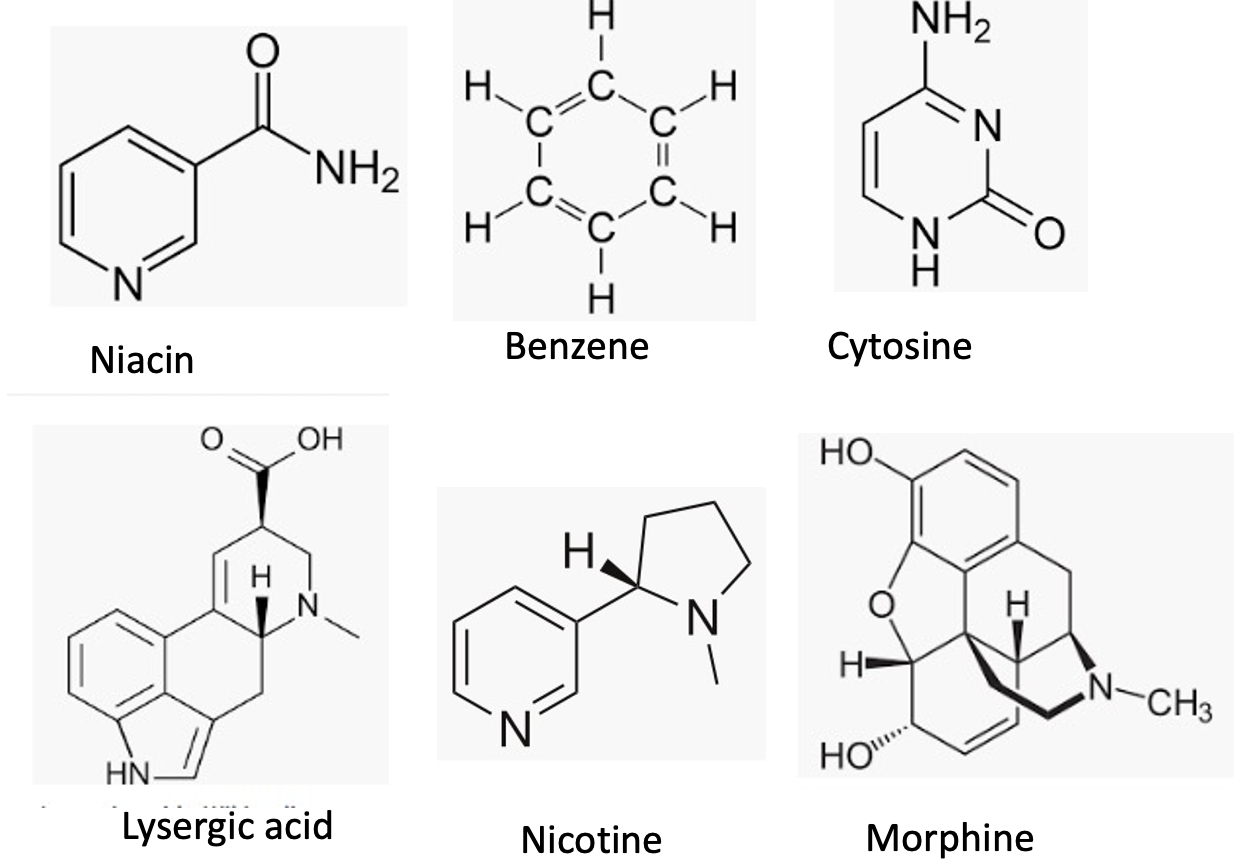
Figure 1. Some examples of naturally occurring organic chemicals containing 6-membered rings.
There is an infinite number of synthetic organic molecules with 6-membered rings out there as well. Some examples: DDT, dioxin, TNT, aspirin, Valium.
LESSON 2 – MOLECULES THAT CAN FORM 6-MEMBERED RINGS ARE HIGHLY MOTIVATED TO DO SO
So, let's look at the structures of CBD side by side with THC and see how close they really are, and also why CBD is experiencing an inferiority complex.
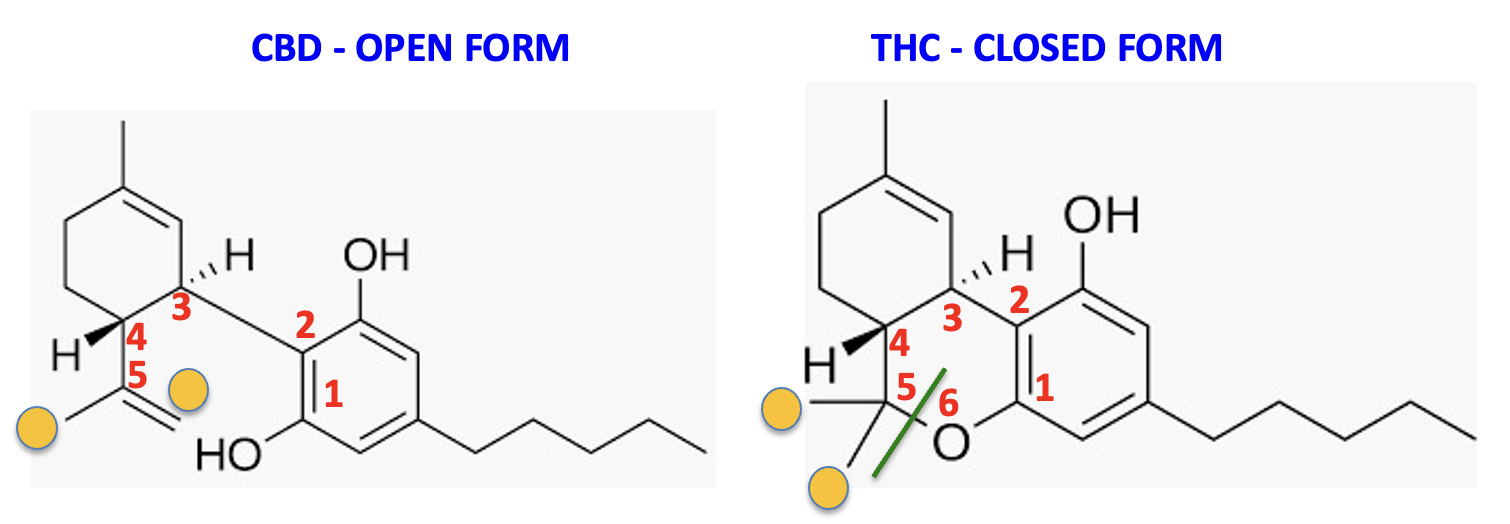
Figure 2. CBD (left) and THC are isomers — they have the same chemical formula, C21H30O2, but different chemical structures and pharmacological properties. To convert CBD to THC, the hydroxyl group (blue arrow) needs to form a bond to carbon #5. This new bond is shown (right) as a green line. The orange circles indicate the carbon atoms in each structure.
LESSON THREE - CAN YOU MAKE THE 5-6 BOND FORM, CONVERTING CBD INTO THC?
Yes. Any organic chemist will look at this simple problem and tell you that this reaction will be catalyzed by acid. Depending on who you ask, you might get a wide variety of answers, such as:
- Hydrochloric acid
- Sulfuric acid
- p-Toluenesulfonic acid
- Boron tribromide
- Acetic acid (vinegar)
All of these are "correct" in that they will perform this conversion, at least to some extent. But if you're going to be smoking whatever you're cooking up in your kitchen, the term "to some extent" becomes relevant.
The study mentioned above shows that what you actually get depends heavily on the reaction conditions. Changes in temperature and other variables can favor different THC isomers, including delta-9 and delta-8 THC.
LESSON FOUR - ORGANIC REACTIONS CAN BE VERY DIRTY
Perhaps the best measure of the success of a chemical reaction in organic chemistry is the yield. This is simply the amount of pure, isolated material that goes into a bottle divided by the theoretical amount that should be formed if the reaction were perfect. Perfect reactions are rare. A yield of 100% is usually met with suspicion. No matter how good a given reaction, byproducts (impurities) almost always form. Every gram of byproduct reduces the amount of final material in the bottle. A yield of 90% is excellent, 70% is fair, 50% is pretty bad, and below that is a horror show. Low-yielding reactions typically have multiple impurities and can be a bitch to purify. This is why you should not make your own THC; it will be full of schmootz.
There are a number of examples in the literature of people trying to do just this. What appears on paper to be a simple transformation is, in reality, a big mess.
Watanabe and colleagues used simulated gastric fluid (SGF, basically salty hydrochloric acid, either with or without a digestive enzyme) to see whether this conversion could take place in the stomach. After 20 hours - far longer than any drug would stay in the stomach - only 2.9% of the CBD was converted to THC. Three other cannabinoids were formed in yields ranging from 1-10%. The rest? Who knows? Depending on the reaction conditions, dozens of byproducts could be formed. Most of them are unknown and might even be dangerous. (For the quintessential example of how even minor deviations from a known procedure can ruin lives, see Frozen Addicts, Garage Drugs, and Funky Brain Chemistry).
Merrick and colleagues investigated the psychoactive components of CBD after it was exposed to SGF. Using HPLC [4], a standard method of determining the purity of a reaction mixture, the group identified two THC isomers, unreacted CBD, and two unknown impurities (Figure 3). Keep in mind that even this reaction, which was run under carefully controlled conditions, gave a mixture of five chemicals. There are almost certainly more in there that haven't been identified.
Of course, simulated gastric fluid isn't a human stomach. Still, subsequent animal and human studies have found no convincing evidence that CBD is converted into meaningful amounts of THC in vivo.
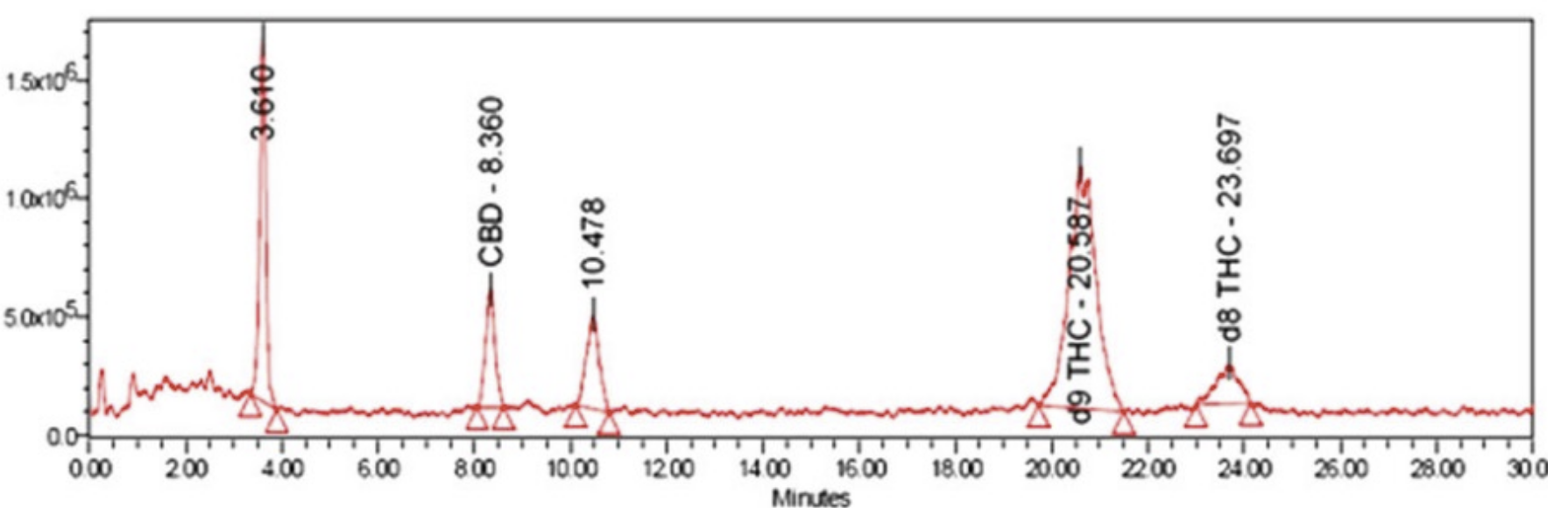
Figure 3. HPLC trace of psychoactive substances formed by reacting CBD with SGF. Source: Cannabis and Cannabinoid Research Volume 1.1, 2016 DOI: 10.1089/can.2015.0004
An example of something even worse is shown in Figure 4. The research chemical supplier Sigma-Aldrich extracted the cannabinoids from a pot brownie and got this collection of 11 different chemicals, some CBD-like and some THC-like. Although this mixture did not result from the reaction of CBD with acid, it shows how complex marijuana chemistry can be.
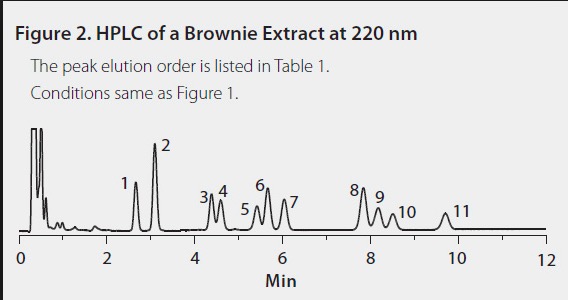
Figure 4. HPLC trace of pot brownie chemicals. Each peak represents a different chemical compound. Source: Sigma-Aldrich
UP TO YOU
So, if you feel sufficiently empowered by this article to put on a lab coat and try your luck, I wish you plenty of it. Organic chemistry isn't always predictable. On paper, it looks like you could sneeze on CBD and have all the THC your heart desires. In the lab, things are quite different. In your kitchen – forget it.
NOTES:
(1) Psychotropic drugs produce altered mental states.
(2) CBD may not pack the punch of THC, but this doesn't mean it's inert. In fact, Epidiolex (pharmaceutical CBD) is FDA-approved to treat certain rare seizure disorders. Gas station CBD may or may not be legal depending on how much THC is in it. The whole thing is a giant mess.
(3) What chemists mean by organic is quite different than what is used for foods. See my op-ed in the Chicago Tribune Organic Oreos? A chemist explains what 'organic' really means
(4) HPLC stands for High-Performance Liquid Chromatography - a very powerful analytical method for determining the composition of mixtures or the purity of single compounds.

Josh Bloom
Dr. Jonathan (Josh) Bloom, ACSH's Director of Chemical and Pharmaceutical Sciences, earned his Ph.D. at the University of Virginia and completed postdoctoral training at the University of Pennsylvania. During his 20-plus years in drug discovery at Wyeth, his research group discovered the antibiotic Tygacil®, approved in 2005. He holds 25 issued patents and has authored 35 academic papers. Since joining ACSH in 2010, he has written more than 2,000 articles and dozens of op-eds for major newspapers, including The Wall Street Journal and Chicago Tribune.