There’s strange fruit hanging from tree trunks and telephone poles in Los Angeles, Greenville, Tennessee, and Kensington, Philadelphia. Boxes of Narcan (naloxone), a medication that reverses opioid overdoses, are waiting to be plucked by any friend or passerby who needs to save a life in a hurry. Just rip open the box, remove the plunger device, and squirt the contents into the nose of someone who has injected, snorted, or smoked too much heroin or fentanyl.
At the methadone clinic in Washington, DC, where I work part-time as medical director, Narcan has made important changes to our routine. We always ensure that our patients have the antidote. We shove boxes into their pockets and purses. Even though they won’t be using it on themselves (it’s almost impossible to spray it in your nose as you are losing consciousness), they can save someone else. For patients, too, Narcan affects daily life. Recently, when a couple came to the methadone clinic to get their daily dose, the woman informed us that her partner had overdosed earlier that morning. “I canned him twice,” she said with a what-can-you-do shrug of her shoulders. Both patients acted as if nothing unusual had happened and asked for more Narcan on their way out.
Naloxone works within two to three minutes to displace opioid molecules from the three major types of opioid (endorphin) receptors in the brain—crucially, the ones located in the brain stem, the region that regulates automatic breathing. Because naloxone occupies those receptors for only 30–40 minutes, a person can slip back into unconsciousness and even fatal respiratory crisis if unattended. The opioid molecules, after all, are still circulating, waiting to jump back onto now-empty receptors. Thus, calling 911 after revival is advised.
For years, public health workers have sought to make Narcan a major pillar of the harm-reduction approach. Harm reduction entails minimizing the negative consequences associated with high-risk behavior while accepting that the behavior might not change. And it worked. Narcan gets credit for contributing to the impressive decline in overdoses on the East Coast and in the Midwest that began in the summer of 2023.
But naloxone is not a new medication. Developed in 1961 by pharmacologists working in a private lab in Queens, New York and approved by the Food and Drug Administration in 1971, naloxone attained its status as a widely available technology only three years ago. Why did it take half a century for this drug with its Lazarus-like properties to become available without a prescription?
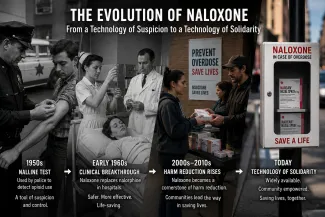
The answer is embedded in societal attitudes toward heroin addicts. The history of naloxone, as encapsulated by historian Nancy D. Campbell, traces the evolution of the medication from being a “technology of suspicion” to a “technology of solidarity.”
The story begins in 1954 with the introduction of a drug called nalorphine (under the brand name Nalline), a pharmacological precursor of today’s naloxone. Nalline was the first narcotic antagonist (opioid receptor blocker) routinely used in hospitals. Doctors administered it intravenously to reverse suppressed breathing due to surgical anesthesia, shallow or depressed breathing in the newborn infant of an opiate-addicted mother, and not-yet-fatal heroin overdoses of victims who made it to the emergency room.
But soon, Nalline assumed a double life, becoming a tool of law enforcement. In the mid-fifties, anti-narcotic agents in Oakland, California, began injecting it under the skin of arrestees, parolees, and probationers to determine whether they were dependent on opioids. It was called the Nalline Test. Agents needed only a small dose to detect the telltale sign of opioid use: a person’s pupillary size. Opioids constrict the iris to produce what is known as a pinpoint pupil. With Nalline administration, the pupils will dilate if a person has taken opioids, even prescribed pain relievers such as Percocet (oxycodone and acetaminophen) and Vicodin (hydrocodone and acetaminophen).
Oakland’s practice inspired the adoption of the Nalline test by police in other parts of the state and in St. Louis, Missouri; Illinois; Hong Kong; Singapore; and Texas. A sociologist who studied the Nalline Test observed that it drove some heroin users to switch to amphetamine (the reversal agent had no effect on stimulant users) and spurred heroin dealers to vacate locales where the police regularly used Nalline, as demand for their product went down.
Reliance on the Nalline Test by narcotics agents extended into the 1970s, mostly in California, but fell out of use, in part because of the reach of a 1962 Supreme Court decision. In Robinson v California, the court deemed it cruel and unusual to punish anyone for the mere status of being an addict. Possessing drugs, selling them, and committing a crime to support one’s habit, however, remained crimes.
In the clinical setting, naloxone replaced nalorphine in the early 1960s. It was a much safer opioid blocking agent. Unless one has an allergy to naloxone, the medication is essentially harmless. If given by mistake—to someone in a deep sleep while sprawled on the sidewalk but not on opioids—absolutely nothing happens. Nalorphine, on the other hand, tended to cause severe side effects like hallucinations, dysphoria, and anxiety, symptoms independent of opioid withdrawal, when administered. The explanation lies in the fact that nalorphine problematically activates one of the three major types of opioid receptors in the brain (while blocking one other to reverse overdoses and basically ignoring the third). Naloxone, by comparison, blocks all three.
For about three decades, naloxone was largely confined to medical settings, with some exceptions. San Francisco’s Haight Ashbury Free Clinic kept some naloxone stocked as early as the 1970s, supplied by sympathetic EMTs and paramedics, and, according to a history of harm reduction, so did doctors whose patients were rock stars.
Access to naloxone expanded somewhat in the mid-1990s, when the Chicago Recovery Alliance, which already operated a syringe exchange, organized itself as a national distribution hub. Other local syringe exchanges and some community-based public health departments offered naloxone without a prescription. Together, they worked to get naloxone carried by local sheriffs’ departments, first responders such as police officers, firefighters, and emergency medical technicians, and eventually nonprofessionals.
They also lobbied state legislatures to enact naloxone access laws and Good Samaritan laws to protect individuals who contacted emergency services to resuscitate overdose victims or rescued the victims themselves. Reception was spotty. For example, it took years to get jails to provide naloxone to inmates upon their release, even though they faced high rates of fatal overdose During their confinement with no access to opioids, they lost their tolerance to the drug and therefore, if they resumed use after discharge, would be far less able to tolerate their usual, pre-incarceration doses.
In many jurisdictions, state health officials authorized pharmacists to prescribe naloxone, or a standing order from those officials could allow anyone to obtain the naloxone. By 2014, over 30 states had naloxone access laws in place. By the 2020s, writes historian Campbell, naloxone had become “a symbol of collective action for social change.”
Then came the spray, approved by the FDA in 2015 under the brand name Narcan. Prior to that, naloxone was available only as an injectable (intravenous, intramuscular, or subcutaneous), but the demands of the opioid crisis (intensified around 2013 by the lethality of fentanyl, at 50 times the potency of heroin) required a more user-friendly device. This put pressure on pharmaceutical innovators to formulate a nasal spray that anyone could use. To meet the need, the National Institute on Drug Abuse, part of the National Institutes of Health, worked with a small for-profit pharmaceutical company to design a nasal delivery device. It would be a crucial turning point in raising the profile of naloxone.
But it was not unreservedly welcome. Many locales’ emergency services and police departments balked at the cost of purchasing Narcan. Some skeptics thought it would “enable” continued addiction and deter treatment. And addicts themselves did not appear especially grateful. As Narcan takes effect, it generally elicits intense withdrawal symptoms. This makes some of them combative, flailing at rescuers and then bolting to get their next hit. “Two strikes and they’re out” is how Judge Andrew Ballard, a judge in the Court of Common Pleas in Lawrence County, Ohio, described the bias of local residents in 2016. “They’d had their chances.” (Since then, the judge has seen a marked change in attitude: “People are more charitable now. Too many of their neighbors’ kids were dying.”)
In 2018, Jennifer L. Doleac and Anita Mukherjee published a 78-page article called “The Moral Hazard of Lifesaving Innovations: Naloxone Access, Opioid Abuse, and Crime.” By following the staggered timing of the passage of state-level naloxone access laws, the economists measured the impact of a natural policy experiment. As naloxone access expanded, the investigators discovered that theft increased along with more opioid-related emergency room visits, but with no measurable reduction in opioid-related mortality.
Responses were swift. “Until now, I had not realized that economists and public policy experts were in the habit of advocating, if obliquely, for de facto death sentences for opioid-related crimes,” huffed an emergency physician. In truth, the authors acknowledged in the paper that “naloxone has a clear and important role in harm reduction.” Other experts critiqued the study on the grounds of confounding variables that were not accounted for. They also pointed to lag times between enacting expansion laws in various states, their implementation, the actual availability of Narcan to the public, and its promotion. These dynamics, critics plausibly allege, were partly due to stigma associated with addiction.
Subsequent research both conflicted with and confirmed Doleac and Mukherjee’s findings. A 2023 study of over 1,300 drug users, for example, found no moral hazard, as reflected in no change in drug risk behavior after naloxone distribution and education. But a 2025 study analysis found that one-third of almost 300 users felt that naloxone enabled or increased drug use and decreased treatment seeking—presumably by reducing the impact of negative consequences which can motivate change. Then, a 2025 review found “very high” survival rates among naloxone recipients relative to baseline overdose mortality in various locales. [1] And one small, intriguing survey of users reported that addicts used their drugs even more cautiously because they so hated the experience of Narcan-induced withdrawal.
In March 2023, the FDA initiated the final chapter in the Narcan story: It approved the nasal spray for over-the-counter purchase. The ease of use—a simple spray combined with legal clarity about the status of Narcan use—was a further boon to availability.
Naloxone is a drug of striking extremes. It saves lives in an instant—a powerful property indeed—yet is has virtually no negative effects. It may well have the highest benefit-to-downside ratio, approaching infinity, really, of any drug in the history of pharmacology. It is also a paradoxical drug. Through one lens, it is the heroic equivalent of an aortic clamp. Through another, it is little more than a Band-Aid—lifesaving, yes, but doing very little to move a person toward recovery.
True, some people are jolted into action after resuscitation—“Oh, my God, I could have died! I’d better quit now.” They enter a treatment program or stop on their own. But the raw, clinical reality is that addicted individuals are, on average, highly ambivalent about giving up drugs. Their reluctance goes to a deeper, existential question of why people become addicts in the first place. Ideally, Narcan keeps people alive long enough to embark on a trajectory of recovery, part of which eventually entails pondering that question.
[1] We calculated the proportion of reported survivals per naloxone use, defined as the proportion of people who remained alive after receiving naloxone among all people for whom an outcome was reported. In other words, the outcome metric was the calculated proportion of people surviving after receiving naloxone, which was the number of reported “survivals”
Dr. Satel is senior fellow at the American Enterprise Institute and a lecturer in psychiatry at Yale University School of Medicine. The article is reprinted with her permission from her Substack, Off-Label

Sally Satel MD
Dr. Satel is senior fellow at the American Enterprise Institute and a lecturer in psychiatry at Yale University School of Medicine. Follow her on X @slsatel.