Looking Under the Molecular Hood
Conventional medicine relies on outward manifestations of disease and health, whether symptoms or increasingly biomarkers, to initiate care. Even with the growing push for preventive measures, conventional medicine still relies on symptoms and biomarkers to develop “risk” scores that enable earlier intervention.
Precision medicine rests on a different proposition. Instead of isolated findings, the simultaneous study of a large set of biological molecules, termed “omics,” may provide more timely, preventive, and actionable information. Genomics identifies inherited variation; transcriptomics captures which genes are expressed; metabolomics records the products of ongoing biochemical activity. Combine these molecular layers with clinical information, and, in theory, we have a “molecular signature” that might identify disease earlier, help us distinguish patients who look clinically similar but are biologically different, and personalize treatment precisely.
However, to recognize the unusual, we need to know what an individual’s normal molecular signature looks like over time. Conventional medicine has used aggregated population measures to define normal ranges. However, “omics” presents a challenge. These studies involve extensive sequencing and measurement of serum metabolites, and many of the techniques that make these measures less costly in time and money are relatively new. As a result, most “omics” research is cross-sectional, examining many individuals at once and comparing the young to the old. Yet cross-sectional studies cannot capture the longitudinal changes (trajectories) we experience as we age. Further, they fail to chart our individual trajectories and yield only population-based findings.
A new study reported in Aging presents a suite of longitudinal “omic” data from a UK twin study. It begins to answer a question precision medicine needs to address: what happens inside us as we age?
The researchers studied 335 women, ages 32 to 80 at enrollment, generating data on the “omic” relationships of more than 5,000 genes and 181 metabolites over a six-year interval. For the TL;DR crowd, the researchers found that molecular aging is a dynamic, highly context-dependent process that varies uniquely for each of us. For the rest of us, here are the pertinent findings.
There Is No Single Road to Aging
More than 5,000 genes changed expression, either increasing or decreasing, along with varying concentrations of 181 metabolites, in both the population aggregate and individuals. Many of these changes involved pathways associated with cardiometabolic disease, neurodegeneration, immune function, and cellular maintenance. There appears to be an identifiable “molecular signature” accompanying aging. However, that aggregate signature masked many individuals’ trajectories, with some moving in the opposite direction or hardly moving at all.
Knowing how the average person ages at the molecular level does not necessarily tell us how a particular person is aging. This adds a new level of uncertainty to work on biological clocks that measure biological age from functional wear and tear reflected in molecular and physiological biomarkers, such as DNA methylation patterns (epigenetic clocks) or transcriptomic shifts in inflammation or mitochondrial function.
Other groups of genes and metabolites, including those involved in our immune, inflammatory, and stress responses, showed strong within-individual changes. However, because comparable numbers of patients moved in different directions, the population-level trend appeared random and failed to provide a “signature” at all.
Further complicating the picture were extensive molecular interconnections. The researchers identified more than 100,000 gene-metabolite associations and coordinated patterns associated with obesity, glycemic status, inflammation, metabolism, and aging.
Many of those coordinated patterns reflect compensatory changes as different parts of the same biological system age in different directions. Specifically for the immune system, cells involved in our “adaptive” response to highly specific antigens showed declining gene expression trajectories, consistent with studies of immune aging, termed immunosenescence. In contrast, natural killer cells, part of our innate immunity, increased gene expression. This not only raises a chicken-and-egg problem but also suggests that aging is more about remodeling than uniform decline.
Circadian rhythms, both within and outside the body, also affected “omic” expression. About 26% of genes and 39% of metabolites varied by time of day, while 25% of genes and 24% of metabolites varied by season. For example, winter showed a molecular bias toward immune and antiviral signaling, while summer showed a bias toward cellular energetics along with protein synthesis.
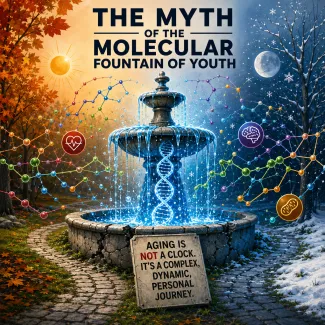
The result is not a biological clock where the right key would let us simply turn the hands back. Instead, the researchers describe a far more complex, chaotic system with multiple interacting trajectories that vary by cell type, genetics, circadian and seasonal rhythms, environmental exposure, and their subsequent interactions.
Precision Diagnosis: When is a biomarker a signal?
A conventional diagnostic test asks whether a measurement lies inside or outside some population-derived range. Precision medicine promises something more ambitious: molecular measurements that identify your disease risk or biological state.
But if the molecular measurement depends on time of day, season, environmental exposure, genetics, cell population, and the behavior of other biological systems, a single measurement becomes difficult to interpret. A rising biomarker could reflect deterioration, adaptation, compensation, or a transient variation. Precision medicine needs to understand a biomarker's changing trajectory relative to other markers over time. It will require moving from episodic snapshots to more frequent interrogation to generate movies of aging and disease.
Precision Treatment: Treating the cause, not the number
Treatment presents an even harder problem. We must separate a marker of aging from a mechanism of aging. Successful intervention must demonstrate not only “normalization” of the biomarker of concern but also a meaningful health improvement. With so many variables in play, identifying and treating the cause rather than the response is far more difficult.
Enter the Tech Bros and their Biological Clocks
This is where the findings in this study become especially uncomfortable for the technology-driven, quantified-self movement that offers greater wellness and longevity. The proposition is fundamentally computational: biology contains an enormous amount of information, but sufficiently comprehensive measurement combined with sufficiently powerful algorithms will extract the signal.
But the current study suggests that more data reveal greater complexity. Our biological systems follow distinct trajectories, and the environment and physiological cycles continually influence them. Beyond the difficulty of distinguishing molecular drivers from molecular reactors, our algorithms' recognition of 11 overarching molecular hubs captures only 10% of transcriptomic and 21% of metabolomic shifts, leaving the lion's share of biological behavior hidden in unexplained or individual noise. Finally, human biology rarely operates in isolated pairs, but through multi-way chains across genes, cellular environments, lifestyle, and time, generating billions, if not more, potential configurations and meanings. Multi-“omic” maps do not provide open-and-shut causal certainty; concluding that “You are 67 years old but biologically 54” seems suspiciously too reductive. The clinically useful question may eventually become: how is your biology changing, and do those changes predict something we can prevent?
Perhaps the problem is not simply that we lack enough molecular data, but that we are using the wrong metaphor to understand the data. If aging is less a clock and more a remodel, then turning back time may be the wrong goal. Another way of thinking about aging comes from a very different tradition.
Aging as Kintsugi: Repair Without Restoration
Another interpretation comes less from Silicon Valley than from the Japanese tradition of wabi-sabi. Wabi-sabi values impermanence, change, and imperfection, which seems unexpectedly close to the biology described in this study. Aging is active remodeling rather than a passive molecular condition that gradually accumulates defects along a single path.
The metaphoric companion to wabi-sabi is kintsugi, which treats damage and repair as meaningful parts of an object's history rather than flaws to be hidden. Broken pottery is repaired without attempting to erase the fracture. The seams remain visible, traditionally highlighted with gold. The vessel is not returned to its original state; it becomes something altered, repaired, and still whole.
This philosophical viewpoint reframes the uncertainty embedded in molecular data. The engineering mind views aging as faulty code awaiting debugging or a clock awaiting rewinding. An alternative, equally human Eastern view sees an active, lifelong negotiation among cellular maintenance, environmental exposures, and metabolic demand. Here, different paths and unexplained variations are the personalized biological seams of survival. As a vessel mended with gold, an aging body does not strive to restore a forgotten baseline; rather, it continuously integrates its history, restructuring its molecular networks to remain resilient, functional, and whole.
That distinction matters because precision medicine is naturally drawn to departures from youthful norms. But if some changes are adaptive, restoring every measure could misinterpret what successful aging actually requires. The goal cannot simply be to erase the evidence of time.
Wabi-sabi and kintsugi offer a useful counterpoint to the longevity movement's more exuberant promises. They do not argue for accepting preventable disease or romanticizing decline. Medicine should repair what it can. But repair does not always mean restoration; sometimes it means preserving function in a body altered by time, exposure, stress, and recovery. Rather than attempt mastery and make the old young again, perhaps the real role of medicine is identifying biological kintsugi, the repairs and modifications that permit an aging organism to remain functional despite everything that has changed
Source: "Longitudinal dynamics of gene expression and metabolomics in an ageing population cohort" Aging DOI: 10.1126/science.aed6452

Chuck Dinerstein, MD, MBA
Director of Medicine
Charles Dinerstein, MD, MBA, is the Medical Director of the American Council on Science and Health. A vascular surgeon with more than 25 years of clinical experience, he brings a physician's understanding of medical decision-making, an appreciation for scientific uncertainty, and a broader perspective on healthcare economics and policy to his writing.