
Britain's Sugar Rationing Became a Natural Experiment
In September 1953, Britain ended its decade-long rationing of sugar and sweets. Before that change, consumption was restricted to levels comparable to current dietary recommendations. As the graph shows, sugar consumption rose sharply, while consumption of 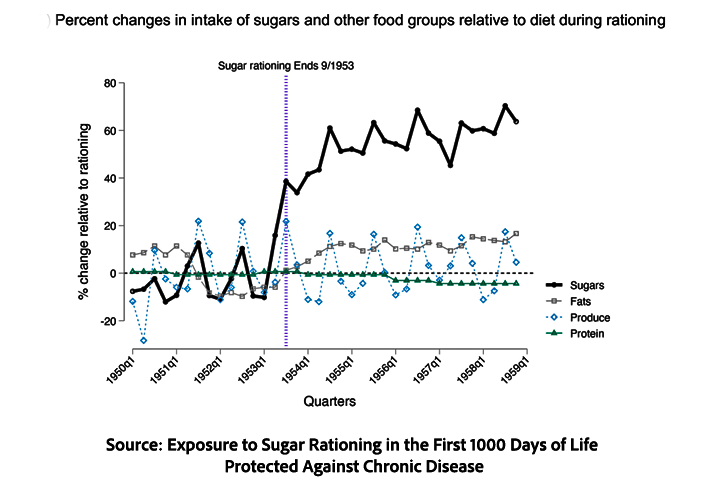 other major food groups remained relatively stable. The authors estimated that increased sugar consumption accounted for approximately 77% of the rise in total caloric intake.
This relative stability in other dietary components provides much of the rationale for treating the end of rationing as a natural experiment on the health impact of sugar.
Tracking the Lifelong Effects of Early Sugar Exposure
The research involved our old friend, the UK Biobank, specifically roughly 60,000 individuals born between October 1951 and March 1956. The timing of rationing served as a proxy for early-life sugar exposure, creating groups exposed to sugar rationing in utero and/or early childhood, or never exposed.
The investigators compared the rates and timing of two outcomes: type 2 diabetes and hypertension among participants now aged 51 to 66. Their models accounted for sex, race, birthplace, month of birth, survey year, geographic coordinates, and parental cardiovascular disease or diabetes.
Because this was Biobank data, the researchers found that the groups had similar measured genetic predispositions to obesity, based on their polygenic BMI scores. This strengthened the comparison but did not eliminate all possible genetic or environmental confounding. Most importantly, this was, at heart, an observational study, not a randomized clinical trial.
Less Sugar in Early Life, Lower Risk of Chronic Disease
Before jumping in, one important caveat. Sugar rationing limited how much sugar individuals could obtain; sugar restriction was assumed to be the resulting dietary exposure and the proposed mechanism for the subsequent health outcomes. We have no data on how much sugar a mother or child consumed, so we will inevitably have some uncertainty about whether sugar restrictions alone explain the outcomes.
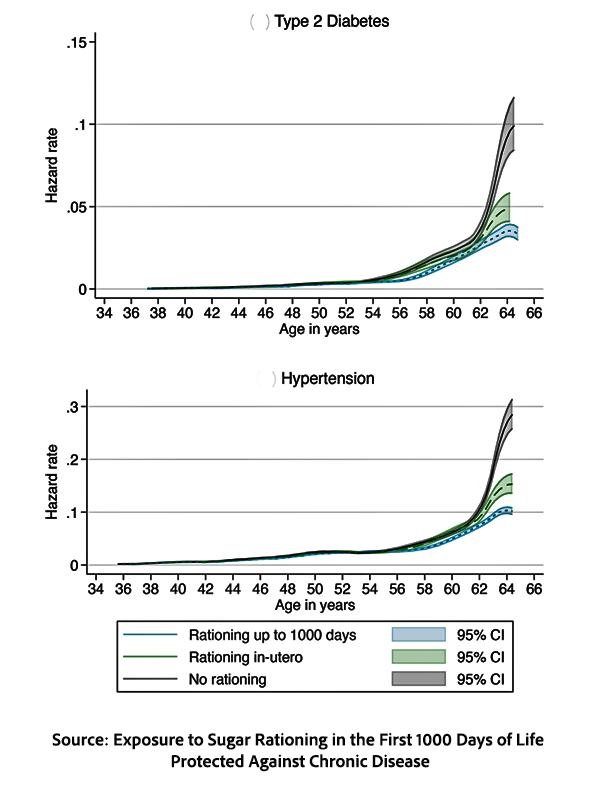 The researchers found that exposure to sugar rationing during gestation and early childhood was associated with a substantially lower risk of developing type 2 diabetes and hypertension decades later. Compared with those who had never experienced rationing, individuals exposed throughout gestation and for up to two years after birth had approximately 36% lower diabetes risk and 19% lower hypertension risk. These risks reflect the speed of onset of these two conditions and the trajectory that might eventually lead to increased incidence of diabetes and hypertension.
The duration of exposure mattered. As the graph shows, children exposed to sugar rationing in utero and during the first 2 years of life had the lowest risk of hypertension and diabetes, followed by those exposed only in utero. This suggests that both the intrauterine environment and infant nutrition may influence susceptibility to chronic disease.
It is also important to note that rationing delayed disease onset by half a year to several years. However, delaying disease is not the same as preventing it. Because the study followed participants only into their 50s and 60s, it cannot determine whether early sugar restriction permanently reduced the likelihood of disease or postponed its onset. Even a delay of several years can meaningfully extend our healthspan.
The benefits were not limited to diabetes and hypertension. Individuals exposed to rationing in utero and beyond their first birthday had approximately a 31% lower hazard of an obesity diagnosis. Body composition, measured by waist-to-height ratio, showed a more nuanced finding: a modest reduction in the proportion of individuals with elevated ratios, but no meaningful difference in average measurements.
These findings suggest that the consequences of what we eat in our earliest years may not become apparent until more than half a century later.
What We Inherit and What We Encounter
Chronic illness results from genetic susceptibility and environmental exposure. Because they interact, it is difficult to neatly apportion their individual contributions neatly. This study introduces another variable: the effect of an exposure may depend on when it occurs. This study finds that early-life environmental exposures may influence how inherited susceptibility ultimately manifests. This finding aligns with epigenetics, the chemical modifications and regulatory mechanisms that influence gene expression without changing the underlying DNA sequence.
Not all epigenetic changes are necessarily beneficial. Another natural experiment that comes to mind is the Dutch Hunger Winter, which occurred during the final months of German occupation, when official rations fell to approximately 500 calories a day. Researchers found that individuals whose mothers were pregnant during the famine had a higher incidence of coronary artery disease. Moreover, a study found that those same adults had lower DNA methylation in a regulatory region involved in fetal growth and development than their unexposed siblings sixty years later, providing direct molecular evidence that a relatively brief nutritional insult during early development can leave a persistent epigenetic signature.
Chronic illness is often considered a consequence of accumulated exposure: decades of dietary excess, smoking, environmental pollutants, or other insults gradually producing damage. That model is useful, but incomplete. Some exposures can have disproportionate effects during brief periods of biological vulnerability, and their consequences may not become clinically apparent until decades later. This lag creates a new concern. We often measure exposures only after symptoms or disease emerge and try to link them retrospectively. But what if the relevant exposures occurred before birth or during infancy, and we are merely chasing associations rather than causes?
Why the Timing of Exposure Matters for Public Health
We do not choose the environment we are born into. Maternal nutrition, household circumstances, food availability, and public policy, all socioeconomic determinants of health, may shape early exposure and influence future health before lifestyle choices become a meaningful factor.
None of this means that adult exposures are unimportant or that developmental influences predetermine disease. Rather, it suggests that the cumulative burden of exposure is only part of the story; the timing and biological context may matter just as much. A brief exposure during a critical developmental window could have consequences that persist long after the exposure ends.
The British sugar-rationing experience cannot tell us precisely which biological pathways were altered or whether those early advantages will persist throughout life. But the findings remind us that the origins of chronic illness may lie much further back in time than our conventional risk assessments are designed to capture.
Source: Exposure to Sugar Rationing in the First 1000 Days of Life Protected Against Chronic Disease Science DOI: 10.1126/science.adn5421

Chuck Dinerstein, MD, MBA
Director of Medicine
Charles Dinerstein, MD, MBA, is the Medical Director of the American Council on Science and Health. A vascular surgeon with more than 25 years of clinical experience, he brings a physician's understanding of medical decision-making, an appreciation for scientific uncertainty, and a broader perspective on healthcare economics and policy to his writing.