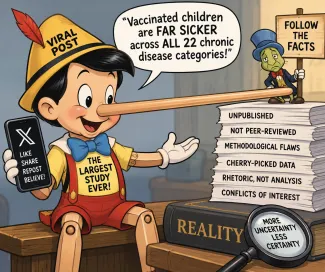
Here is the X headline
“The LARGEST vaccinated vs. unvaccinated birth cohort study EVER done shows vaccinated children are FAR SICKER across ALL 22 chronic disease categories”
If you read a few of the comments, you will run across an opinion by Grok, the X AI:
“No, the post is not fully truthful or reliable as scientific evidence. It accurately relays numbers and claims from a specific reanalysis of an unpublished draft, but presents them as definitive proof while ignoring major, well-documented methodological flaws that undermine the conclusions.”
For the sake of being “fair and balanced,” let’s jump down the rabbit hole, just a bit.
From Viral Claim to Unpublished Study
The “study” Mr. Hulscher, an epidemiologist, has authored is itself based on researchfrom Henry Ford Hospital in Detroit, and while it has not been peer-reviewed or published, it was presented to the US Senate in September 2025. Mr. Hulscher's study, the one subject to our trip down the rabbit hole, can be found here.
You can tell from the first paragraph that this is a publication with a viewpoint.
“This review article focuses on the disastrous outcomes of childhood vaccines as documented in the landmark study by Lamerato…. The effort undertaken by those authors was, in our view, courageous. …As Aaron Siri explained at the Senate Hearing on September 9, 2025 … the authors of the study in question were very much in the “I-believe-in-vaccines!” congregation before they undertook the study. …As Siri points out in his book about the vaccine religion, none of the prior backsliders from that religious faith seem to have ever thought to ask why the US Congress found it necessary in 1986 to make vaccine manufacturers immune to lawsuits ….”
Even before the data, let alone a discussion, vaccines produce “disastrous outcomes,” investigators are “courageous,” supporters belong to a “congregation,” and dissenters are “backsliders.” There is little neutrality here; the conflicts of interest are clear.
The rising tide of autism is mentioned more than once in this article, including in this graph.
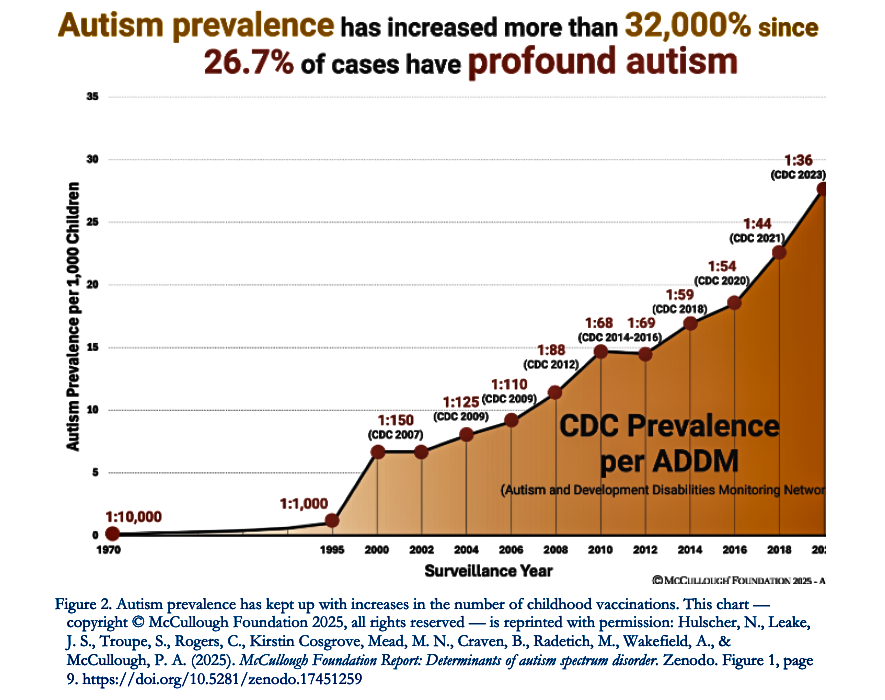
The graph does not come from the Lamerato study; it comes from a separate report by Mr. Hulscher, who writes:
“The surveillance numbers through 2022, summed up in Figure 2, emphatically confirm growth trends in chronic childhood diseases that were just beginning to be detected 50 years ago.”
What the Underlying Data Actually Show
If we turn, just for a moment, to the Henry Ford study that underlies Mr. Hulscher's report, and ignore the methodological flaws in comparing apples to oranges between the vaccinated and unvaccinated groups, and we call it ground truth, what do they report about vaccination and autism?
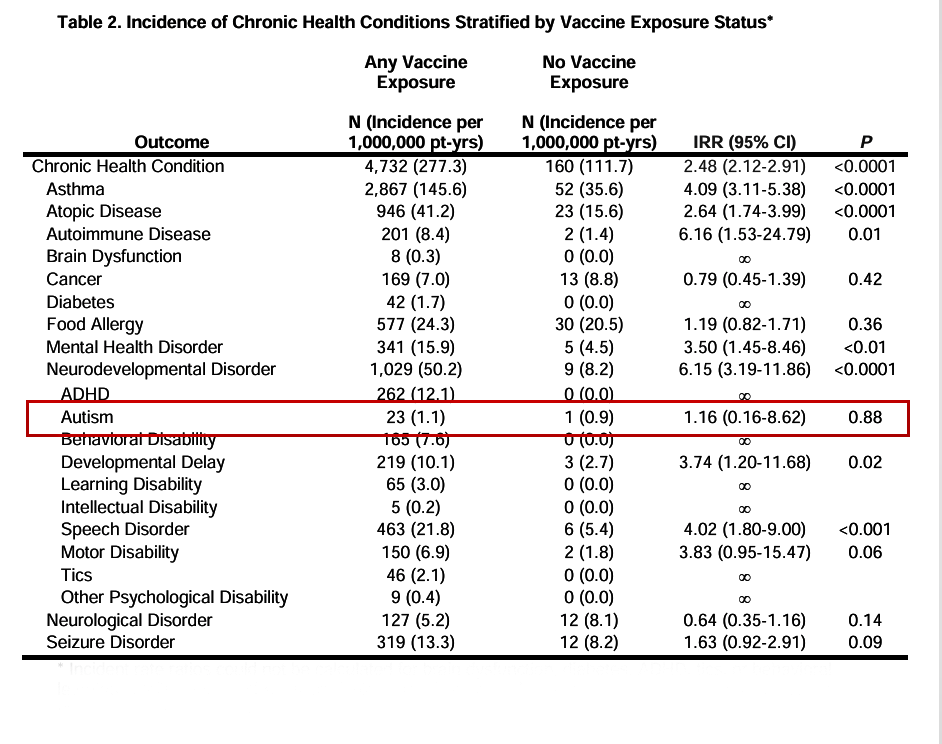
It seems that autism isn’t related to vaccination at all. Oops. Oddly, this finding never sees the light of day for Mr. Hulscher.
The ‘Money Machine’ Claim
Moving on. I was taken by this moment of economic analysis:
“The present schedule for the ‘childhood vaccines,’ which is the money machine at the center of the pharmaceutical industry…”
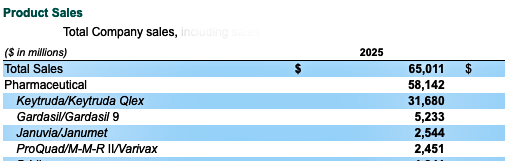 While vaccines are a source of revenue, we once again have rhetoric masquerading now as financial analysis. Consider Merck’s Securities and Exchange Commission filing. They manufacture two vaccine products, Gardasil and ProQuad. And while those two generate a bit more than 10% of Merck’s revenue, Keytruda, a cancer drug, generates fourfold more. If vaccines are the industry's financial center, the industry's own balance sheets have apparently failed to notice.
Rhetorical sleight of hand
Mr. Hulscher makes a valid point, captured in this general rule of thumb. The absence of evidence is not evidence of absence; that is, that just one case of autism caused by vaccines is sufficient to disprove the notion that vaccines cannot cause autism.
The proposition that vaccines are not a cause of autism is not subject to scientific verification. Epidemiologic studies consider whether vaccination is associated with an increased risk of autism – they make no claim that vaccines can conceivably cause autism. This nuance has echoes in the public health back-and-forth over whether an individual died from or with COVID.
Epidemiologic studies ask whether vaccination is associated with an increased risk of autism in populations, usually estimating an effect size and its uncertainty. A study finding no increased risk is not claiming to have logically proved that no vaccine could conceivably contribute to autism in any individual.
However, to prove his point, Mr. Hulscher turns to one pivotal case, the story of Hannah Poling.
“The null hypothesis that autism cannot be caused by vaccines was disproved in a dramatic empirical court case decided on September 15, 2010, when a federal Vaccine Court (formerly the People’s Court) awarded more than $20 million dollars to Hannah Poling’s family, acknowledging that her diagnosis of severe autism was caused by vaccines.”
I will let Paul Offit, writing contemporaneously in the New England Journal of Medicine, describe the case.
“When she was 19 months old, Hannah, the daughter of Jon and Terry Poling, received five vaccines — diphtheria–tetanus–acellular pertussis, Haemophilus influenzae type b (Hib), measles–mumps–rubella (MMR), varicella, and inactivated polio. At the time, Hannah was interactive, playful, and communicative. Two days later, she was lethargic, irritable, and febrile. Ten days after vaccination, she developed a rash consistent with vaccine-induced varicella.
Months later, with delays in neurologic and psychological development, Hannah was diagnosed with encephalopathy caused by a mitochondrial enzyme deficit. Hannah's signs included problems with language, communication, and behavior — all features of autism spectrum disorder. Although it is not unusual for children with mitochondrial enzyme deficiencies to develop neurologic signs between their first and second years of life, Hannah's parents believed that vaccines had triggered her encephalopathy.”
Hannah’s parent took their claim to the National Vaccine Injury Compensation Program (VICP), where the government conceded that compensation for Hannah’s lifelong care was appropriate – finding that the vaccination had significantly aggravated an underlying mitochondrial disorder; a case of with not from.
While the headlines misstated that the government finally admitted that vaccines caused autism, a closer look at the decision reflects a very different finding. Hannah’s parents were compensated under a “Table Claim,” a shortcut built into the VICP. A vaccine injury table lists particular vaccines, injuries, and time intervals in which the injury must be documented to have occurred. Proving all three elements presumes causation; there is no requirement or need to prove the claim scientifically.
Compensation for a Table Injury is not an affirmative scientific finding. Several subsequent cases before the Vaccine Court have followed Poling’s Table Claim pathway, but cases attempting to extend the Court’s findings that vaccines cause autism have not succeeded.
Certainty Outruns the Evidence
The problem with this “study” is not that its authors have a point of view. Scientists have points of view. The problem is that the certainty of their point of view repeatedly outruns the evidence. The underlying Henry Ford data find no significant association between vaccination and autism—the very result that should give such certainty pause.
That makes terrific material for X. It makes considerably poorer science. When the rhetoric outweighs the data, the most important finding may not be what the study tells us about vaccines, but what it tells us about the people interpreting it.

Chuck Dinerstein, MD, MBA
Director of Medicine
Charles Dinerstein, MD, MBA, is the Medical Director of the American Council on Science and Health. A vascular surgeon with more than 25 years of clinical experience, he brings a physician's understanding of medical decision-making, an appreciation for scientific uncertainty, and a broader perspective on healthcare economics and policy to his writing.