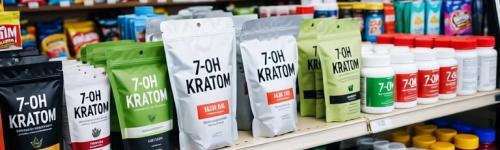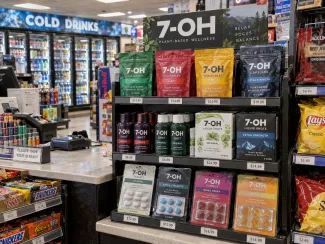
Dr. Singer’s article on kratom’s concentrated active ingredient, 7-hydroxymitragynine, left me uneasy, something I rarely experience when considering Dr. Singer’s views on pain medications and the Iron Law of Prohibition. That unease first prompted deeper reflection and then a desire to share a few thoughts. Let’s get into it.
Kratom and 7-OH: A Difference That Matters
The μ (mu)-opioid receptor is the principal target of familiar opioids such as morphine and fentanyl. Kratom’s principal alkaloid, mitragynine, is converted in the liver into the 7-OH form, a μ-opioid receptor agonist with substantially greater opioid activity than mitragynine, including greater pain-suppressing effects in animal studies. Although naturally present in trace amounts in kratom leaves, 7-OH can be concentrated into products that deliver substantially greater opioid activity.
This means there is a meaningful biological distinction between consuming ordinary kratom leaves and consuming a tablet containing concentrated 7-OH. When consumed as kratom leaves, the conversion of mitragynine to the 7-OH form puts an upper limit on the amount of 7-OH formed and provides pain relief. It also limits the fellow travelers of μ opioid receptor activation, i.e., euphoria, sedation, dependence, and respiratory depression.
Animal studies suggest that the body's conversion of mitragynine to 7-OH may limit some of its opioid effects. In mice, investigators observed a ceiling on mitragynine-induced respiratory depression, whereas directly administered 7-OH produced increasing respiratory depression with increasing doses. Whether this apparent protection extends to humans consuming traditional kratom remains uncertain. Despite the uncertainty, these findings support treating concentrated 7-OH as a distinct pharmacological exposure, rather than assuming it shares the risk profile of traditional kratom.
The evidence of harm is no longer confined to laboratory animals. Published case reports describe patients who developed opioid-like dependence and withdrawal after using concentrated 7-OH, sometimes requiring treatment with medications such as buprenorphine. These reports do not indicate how often dependence develops, at what doses, or among which users. But dependence itself appears to be a demonstrated clinical hazard.
A Warning Signal, Not a Risk Estimate
In July 2026, America's Poison Centers reported a sharp rise in exposures involving 7-OH, from 593 cases in all of 2025 to 901 during the first six months of 2026. Among cases involving 7-OH alone, approximately 20% resulted in hospitalization. The CDC notes that roughly 25% of kratom exposures result in hospitalization. They go on to note that,
“The large increase in 2025 coincides with the emergence of high-potency, semisynthetic formulations, including 7-hydroxymitragynine.”
Poison-center cases are a selected population, not a representative sample of users, and the data cannot establish the true incidence of serious injury from consuming 7-OH, especially since many of the cases involve other substances. However, they constitute an additional safety signal that I believe deserves investigation.
Caught Between Approval and Prohibition
The pharmacological activity of 7-OH creates foreseeable obligations for manufacturers. The FDA regulates medications not because patients are incapable of making decisions, but because manufacturers must substantiate claims about safety, efficacy, identity, strength, and quality.
Conducting the necessary Phase I-III trials requires a considerable investment of time and money. FDA oversight of a claim that 7-OH is a medication indicated for pain relief can become a de facto prohibition, especially when manufacturers lack the financial incentives or capacity to run clinical trials. That has been the argument made around regulations involving vape products.
Dr. Singer cites individuals who report using 7-OH to manage pain and reduce reliance on other opioids. These testimonials, as a form of harm reduction in opioid dependence, should be neither wholly accepted nor ignored. A rigorous evaluation must consider both the harms of continued availability and the harms of restricting availability.
From an economic and practical standpoint, regulating 7-OH as a medication is unlikely. Perhaps 7-OH could be considered a supplement.
Under the Dietary Supplement Health and Education Act, manufacturers generally bear responsibility for demonstrating that their products meet applicable safety requirements, with the FDA relying on postmarket enforcement.
In July 2025, FDA explicitly stated that concentrated 7-OH is not lawful in dietary supplements or as an added conventional-food ingredient, and that no FDA-approved medication contains it. In December, they began seizing 7-OH products. FDA has separately concluded that kratom itself cannot lawfully be marketed as a dietary supplement under existing safety requirements.
With concentrated 7-OH excluded from lawful supplement marketing and no FDA-approved medication containing the compound, manufacturers face a difficult choice: undertake expensive clinical development or remain outside lawful marketing channels. FDA has already used its enforcement powers against these products and has now chosen to resort to a more blunt weapon, the Controlled Substances Act, requesting that the drug be classified as a Schedule 1 drug, [1] adding potential criminal sanctions to the existing regulatory barriers.
When Schedule I Comes With an Exception
In October 2026, the DEA proposed classifying 7-OH as the FDA recommended, with an unusual qualification. Rather than controlling every detectable amount of 7-OH, it uses concentration and composition thresholds to distinguish products subject to Schedule I restrictions from those outside the proposed control. I could not identify a similar decision regarding a Schedule 1 drug, although it resembles the concentration-based distinction historically made between marijuana and hemp.
Dr. Singer is correct that a concentration threshold is not necessarily a scientifically adequate measure of toxicological risk or a basis for imposing criminal penalties. The FDA argues that these distinctions [2] are intended to distinguish concentrated formulations from botanical kratom, not to define a safe human dose.
But this distinction raises a paradoxical question that Dr. Singer is happy to ask.
Schedule I decisions ordinarily reflect judgments about a substance, not its composition in a marketed product. If regulators really want to control composition, why use a criminal drug-scheduling mechanism?
Dr. Singer reasonably argues that the government should show that prohibition improves public safety. But that does not resolve the separate question of whether manufacturers have a responsibility to demonstrate an acceptable benefit-risk profile before selling concentrated opioid-active substances.
Dr. Singer does suggest accurate labeling, independent testing, age restrictions, and enforcement against fraud. All are reasonable safeguards, but they address primarily what is in the product, who can purchase it, and how it is marketed. They do less to characterize the intrinsic hazards of consuming a potent opioid agonist at varying doses. A precisely labeled product can still produce dependence or respiratory depression.
There remains an asymmetry in his burden of proof: the government must establish the benefits of restricting access, but manufacturers are not explicitly required to establish the safety of providing access.
This is not merely a disagreement over whether government should protect consumers from themselves. It is a disagreement over what consumers must know to make a meaningful choice. The right to assume risk is not quite the same as the ability to assess it.
The Right to Choose Requires the Right to Know
I return to my oft-quoted remark from Sy Syms, “An educated consumer is our best customer.” Informed consent requires more than willingness to take a risk. Consumers may knowingly accept the hazards of opioids, but can they meaningfully consent when product concentrations vary, and appropriate dosing has not been established? Warnings about dependence or interactions may be inadequate. Autonomy without reliable information is an incomplete freedom.
Dr. Singer is right that criminal law is a poor substitute for scientific inquiry, and that prohibition carries risks of its own. But the absence of evidence supporting prohibition does not establish that unrestricted sales are safe. The government should bear the burden of demonstrating that its restrictions improve public health. In contrast, manufacturers should bear the burden of providing credible information about what they sell and the risks consumers assume.
Perhaps the real problem is not that we lack sufficient evidence to choose between prohibition and permission, but that our regulatory framework offers too little room between them. We should not have to choose between criminalizing a potentially useful substance and allowing manufacturers to sell a potent opioid-active product without adequate safeguards. Can we create a regulatory middle ground that protects both public health and individual freedom?
[1] A Schedule 1 drug has a high potential for abuse, no currently accepted medical use in treatment in the United States, and a lack of accepted safety for use under medical supervision.
[2] 7-OH is subject to Schedule I if the product contains more than 1 mg of covered alkaloids per gram of solid material or per milliliter of liquid, or has a mitragynine-to-covered-alkaloid ratio below 100:1.

Chuck Dinerstein, MD, MBA
Director of Medicine
Charles Dinerstein, MD, MBA, is the Medical Director of the American Council on Science and Health. A vascular surgeon with more than 25 years of clinical experience, he brings a physician's understanding of medical decision-making, an appreciation for scientific uncertainty, and a broader perspective on healthcare economics and policy to his writing.