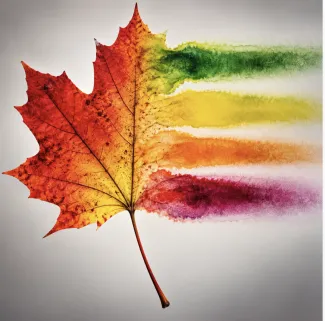
Every fall, trees put on one of nature's most spectacular chemistry shows. Green disappears. Yellow and orange emerge. Reds and purples seemingly come out of nowhere.
They don't, of course. Molecules are responsible for the whole show.
One of the best places I've ever seen it is Skyline Drive, the 105-mile road that meanders through Shenandoah National Park in Virginia, just a hop, skip, and a jump from Charlottesville, where I got my degree.
Spare me the "Was Thomas Jefferson there with you?" old-age jokes. Not even remotely original. And he was there a few years before me.
If you can't get to Skyline Drive, New England, or somewhere else where trees put on their annual dazzling show, perhaps learning the chemistry behind it will suffice. But probably not.
Too bad. You're getting a Dreaded Chemistry Lesson From Hell® anyhow.
Even Steve (left) and Irving, perpetually miserable residents of Hell, can get into the spirit of autumn. It helps that they're big fans of The Mamas and the Papas.
Why are leaves green in the first place?
For most of spring and summer, the color of a healthy leaf is dominated by chlorophyll, the pigment responsible for capturing light energy during photosynthesis.
There are several chlorophylls, but chlorophyll a and chlorophyll b [1] are the major forms in plants. Both forms absorb strongly in the blue and red regions of visible light but poorly in the green. (The primary light colors are red, green, and blue, as I wrote about here.) Much of that green light is reflected or transmitted, which is why leaves look green.
But chlorophyll isn't alone in there.
Leaves also contain carotenoids, a family of yellow, orange, and sometimes reddish pigments. Two important groups in the carotenoid family are the carotenes, such as β-carotene, and the xanthophylls, such as lutein.
You usually don't see these other pigments in warm weather because chlorophyll overwhelms them.
Until autumn.
It's Autumn: Green Gets a Pink Slip
As days shorten and trees prepare for winter, chlorophyll production slows, and the chlorophyll already present takes a one-way walk on the wild side.
Chances are that Lou Reed never expected to be participating in a Dreaded Chemistry Lesson From Hell®. Especially since he's dead.
Once enough chlorophyll disappears, something interesting happens.
Yellow and orange appear.
But for the most part, these pigments didn't suddenly show up in October. They were there all along. The disappearance of chlorophyll simply unmasks carotenoids that had been hiding underneath all that green.
So much for yellow and orange.
Red is another story.
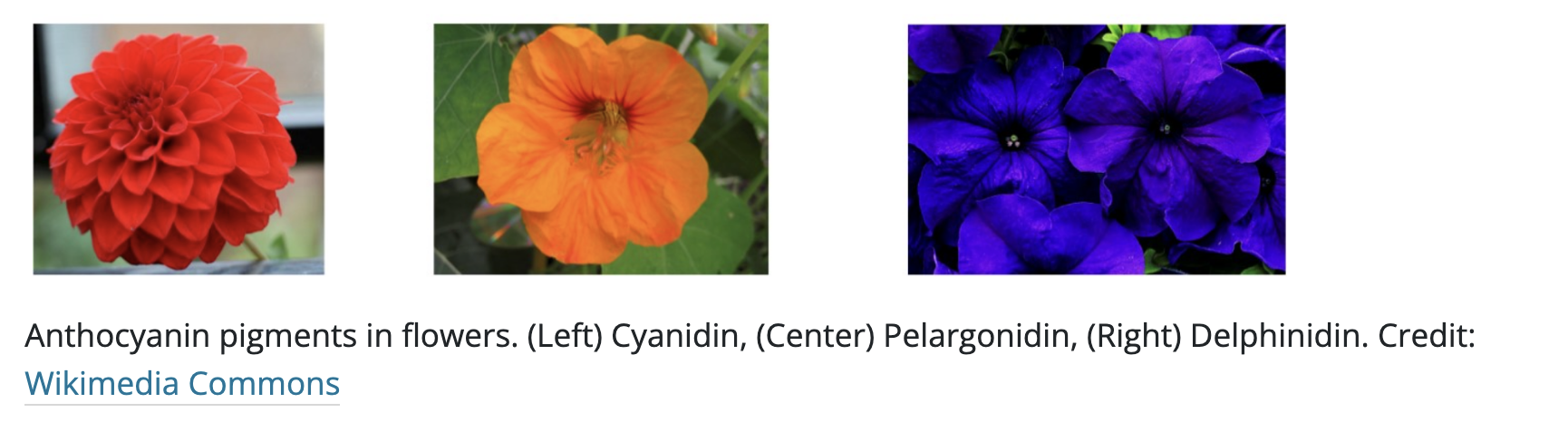
The brilliant reds and purples of maples and some other trees come primarily from another family of pigments: anthocyanins.
Unlike the carotenoids already present in the leaf, anthocyanins are often synthesized during autumn. This raises an obvious question. Why would a tree expend energy making new molecules in a leaf it's getting ready to throw away?
There is no universally accepted answer. One leading hypothesis is that anthocyanins provide photoprotection, acting somewhat like sunscreen while the tree recovers valuable nutrients from the dying leaf. Antioxidant and other protective roles have also been proposed. Whole Foods for Trees doesn't sell it yet.
Whatever they're doing for the tree, they're doing wonders for Skyline Drivers.
Anthocyanin chemistry is especially interesting because these pigments can produce colors ranging from red through purple and even blue. Molecular structure matters, but so do pH and the chemical environment inside the plant cell.
So autumn color isn't one chemical event. It's at least three:
- Green chlorophyll is destroyed.
- Yellow and orange carotenoids are unmasked.
- Red and purple anthocyanins are synthesized.
Not bad for a dying leaf.
Taking a leaf apart
Here's where we get to play chemist.
When I was a teaching assistant at UVA, while simultaneously trying to teach organic chemistry to pre-med students and prevent them from blowing themselves up, I supervised a cute experiment involving spinach leaves.
It's called thin-layer chromatography, or TLC.
Spinach works beautifully for this because it's loaded with chlorophylls and carotenoids. Grind it up with an organic solvent, and you get an ugly dark-green mixture containing a bunch of different molecules.
To your eye, it's green glop.
To a chemist, it's an invitation.
A small amount of the extract is placed near the bottom of a plate coated with silica gel. The bottom of the plate is then placed in a solvent, which climbs the plate by capillary action.
The pigments go along for the ride.
But they don't all travel at the same speed.
Chemistry becomes a horse race
Silica is polar. Molecules that interact strongly with it tend to hang back, while those that interact less strongly spend more time traveling with the solvent and move farther up the plate.
The result is separation.
Instead of one dark-green blob, different colored bands begin appearing at different positions on the plate.
There's one catch with my old spinach experiment: spinach doesn't give us the red or purple anthocyanin pigments that contribute to some of the most spectacular fall colors.
So I've cheated.
Just a little.
For the illustration below, I've added anthocyanins to the TLC plate so that it represents the major pigment families involved in fall color rather than the literal contents of our undergraduate spinach extract.
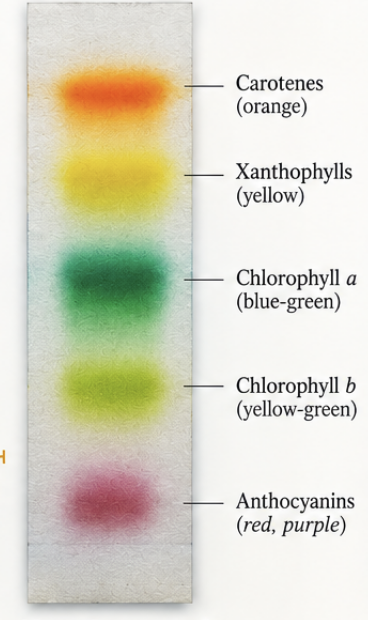
Figure 1. A hypothetical thin-layer chromatography plate separating the colors found in leaves. Thin-layer chromatography separates a mixture of leaf pigments (or anything, really) according to their different affinities for the silica on the plate. Anthocyanins are included here to represent the full palette of fall colors; they are not present in spinach. Even if they were, they would barely budge up the plate.
Now we can see the whole palette: carotenes, xanthophylls, chlorophylls, and anthocyanins that would otherwise be mixed together in plant tissue.
This is one of the things I've always liked about chromatography. Most chemistry is invisible. You don't normally get to watch molecules behave differently because of their structures.
With plant pigments, you can.
But TLC is a quick-and-dirty method in chemical research. Chemists now have considerably fancier toys.
HPLC: TLC on steroids
One of them is high-performance liquid chromatography, better known as HPLC.
HPLC plays the same game as TLC, only with much fancier equipment and much better resolution. Molecules still "choose" between hanging around with the stationary phase (frequently silica) and taking off with the solvent. Those different preferences, which are governed (mostly) by polarity, are what separate them.
Instead of watching solvent creep up a silica-coated plate, liquid is pumped under high pressure through a thin column. Different molecules spend different amounts of time interacting with the stationary phase, so they emerge from the column at different times.
What appeared to be one colored mixture can now become a forest of individual signals. A detector records them as peaks. Since most compounds aren't conveniently colored, HPLC commonly uses ultraviolet light to detect them.
For the figure below, I'm again "cheating" by including the major pigment families responsible for fall colors, not pretending that everything came from our spinach extract.
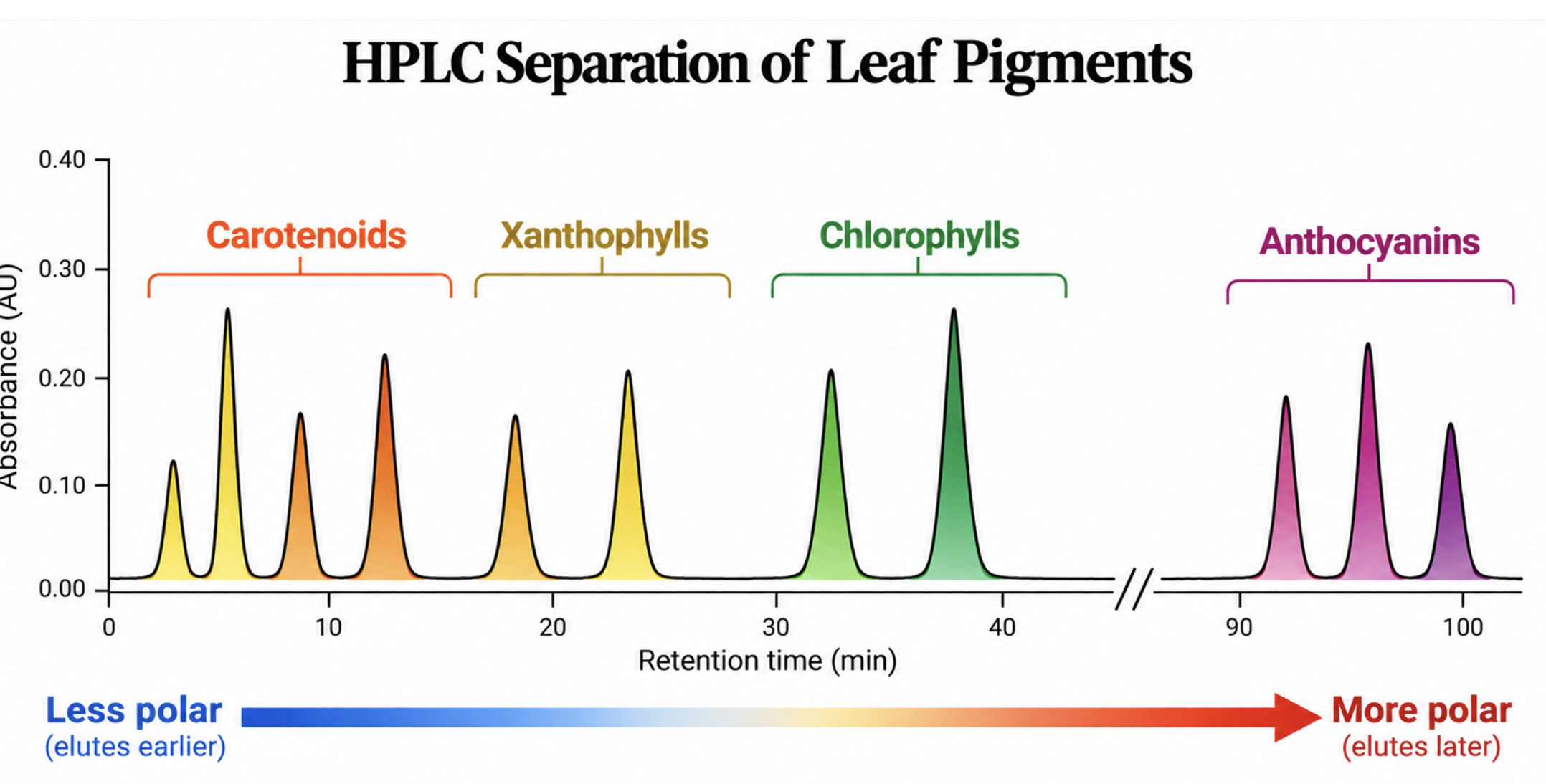
Figure 2. A cartoon HPLC chromatogram illustrating the relative polarities of the major pigment families responsible for fall colors. As with the TLC example, the nonpolar carotenes emerge first. Anthocyanins are shown after the break because of their much greater polarity; in practice, they would generally be analyzed separately under different chromatographic conditions.
All the Leaves are Brown
Back to Michelle Phillips. Eventually, the tree seals off the connection to the leaf. Pigments continue to break down, cells die, brown compounds increasingly dominate, and the leaf finally drops.
What looks like a simple progression from green to yellow, orange, red, purple, and finally brown is actually the visible result of a remarkable collection of biochemical processes.
Some molecules disappear. Others that were there all along are revealed. Still others are manufactured almost on cue.
And chromatography lets us take the colorful mess apart and see some of the molecules responsible.
So enjoy the leaves while you can.
Unlike the Yankees, they generally don't disappoint in October.

Josh Bloom
Dr. Jonathan (Josh) Bloom, ACSH's Director of Chemical and Pharmaceutical Sciences, earned his Ph.D. at the University of Virginia and completed postdoctoral training at the University of Pennsylvania. During his 20-plus years in drug discovery at Wyeth, his research group discovered the antibiotic Tygacil®, approved in 2005. He holds 25 issued patents and has authored 35 academic papers. Since joining ACSH in 2010, he has written more than 2,000 articles and dozens of op-eds for major newspapers, including The Wall Street Journal and Chicago Tribune.