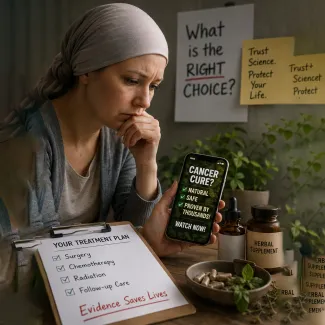
Few situations generate as much uncertainty and anxiety as the possibility of a cancer diagnosis. Before confirmation, patients and their families often face an avalanche of questions about the severity of the illness, treatment, and recovery. Unfortunately, this experience is far from rare. More than 2.1 million Americans are expected to receive a cancer diagnosis in 2026, and more than 626,000 are expected to die from the disease. Beyond its physical consequences, cancer can have a profound psychological impact.
A qualitative study published in Cancers, which interviewed 43 adolescents and young adults affected by cancer, found that anxiety, uncertainty about the future, fear of recurrence, and feelings of isolation were common patient experiences. Many described feeling overwhelmed and emotionally drained following diagnosis.
In this context, patients often begin actively searching for information. While physicians remain central sources of guidance, social media platforms, online communities, and influencers now provide a continuous stream of advice, personal testimonies, and proposed solutions for those seeking a sense of control amid uncertainty.
Among the wide range of information circulating online are diets, natural remedies, and alternative cancer treatments that are frequently promoted as safer, natural, or even more effective than conventional medical care. Some of these approaches are harmless or simply ineffective, while others have led patients to delay or abandon treatments that improve survival. Jessica Ainscough, an Australian blogger known as “The Wellness Warrior,” who was diagnosed with a rare cancer, declined the surgery recommended by her physicians and instead pursued Gerson Therapy. She died in 2015 at the age of 30.
When individuals facing life-threatening illness encounter misinformation disguised as hope, the consequences may extend beyond wasted time or resources and directly affect survival. Cases such as Ainscough’s illustrate that discussions about alternative cancer therapies go beyond questions of personal preference.
Cancer Misinformation
People’s ability to recognize health misinformation on social media is limited. As described in a review published in CA: A Cancer Journal for Clinicians, social networks facilitate the spread of misinformation through content produced by sources lacking institutional oversight, echo chambers, and confirmation bias.
A nationally representative survey of 5,041 users in the United States found that two-thirds had difficulty distinguishing true from false content.
The problem is often amplified by sensationalist messaging that highlights benefits while downplaying uncertainty or potential harms. This is especially evident in audiovisual content, which has increasingly become a major source of medical information.
A study analyzing 831 cancer-related TikTok videos identified a high prevalence of misinformation, distortion of scientific understanding, and promotion of alternative health narratives. Another study of Instagram posts found that approximately 90% of 126 prostate cancer–related media sources were low to moderate quality, and about 40% contained significant misinformation. In a survey of 2,183 healthcare professionals, 94.2% reported encountering patients who brought misinformation into clinical consultations in the previous year.
These findings suggest that the problem lies not only in the volume of misleading information but also in people's ability to recognize it.
The Appeal
These trends coexist with the growing use of complementary and alternative medicine (CAM). Data from the NIH’s National Center for Complementary and Integrative Health indicate that CAM use has doubled since 2002, reaching 36.7% of U.S. adults in 2022.
Online, conventional, and alternative health content differ markedly in how they convey information. Conventional medicine tends to pair educational material with references to expertise and institutional sources, whereas alternative health content relies more heavily on personal testimonials and emotionally engaging narratives. This approach aligns particularly well with the persuasive dynamics of social media, where patients often seek not only information but also reassurance, hope, and a sense of personal connection.
Influencers promoting alternative therapies often appeal to these needs by offering simpler, less burdensome narratives of care. Empirical evidence supports this pattern. A study analyzing more than 1.6 million posts about cancer and alternative medicine found that positive content often emphasized symptom improvement, enhanced well-being, reduced medication use, and relief from treatment-related side effects.
Other posts highlighted adverse outcomes, potential interactions with conventional therapies, and the lack of scientific support for many interventions. Some also discussed cases such as Jessica Ainscough's, in which delaying or refusing conventional treatment led to poor outcomes. Patients actively use these platforms to share experiences and seek guidance on cancer treatment.
The evidence suggests that misinformation can shape perceptions of risk and benefit, influence treatment decisions, and increase the appeal of interventions that have not demonstrated meaningful clinical effectiveness. The consequences of these decisions become clearer when clinical outcomes are examined.
The Risks
A study published in JAMA Network Open examined the association between CAM use and survival among patients with breast cancer. Researchers analyzed data from the National Cancer Database, which covers about 70% of new cancer cases in the United States. Patients were classified into four treatment groups: traditional therapy alone, CAM alone, combined CAM and conventional therapy, and no treatment.
Nearly all of the 2 million-plus patients received traditional therapy (97.6%), while fewer than 0.1% used CAM alone or combined CAM with conventional treatment, and 2.3% received no treatment. So, caveat one, the CAM sample is very small, roughly 500 patients.
Five-year overall survival was highest in the traditional therapy group, followed by the combined therapy, CAM alone, and no treatment.
After adjustment, all non-standard approaches showed higher mortality when compared with traditional therapy:
- Combined therapy a 1.45-fold higher risk.
- CAM alone showed a 3.67-fold higher risk
- No treatment a 3.53-fold higher risk
To better understand the unexpected mortality observed in the combined group, the authors examined treatment patterns. Most patients receiving combined therapy still underwent surgery, but differences in systemic and adjuvant treatments were observed, particularly in hormonal and radiotherapy. It was unclear to what extent social media influenced patients to adhere less to effective interventions or to replace evidence-based treatments.
In addition to the small sample size, the study has important limitations. It is observational and does not establish causality, nor can it distinguish between patients who adhered strictly to conventional therapy while using CAM and those who partially substituted standard care.
This does not imply that all complementary interventions are harmful, nor that they cannot support symptom management or quality of life when used alongside evidence-based care. But the distinction between complementary and alternative is not semantic; it is clinical. Practices that help patients cope with treatment are different from those that delay, replace, or undermine treatments known to improve survival.
The danger is greatest when misinformation reframes evidence-based medicine as toxic, impersonal, or optional, while portraying unproven therapies as natural, empowering, or curative. For patients facing cancer, hope is essential, but hope detached from evidence can be dangerous.
In the end, when health is at stake, trading evidence for belief is rarely a good strategy.