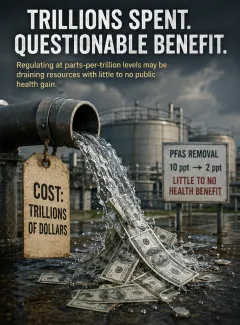
American industry faces a significant regulatory challenge: the near-total eradication of PFAS chemicals. Driven by an emotional and, at times, unscientific narrative, the EPA and state legislatures are establishing maximum contaminant levels in the single-digit parts-per-trillion range. This is not just a compliance hurdle—it is a serious societal issue. Total remediation and litigation costs are projected to consume hundreds of billions of dollars from the American economy over the next decade. But what if the foundational science driving these near-zero thresholds is largely or even completely wrong?
Last month, in June 2026, a groundbreaking trifecta of papers [1] was published by me and US and international colleagues. These data provide the empirical basis needed to challenge these rules and restore scientific integrity to environmental policy.
The Zero-Risk Assumption Under Fire
For fifty years, the EPA has operated under a default assumption regarding risk: the Linear Non-Threshold, or LNT, model. This model assumes that any exposure above zero carries a proportional risk of harm. Under this logic, if high doses of PFAS are toxic, then ultra-low parts-per-trillion doses must be marginally toxic, justifying total elimination. Our recent review article, spanning mammalian cell lines, animal models, and botanical systems, has challenged this assumption.
What the New PFAS Science Actually Shows
We found that per- and polyfluoroalkyl substances (PFAS) can induce hormesis—a biphasic dose-response relationship characterized by low-dose stimulation and high-dose inhibition. These findings challenge conventional linear non-threshold (LNT) models and suggest that hormesis should be integrated into ecological and human risk assessment practices.
Among the key findings:
- PFAS-induced hormetic responses are commonly reported in human and animal primary cells and cell lines across multiple organ systems, including the liver, lung, colon, breast, prostate, brain, and immune system.
- Hormetic effects are successfully induced by both historical long-chain PFAS agents and shorter-carbon-length alternative PFAS replacements, showing similar overall dose-response features.
- Although more limited than in vitro data, experimental animals exposed to PFAS agents exhibit hormetic dose responses in both short-term and chronic (104-week) studies.
The findings complicate regulatory hazard interpretations, as some low-dose hormetic stimulations may represent beneficial adaptations (e.g., extended lifespan in rats or anti-inflammatory protection), while others may present potentially harmful outcomes (e.g., promoting tumor cell line progression or increasing osteoporotic effects).
At parts-per-trillion levels, PFAS act as mild stressors that trigger cellular preconditioning and upregulate protective antioxidant pathways. In short, the EPA is regulating a zone of biological adaptation as if it were a zone of toxic injury.
A Trillion-Dollar Regulatory Gamble
Right now, billions of dollars are being diverted away from corporate R&D, infrastructure growth, and job creation to build complex filtration systems. Water utilities, manufacturers, and aerospace firms are being forced to chase 'chemical shadows'—filtering water and soil down to near-zero levels.
If the 2026 UMass Amherst findings are correct—and the peer-reviewed evidence is clear—then cleaning water from 10 parts per trillion to 2 parts per trillion yields little public health benefit. We are spending trillions of dollars to solve a public health problem that, at these low doses, does not exist. This is a major misallocation of our national resources.
Time to Reset America's PFAS Strategy
Federally, we are seeing some regulatory relief, with the current administration’s EPA extending compliance deadlines and pausing certain unworkable standards. However, a concerning fragmentation is occurring at the state level. State legislatures are ignoring federal relief and passing sweeping bans. For example, New Jersey recently banned intentionally added PFAS in consumer products, while Maine continues to enforce aggressive bans on textiles. Furthermore, Congress continues to debate the reintroduced Forever Chemical Regulation and Accountability Act, which seeks to phase out all non-essential uses.
Our message to policymakers must be clear: state-level bans and federal overreach rest on outdated assumptions and do not reflect the toxicological realities of 2026.
These findings demand a three-part response:
1. Convene an Emergency Scientific Review. Petition the EPA to pause PFAS rulemaking until an independent Science Advisory Board evaluates the June 2026 UMass Amherst findings.
2. Require Risk-Risk Analysis. Regulators must weigh the economic and public health costs of compliance against demonstrable health benefits. Rules that impose billions in costs while targeting biologically adaptive, sub-toxic exposure levels fail a credible cost-benefit test.
3. Clarify the Legal Standard for Adverse Effects. Courts should distinguish genuine toxic injury from normal biological adaptation, ensuring that regulatory decisions and litigation are grounded in contemporary toxicological evidence rather than outdated assumptions.
By shifting the regulatory focus away from ambient tracking and toward cumulative, long-term tissue burden, it is possible to protect public health where it matters most without bankrupting the American supply chain. Persistence does not automatically equal peril. The fact that a chemical is a 'forever chemical' does not mean it is a 'forever toxin' at every single dose. This brief summary is intended to provide an empirical roadmap for restoring objectivity, economic balance, and scientific rigor to Washington. It needs to be used to protect American innovation, safeguard our industries, and demand a regulatory framework built on facts, not fear.
[1] Hormesis in biomedical and toxicological models: A generalizable phenomenon induced by per- and polyfluoroalkyl agents
Hormetic effects of per- and polyfluoroalkyl substances on ecologically relevant animal models: Generality, quantitative features, and risk assessment implications
Hormesis in plant systems: A widespread and highly generalizable phenomenon induced by per- and polyfluoroalkyl substances
Sources: Hormesis in biomedical and toxicological models: A generalizable phenomenon induced by per- and polyfluoroalkyl agents Chemico-Biological Interactions DOI: 10.1016/j.cbi.2026.112222