
Apparently, beef tallow isn't just good for frying potatoes or replacing those murderous seed oils anymore.
The geniuses on TikTok are yapping about how it's a great (and natural) sunscreen. And it shouldn't be the least bit surprising that the stuff is being sold by TikTok Shop.
At first I assumed it was satire.
It wasn't.
According to various TikTok influencers and online vendors, beef tallow doesn't merely moisturize your skin. It's also supposed to clear acne, slow aging, soothe eczema, and maybe even make your mitochondria smile.
That's quite a résumé for glorified fat from chopped-up cows whose primary chemical talent is storing calories.
The hype is not entirely wrong. Beef tallow can make a perfectly good moisturizer. The problem begins when people assume that because something is good for the skin, it must also protect it from the Sun.
Those are two completely different chemical properties.
The recipe for a human French fry
Suppose your goal were to become the world's largest French fry.
- Coat yourself liberally with beef tallow.
- Go to the beach around noon, preferably on a cloudless day.
- Put on Edith Piaf on your Bluetooth speaker.
- Lie there for three hours.
Voilà!
You're now the world's best-moisturized human French fry.
Good Moisturizer. Terrible Sunscreen
Use this stuff, and it won't end well. At best, you'll end up with well-moisturized second-degree burns because beef tallow does nothing to protect skin from ultraviolet radiation.
Before anyone accuses me of being an anti-tallowite, let's (try to) be fair. Beef tallow is a perfectly good moisturizer. By forming an oily barrier on the skin, it slows the evaporation of water and helps keep skin hydrated.
But somewhere on TikTok, "good moisturizer" became "good sunscreen."
Not so fast.
Every second you're outdoors, ultraviolet light bombards your skin with photons energetic enough to damage DNA, proteins, and cell membranes. Left unchecked, those photons trigger inflammation, accelerate skin aging, and increase the risk of skin cancer.
A sunscreen molecule has one job: Catch those photons before your cells do.
That sounds simple. It isn't. An effective sunscreen ingredient must absorb ultraviolet light over a broad range of wavelengths, survive thousands of rounds of irradiation without falling apart, remain stable on the shelf for years, spread evenly across the skin, and avoid penetrating deeply into the body.
So how do chemists know whether a molecule can actually do that? Simple. We measure the wavelengths of light it absorbs. Chemists know a lot of stuff; some of it is actually useful.
Chemistry 1, TikTok 0
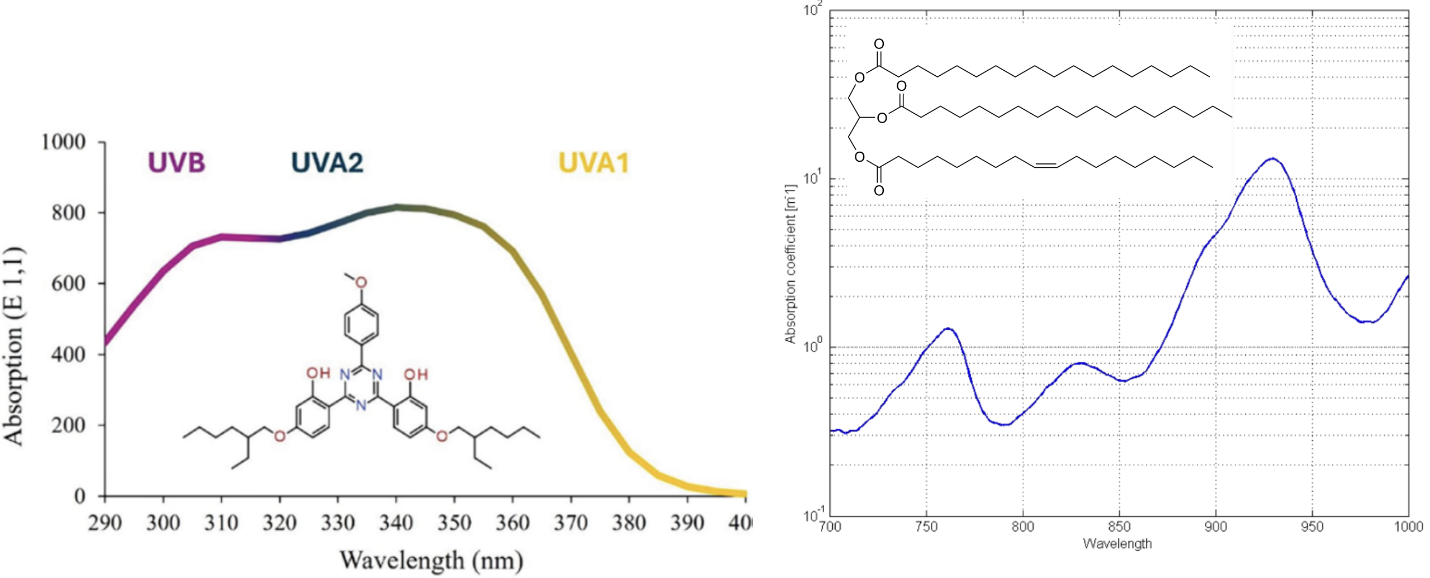
Although the last thing any remotely sane person is probably in the mood for is staring at UV spectra, sorry. You're going to stare at Figure 1 anyway.

Josh Bloom
Director of Chemical and Pharmaceutical Science
Dr. Josh Bloom, the Director of Chemical and Pharmaceutical Science, comes from the world of drug discovery, where he did research for more than 20 years. He holds a Ph.D. in chemistry.