
I’ve reached the point in my life where my memory is slipping a bit. You know — getting on a bus with a movie ticket, finding my sneakers in the freezer, or driving on the left side of the road. Backwards.
But there is one memory I will never forget: the day I had my mouth washed out with soap. I had just turned 4, and for reasons I cannot explain, I found the phrase "doodie head" to be nothing short of brilliant, so I was running around expressing myself thusly. Finally, my mother had had enough:
Mom: "Josh, if you keep talking like that, I'm going to wash your mouth out with soap!"
[Pause]
Me: "You're a doodie head!"
So much for testing disciplinary boundaries. Next thing you know, I’m being dragged to the bathroom, where I indeed get my mouth washed out with soap as promised.
It wasn't so bad, perhaps because she used Ivory Soap. (Note: if she thought that this futile act would somehow prevent me from developing a foul mouth, this was about as f###### wrong as it gets.)
Can you eat soap?
Theoretically, yes. It's biologically plausible that soap could act as an energy source, much like fats and oils; both are energy-rich fatty acids or can be converted to them. Here's what happens in your body.
- Fats and oils are digested in the gut, where lipase enzymes hydrolyze them, yielding three fatty acids and one molecule of glycerol (aka glycerine).
- The fatty acids are broken down in repeating two-step cycles, each generating energy (beyond the scope of this article).
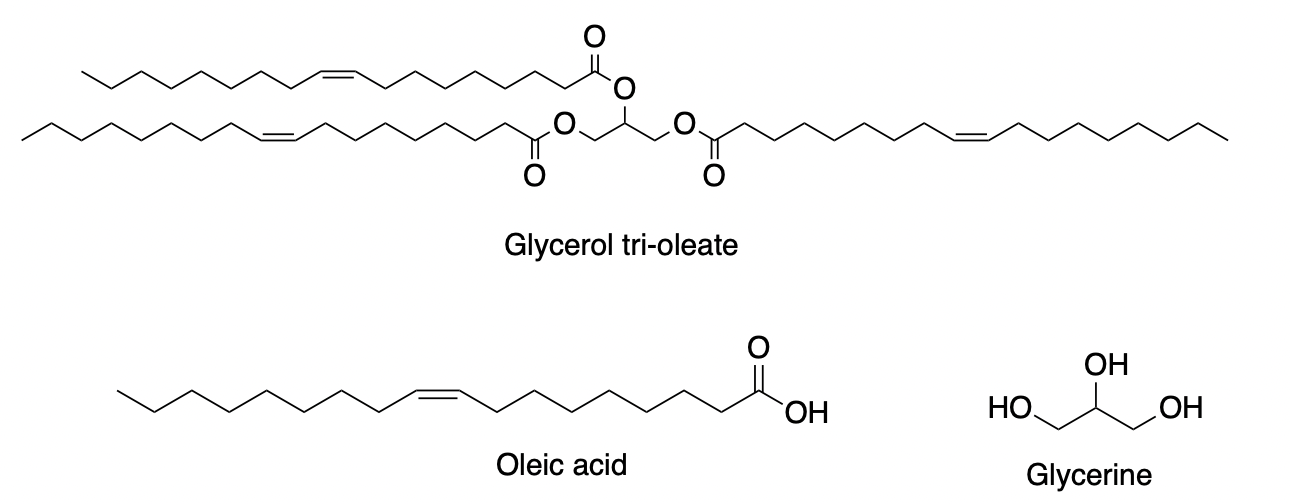
Figure 1. Shown above is the hydrolysis of glycerol trioleate, a fat [1] with three oleic acid molecules (a monounsaturated fatty acid with one double bond) and one molecule of glycerol released. Virtually all the energy from fat comes from the fatty acid chains, not the glycerol backbone.
But it's not that simple. About 10 fatty acids make up the majority of those in food. Any one of these can be attached to glycerol, along with any of the others, in countless combinations. Adding up the different ways this can happen gives about 200 different fats and oils that make up the diet.
So, why not eat soap?
The following reaction (saponification) illustrates why this might be feasible (Figure 2).
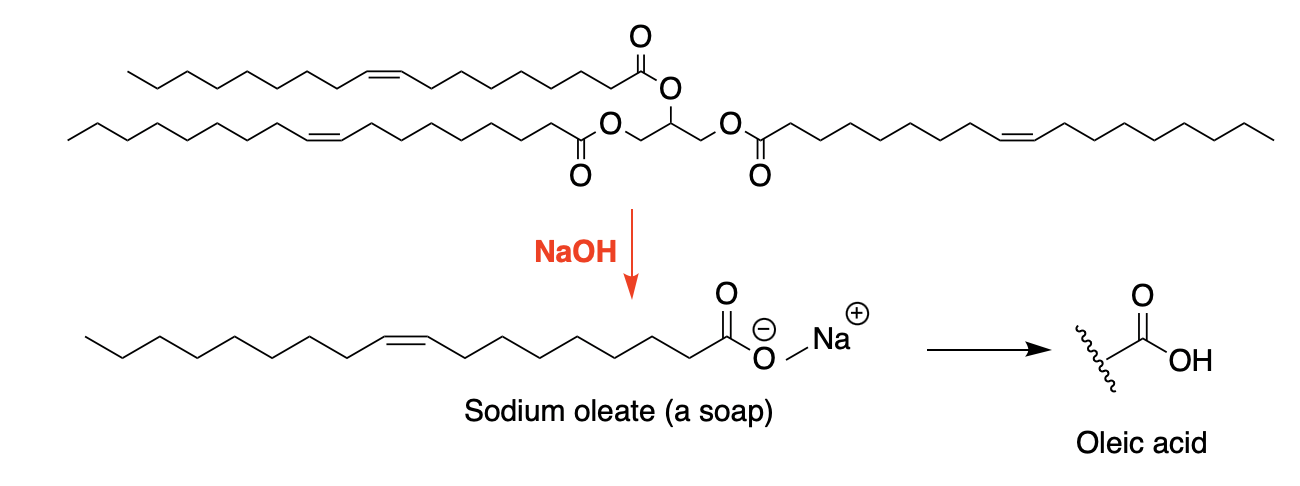
Figure 2. The saponification of a fat
Fats, which are just big esters, are hydrolyzed by lye to form the sodium salt of fatty acids, aka soap, a process called saponification, which was discovered about 5,000 years ago. Logically, it would seem that stomach acid would convert soap to its fatty acid form, so you would be ingesting a fatty acid, aka, food.
But this assumption falls apart when a second reaction is considered:
SOAP + STOMACH --------> MASSIVE SPEWAGE + MOP
No, you can't eat soap because that stuff will come flying up faster than a Saturn rocket. Soap is an emulsifying agent, which will have you emulsifying all over the living room carpet.
So even though the fatty acids in fat and soap are essentially the same, the route of administration matters. After lipase breaks dietary fat into fatty acids, they’re absorbed through the intestinal wall and eventually enter the bloodstream for energy or storage. Eating soap, however, delivers fatty acid salts straight into the stomach, where their alkaline, detergent-like properties trigger irritation instead of absorption. One leads to a massive belly; the other to massive spewage.
Eating Soap Is Stupid. So Is Worshipping Tallow
Tallow (beef fat, rich in saturated fat) has become all the rage amid RFK Jr.’s misguided war against seed oils and his push for animal fats over vegetable oils. I’m not going to get into all of that here. Instead, let’s listen to my colleague Dr. Joe Schwarcz, head of the Office for Science and Society at McGill University in Montreal.
Simply put, the crusade against seed oils is not based on evidence, but nevertheless has led to changes such as the fast-food chain Steak ‘n Shake switching to beef tallow for frying with the promise that “if veg oil broke your heart, our tallow will make you fall in love again.” Maybe with the undertaker.
– Dr. Joe Schwarcz, Montreal Gazette, April 4, 2025.
Bottom Line
As I have written many times, fad diets are usually "fade" diets; they come on strong and then fade away when the next fad comes along. The seed oil–tallow obsession will fade away as well. The Soap Diet, however, is unlikely to catch on. I tested it long ago.
NOTE:
[1] There is no real difference between fats and oils other than their physical form at room temperature. Fats are solids, oils are liquids. Go into a warmer room and the whole thing falls apart.

Josh Bloom
Dr. Jonathan (Josh) Bloom, ACSH's Director of Chemical and Pharmaceutical Sciences, earned his Ph.D. at the University of Virginia and completed postdoctoral training at the University of Pennsylvania. During his 20-plus years in drug discovery at Wyeth, his research group discovered the antibiotic Tygacil®, approved in 2005. He holds 25 issued patents and has authored 35 academic papers. Since joining ACSH in 2010, he has written more than 2,000 articles and dozens of op-eds for major newspapers, including The Wall Street Journal and Chicago Tribune.