The movement's philosophical roots trace to Rudolf Steiner, founder of biodynamic agriculture, who rejected industrial, chemical-based farming in favor of a holistic, ecological approach. However, some of his methods, such as burying manure-filled cow horns and planting by lunar cycles, have no scientific basis. These ideas fed into the growth of organic farming throughout the 20th century, formalized internationally by the International Federation of Organic Agriculture Movements’ (IFOAM) 1980 Basic Standards and later by national legislation. In the U.S., a product can be labeled "organic" only if at least 95% of its ingredients meet standards for soil and water conservation, biodiversity, and reduced synthetic inputs.
Growing public concern over pesticides and synthetic fertilizers accelerated the movement's spread throughout the century, explaining why "organic" still carries an ecological and ethical pedigree today. But this legitimate ecological framework has, over time, been stretched into a much broader, and largely unsupported health claim: that organic foods are more nutritious, safer, and even pesticide-free.
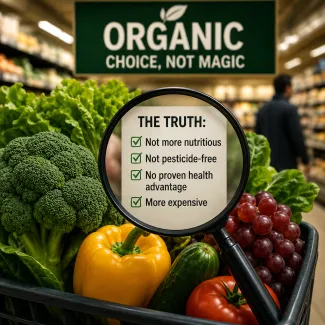
They are not pesticide-free. Organic farming permits crop protection products of natural or mineral origin, including vegetable oils, botanical extracts, and copper-based compounds. Copper sulfate, widely used against fungal diseases, can harm the environment and, when applied intensively, cause occupational poisoning.
Consumers are largely unaware that the real distinction between organic and conventional systems isn't the presence or absence of pesticides, but which substances are permitted and how they're regulated. One survey of North American consumers found:
● 48% cited health as their main reason for buying organic
● 19% believed organic products are pesticide-free
● 15% cited sustainability
● 9% cited freshness
Media coverage has often reinforced rather than corrected this gap. A 2018 interview with a nutritionist in Brazil’s Federal Council of Nutrition argued that lower pesticide use stimulates plants to produce more antioxidants, a claim that the broader nutritional evidence does not consistently support.
An Everyday Health article asserted, without evidence, that organic farming reduces the risk of allergies, lung disease, birth defects, and cancer. While true that certified organic producers use fewer antibiotics and that organic foods can't be genetically modified, neither fact demonstrates a lower risk for chronic disease.
The most consequential of these claims comes from the NutriNet-Santé cohort, a large French prospective study that has tracked participants' diets, medical histories, and lifestyles for over a decade. One of its analyses reported an association between organic fruit and vegetable consumption and a lower risk of breast cancer. As with any observational finding, it deserves scrutiny before being treated as causal — and the scrutiny is where this gets interesting.
Are They More Nutritious?
A 2021 systematic review published in Helyon pooled data from 147 studies, including 1,779 samples and 656 comparisons, spanning 1990 to 2020 and covering macronutrients, micronutrients, pesticide residues, and bioactive compounds such as polyphenols.
The result was a wash. Roughly half of fruit comparisons showed no significant difference; vegetables were even more heterogeneous, with results favoring organic, conventional, or no effects, in roughly equal measure. Organic foods generally had higher vitamin C levels, but conventional foods frequently had higher lycopene and β-carotene levels. Even pesticide residues did not consistently favor organic foods, as some comparisons found higher heavy-metal concentrations in organic samples.
The takeaway isn't that one system is better — it's that nutritional composition depends on the specific food and nutrient, not on the farming category. Soil, climate, ripeness at harvest, and cultivar matter more than certification. Labeling a food "organic" tells you nothing reliable about its nutrient content relative to its conventional counterpart. One caveat tempers even this modest conclusion: the pooled studies were too heterogeneous to support more detailed statistical analysis.
The NutriNet-Santé Cancer Studies
With nutritional composition a wash, we might ask whether consumption of “organics” changes disease risk. That question demands a stricter standard than a list of limitations; it requires a dose-response relationship: cancer risk should decline progressively as organic consumption rises.
Consider a 2018 JAMA Internal Medicine study, in which participants in the highest quartile of organic food consumption had about 25% lower relative cancer risk than those in the lowest (an absolute reduction of roughly 0.6 percentage points), while every five-point increase in an organic-consumption score was associated with an 8% lower risk. But heavier organic consumers also tended to be wealthier, more educated, more physically active, and to eat healthier diets, differences that statistical adjustment cannot fully eliminate.
That raised a sharper question: was the association driven by eating organic in general, or specifically by replacing conventional produce with organic? A follow-up study of the same cohort was designed to test that substitution.
Biological plausibility is important here. Some pesticides can damage DNA; several are recognized as endocrine disruptors even at low dietary doses; and others may alter the gut microbiome and inflammation. Organophosphate insecticides show estrogenic activity, while some herbicides interfere with androgen signaling, mechanisms proposed for hormone-dependent cancers such as breast cancer. If these mechanisms are responsible, however, we should expect a graded decline in risk as organic fruit and vegetable intake increases. Dose-response is one of epidemiology's strongest indicators of causality.
At first glance, the substitution study — 31,179 participants, 75% women, followed for 7.3 years with 1,718 cancer cases — appeared to show exactly that. Every additional 100 g/day of organic fruits and vegetables replacing conventional was associated with a 3% lower overall cancer risk and a 10% lower risk of postmenopausal breast cancer.
However, the pattern disappears under closer inspection. When participants were divided into quintiles, there was no dose-response for overall cancer. Even for postmenopausal breast cancer, the first four quintiles had nearly identical risks; only the highest quintile showed a reduction. In other words, the widely cited 10%-per-100 g estimate was driven almost entirely by a small group of the heaviest organic consumers rather than by a gradual trend across the population.
That weakens a pesticide-mediated explanation. A threshold effect is possible, but the study cannot demonstrate one. Instead, the highest-consumption quintile may identify people who differ from everyone else in ways the models could not completely capture.
Higher conventional fruit and vegetable intake was associated with a lower risk of all cancers at the three highest quintiles. Given the broadly similar nutritional composition of organic and conventional produce reported in the 2021 review, this result argues for a simple "more fruits and vegetables, regardless of source" explanation.
The results are less consistent with the pesticide-mediated hypothesis. Eating more conventional produce does not reduce pesticide exposure; if anything, it modestly increases it. If lower pesticide exposure were the primary driver of the association observed with organic foods, a similarly protective association with conventional produce would be unexpected. What initially appeared to be a single explanation is actually two distinct ones. The data lend support to the nutritional explanation while weakening the case for pesticides as the main mechanism. Any remaining difference may instead reflect specific food choices or other characteristics of highly health-conscious consumers that the study did not fully measure.
None of this proves the association is spurious. The authors acknowledge that estimates for individual cancers are imprecise because of small case numbers and wide confidence intervals; some analyses even suggested higher, but not statistically significant, colorectal cancer risk among heavy organic consumers. Still, the proposed biological mechanism sits uneasily with the data. A process operating continuously in the body is not expected to produce a statistical step function.
Standard limitations apply:
- The cohort is disproportionately female and drawn from health-conscious volunteers, which limits the extent to which the findings apply to the wider population.
- Diet was self-reported, which invites measurement error, recall bias, and a tendency to over-report virtuous behavior.
- Consumption was measured only once, at baseline, with no guarantee patterns held steady across a mean 7.3-year follow-up.
- Residual confounding remains plausible throughout
- Even if the association were genuinely causal, it would still need to be replicated in other populations and settings before supporting any general recommendation.
Should You Buy Organic?
Pharmacologist Qin M. Chen and physician Joseph S. Alpert, both at the University of Arizona, sought an answer in a 2025 review of the nutritional composition, pesticide exposure, and antibiotic and hormone use in agriculture. They acknowledged organic farming's plausible environmental benefits, including reduced nitrate and phosphate runoff and greater preservation of insect and microbial biodiversity.
However, after reviewing four major studies, they found no consistent evidence that organic foods provide clinically meaningful health benefits over conventional foods. Reports of a 25% lower cancer risk, they noted, are just as plausibly explained by the generally healthier lifestyles of organic consumers as by the food itself. Their conclusion was blunt: organic consumption appears safe. It may modestly reduce exposure to pesticide residues and antibiotic-resistant bacteria, but there is no definitive evidence that it improves health outcomes or extends life expectancy.
A separate systematic review of 35 studies, including 15 clinical trials and 20 observational studies, reached the same conclusion. The trials, mostly short (days to four weeks) and at high risk of bias, found little difference in biomarkers like antioxidant capacity between organic and conventional diets, and none tracked a clinically meaningful long-term outcome. The observational studies reported associations with fertility, allergic sensitization, and metabolic syndrome. However, the same confounding problem applies: organic consumers are consistently healthier, more active, and leaner than average, which makes it very difficult to isolate the food from the lifestyle around it. What is well established is that organic diets lower urinary pesticide metabolite concentrations; what remains unestablished is whether that reduction translates into any measurable health outcome.
The central message is simple. If you have the means and prefer organic food, there is nothing wrong with buying it, whether to support a farming system you value, because of its plausible environmental benefits, or simply because you prefer it. Just don't buy it believing it's nutritionally superior or protective against disease; the evidence doesn't support that, and even the cohort's most consistent signal — that quintile-5 breast cancer finding — still awaits an explanation that survives its own data, rather than one built around it.
If you do not buy organic, or cannot afford to, keep eating fruits, vegetables, and legumes with confidence. Far more than the label on the package, regular consumption is what the evidence consistently supports.