
What does it mean to have problems sleeping? The difficulty, of course, is that we know so little about our own sleep beyond the qualitative sense of difficulty falling or staying asleep. But sleep scientists studying those hours have found, just as a duck appears placidly floating by, that there is a great deal going on below the surface.
Why the Internet Can't Stop Debating Sleep Supplements
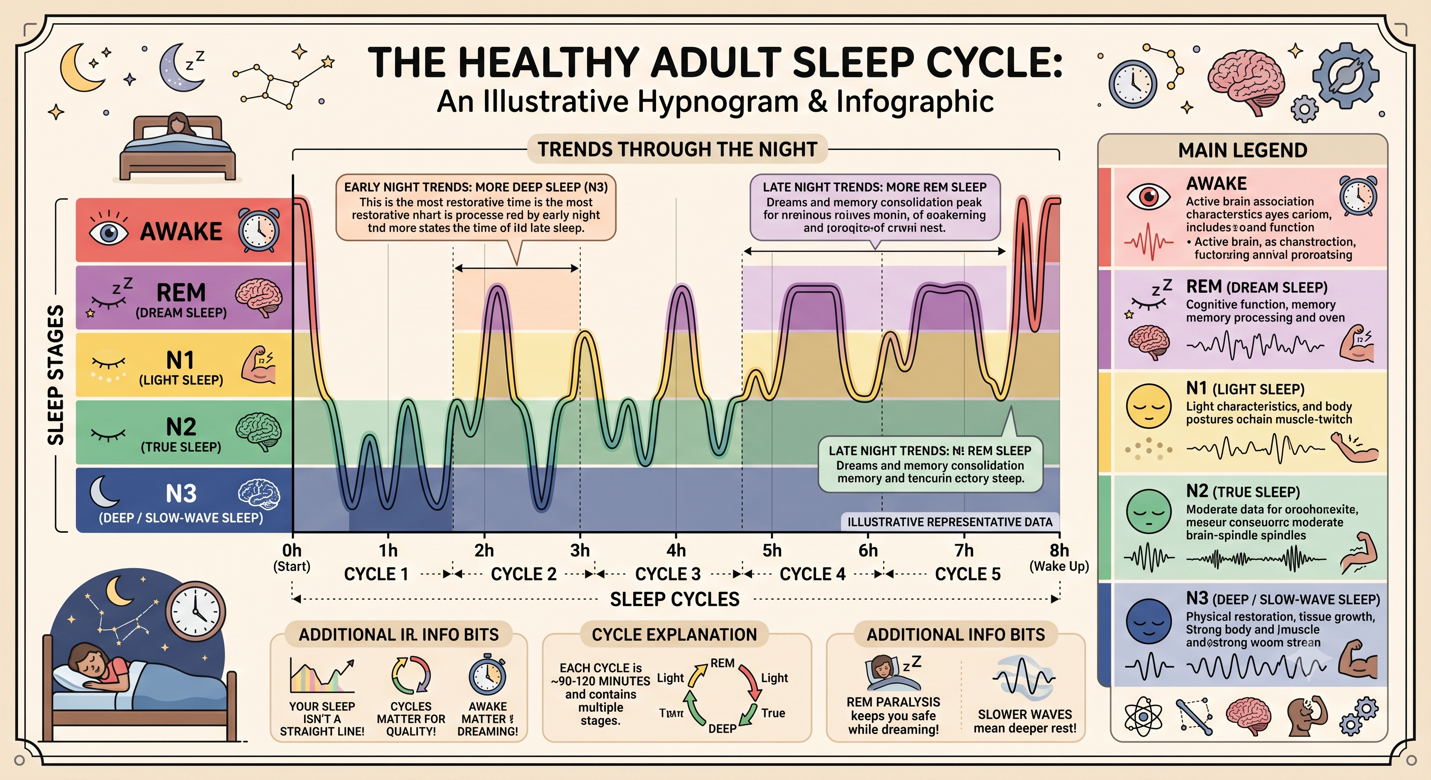
The problem is that "I can't sleep" can describe several entirely different conditions. Sleep specialists don't simply ask whether you slept poorly—they ask how you slept poorly. Did you struggle to fall asleep? Stay asleep? Wake too early? In addition, there may be disturbances of our sleep architecture, the structure of the cycle.
There Is More Than One Way Sleep Goes Wrong
Scientists have developed various measures of our sleep cycle and have attributed various causes to each.
Trouble Falling Asleep – the difficulty of falling asleep is assessed by Sleep Onset Latency, the time from our explicit intent to sleep ("lights out") to the earliest neurophysiological onset of sleep (N1). In adults, this is primarily driven by a lingering stress response to daily events, with further disruption from the internal clock and blue light, which suppresses melatonin release, as well as chemical interference from caffeine and alcohol or various physical discomforts. For the young, which we will define as age 18 or under, the primary driver can be environmental, as in young children who need a song, a stuffie, or white noise, or biological, as in teens who delay melatonin release. Further alterations of our internal clock with evening screen use and neurodevelopmental conditions like autism and ADHD, which affect our internal clock genes, can heighten the difficulty of falling asleep.
Trouble Staying Asleep – the difficulty staying asleep is assessed with two metrics, Wake After Sleep Onset, the total time spent awake after you fall asleep and before you fully wake; and the Arousal Index, which measures brief brain “awakenings” during sleep. Adults and children share a common underlying problem: physiologic disturbances, primarily adult or pediatric obstructive sleep apnea. Adults may experience heartburn, some rebound from drinking, and, for older men, multiple trips to the bathroom, and for older women, perimenopausal hot flashes. Children may also experience sleep terrors and sleepwalking.
Waking Too Early – characterized by reduced late-cycle REM sleep and total sleep time, the time from going to bed to getting up, with all periods of wakefulness during sleep subtracted. This is usually due to psychiatric factors, i.e., major depressive disorder in adults and anxiety in children, or to circadian mismatches from normal aging in adults or developmental mismatches in children.
When Sleep’s “Architecture” Breaks Down – characterized by altered sleep percentages. This results from conditions that affect N3 or REM sleep. In adults, aging, benzodiazepines, chronic pain, and antidepressants are drivers; for children, these changes are due to neurodevelopmental difficulties.
Two Supplements, Two Very Different Mechanisms
Once we understand that insomnia has multiple causes, it becomes easier to see why no single supplement can treat all sleep problems. Despite being lumped together on pharmacy shelves and on social media, melatonin and magnesium are fundamentally different compounds that influence sleep through distinct biological pathways.
Melatonin is a chronobiotic signaling hormone that promotes sleep onset, lowers core temperature, and drives our circadian clock. A meta-analysis found that it reduced sleep onset latency, increased total sleep time by about 8 minutes, and moderately improved subjective sleep quality. However, the American Academy of Sleep Medicine’s (AASM) clinical guidelines were more cautious, recommending against routine over-the-counter use for chronic sleep problems.
Children and adolescents are an important exception, where the evidence for melatonin becomes considerably stronger. Melatonin has established efficacy in specific neurodevelopmental conditions. A review found that melatonin significantly reduced sleep onset latency and increased total sleep duration, though it did not reduce nighttime awakenings. This is driven by the fact that many individuals with ASD display abnormal melatonin levels and specific gene variants that lower endogenous melatonin production. The same review noted that individuals with ADHD have similar melatonin disruptions, and that supplementation increased sleep duration and reduced sleep onset latency for them. Melatonin demonstrates a strong overall safety profile, with no serious adverse concerns reported for either short- or long-term pediatric use, including in children with ASD.
Magnesium tells a very different story. Although biologically plausible, as an essential mineral reducing central and autonomic excitability, the clinical evidence remains surprisingly weak. According to one meta-analysis, the data here are substandard for physicians to make well-informed recommendations on the use of oral magnesium for older adults with insomnia. Although the study found a nearly 18-minute reduction in sleep-onset latency and a 16-minute increase in total sleep time, neither effect was statistically significant. In another meta-analysis, qualitative sleep assessments improved with melatonin, but the researchers cautioned that the results were highly variable, with wide confidence intervals, reducing confidence in those assessments. Magnesium has not been clinically recommended for adults. There are essentially no studies in individuals 18 or younger evaluating oral magnesium as a treatment, and no major pediatric societies recommend its use.
But there is another possibility: what if neither supplement addresses the underlying problem? For chronic insomnia, physicians increasingly argue that changing the brain's learned relationship with sleep is more effective than changing brain chemistry.
The Treatment Most Sleep Specialists Recommend First
While acute sleep loss is often triggered by stressful events, chronic insomnia persists because individuals adopt maladaptive compensatory behaviors, such as spending excessive time in bed and napping during the day, and develop Pavlovian psychophysiological arousal, such as conditioning the bed as a cue for anxiety and frustration. Cognitive behavioral therapy (CBT) works by breaking those conditioned responses. A meta-analysis has shown 8-minute reductions in sleep-onset latency and 7-minute increases in total sleep time. Unlike pharmacologic interventions, whose effects end upon discontinuation, CBT’s therapeutic improvements seem to persist beyond the cessation of therapy.
Chronic insomnia is rarely due to a mineral deficiency treated with magnesium or a melatonin dysfunction treated with melatonin; it is most often due to the day’s anxiety and stress that follow us to bed. Both the American College of Physicians and the American Academy of Sleep Medicine have recommended CBT as the first-line treatment for chronic insomnia, absent a diagnosis of ADHD or ASD.
So why do individuals consider melatonin or magnesium?
If CBT Works Better, Why Do We Reach for Supplements?
Taking a pill takes seconds and requires no lifestyle change. CBT demands 6 to 8 weeks of sustained effort to break ingrained conditioning. So, there is a time and willpower cost.
Over-the-counter (OTC) supplements cost $10–$20 at any pharmacy without a prescription. Accessing CBT requires navigating our health system, with its hurdles, waits, and rising out-of-pocket costs. So, there is a financial cost.
Patients logically frame insomnia as a physical deficiency, assuming sleep loss stems from a lack, rather than a psychophysiological state sustained by conditioned hyperarousal and behavioral habits. Today’s typical 15-minute primary care visit rarely allows for real discussion and informed consent. Recommending an OTC supplement is your consolation prize for coming in.
The global wellness and supplement industry heavily promotes melatonin and magnesium across digital media, retail channels, and wellness branding. CBT is prescribed, but market economics do not provide enough margin for advertising.
The debate, while compelling, asks the wrong question. Sleep is not a single process. Difficulty falling asleep, waking repeatedly during the night, or waking too early often stem from different biological and behavioral causes, each requiring a different approach. Understanding what is disrupting your sleep is by far the most important step; treatment follows. For most of us, a good night’s sleep begins with shedding the day’s worries.

Chuck Dinerstein, MD, MBA
Director of Medicine
Dr. Charles Dinerstein, M.D., MBA, FACS is Director of Medicine at the American Council on Science and Health. He has over 25 years of experience as a vascular surgeon.