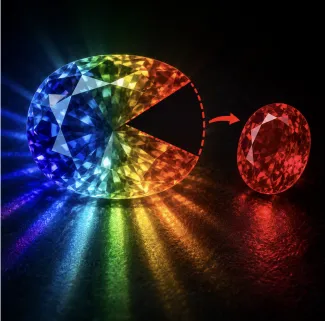
In today's politics, there's red, and there's blue. Most of the time, they have little in common.
The same cannot be said for ruby, July's birthstone, and blue sapphire, September's. They're actually the same mineral: corundum, a crystalline form of aluminum oxide, which is white [1]. Yet their colors couldn't be more different.
Red, white, and blue. How can essentially the same stuff end up looking so different? The answer comes down to whether there is a tiny amount of chemical impurity. And I mean really tiny. More on this below.
A Corundum conundrum: What is going on??
On paper, corundum is a real snoozer. Its chemical formula is Al₂O₃ (aluminum oxide). And you don't need a Nobel to figure this out: it's aluminum plus oxygen. Much of the sandpaper you buy is aluminum oxide. That's about as boring as it gets (unless you're using it to sand your eyeballs, which is not recommended nor boring). But nature rarely produces perfectly pure crystals. During formation, small amounts of other elements can sneak into the crystal lattice, replacing some of the aluminum atoms.
Those chemical trespassers are what make things interesting.
Ruby gets its red color primarily from chromium, something I bored you with wrote about recently. A small fraction of the aluminum ions in the crystal are replaced by chromium ions. That seemingly trivial substitution changes which wavelengths of visible light the crystal absorbs. Much of the blue and green light is absorbed, while red light makes its way back to our eyes. The result is ruby.
Blue sapphire plays a different trick. Tiny amounts of iron and titanium take the place of some of the aluminum atoms. When light hits the crystal, electrons can jump between the iron and titanium atoms, but they need energy to do it. They get that energy by absorbing certain colors of light. What's left is predominantly blue, so that's the color we see.
For all the chemists, living or dead, who may be reading this, here's the reaction.
Fe²⁺ + Ti⁴⁺ → Fe³⁺ + Ti³⁺
In both cases, we're talking about contaminants present in very small amounts. In blue sapphire, titanium may make up only about 0.001–0.01%, while iron can range from roughly 0.01% to a few tenths of a percent. That's not much contamination for such a dramatic change in color. Without them, corundum wouldn't be ruby or blue sapphire at all. It would be essentially colorless.
So, as with ruby – the most expensive birthstone – the impurities are the valuable part.
Sapphire doesn't necessarily mean blue
Here's some more chemical craziness: Sapphire comes in almost every color except red. There are yellow, green, pink, purple, orange, and even colorless sapphires. Different trace elements, sometimes in different chemical forms or combinations, change which colors of light the crystal absorbs and therefore the color we see.
So why no red sapphire?
There is one. We just don't call it sapphire.
When chromium produces a sufficiently red piece of corundum, gemologists call it ruby. Ruby and sapphire aren't two fundamentally different minerals. They're names we've given to different-colored versions of the same one. How cool is that?
Chemistry doesn't care what the jewelry store calls them.
Hard stuff
Corundum is also remarkably hard. It scores 9 on the Mohs hardness scale, surpassed among common natural minerals only by diamond. That makes sapphire useful for considerably more than rings and necklaces.
Synthetic sapphire can be manufactured as extremely pure, transparent aluminum oxide. Its hardness, chemical resistance and optical properties make it useful for watch crystals, optical windows, scientific instruments and other applications where ordinary glass would be too easily scratched or damaged.
And synthetic doesn't mean fake. Synthetic sapphire has essentially the same crystal structure and chemical composition as natural sapphire. The difference is where it formed: one grew in the Earth, while the other grew under controlled conditions.
A little dirt can be a beautiful thing
Gemstones provide a nice reminder that chemical purity isn't always desirable. In corundum, tiny quantities of foreign atoms transform an otherwise colorless crystal into some of the world's most recognizable gemstones.
Chromium gives us ruby. Iron and titanium give us blue sapphire.
Red and blue really do have quite a lot in common, after all.
Just not at polling places.
NOTES:
[1] Technically, pure crystalline corundum is colorless and transparent. Aluminum oxide is commonly encountered as a white solid or powder. I'm taking a small liberty here in the interest of red, white, and blueness.

Josh Bloom
Dr. Jonathan (Josh) Bloom, ACSH's Director of Chemical and Pharmaceutical Sciences, earned his Ph.D. at the University of Virginia and completed postdoctoral training at the University of Pennsylvania. During his 20-plus years in drug discovery at Wyeth, his research group discovered the antibiotic Tygacil®, approved in 2005. He holds 25 issued patents and has authored 35 academic papers. Since joining ACSH in 2010, he has written more than 2,000 articles and dozens of op-eds for major newspapers, including The Wall Street Journal and Chicago Tribune.