We at ACSH are not big on horoscopes, homeopathy, or Reiki, but we are into crystals. Not the kind where holding a crystal is supposed to shrink the bunions you developed in a past life. We're talking about the chemistry and physics of crystals, the beautiful arrangements of atoms that produce some of nature's most spectacular materials. The kind that keep your wife from being pissed at you make women ecstatic!
So, Leos and Cancers who had the astronomical good fortune to emerge from your mother's reproductive machinery in July, you have expensive tastes. Your birthstone is the ruby, one of the rarest and most valuable gemstones on Earth. In fact, the finest rubies can sell for more per carat than comparable diamonds.
Rubies are made from boring stuff
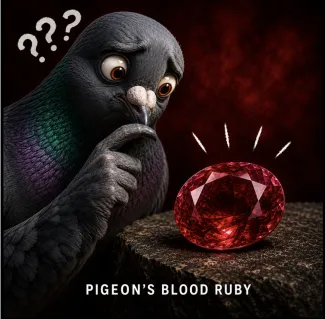
Chemically speaking, a ruby is mostly aluminum oxide, a material better known for sandpaper and industrial ceramics than million-dollar gemstones. Nature's trick is to add just enough chromium to turn an ordinary crystal into a treasure. And it doesn't take much chromium. As little as a few tenths of a percent of chromium is all that's required to give rubies their red color. The color so prized that gem dealers gave it one of the strangest names in jewelry: "pigeon's blood."

Stan, the pigeon, is uneasy with such terminology.
Ruby belongs to a family of minerals called corundum, a crystalline form of aluminum oxide (Al₂O₃). Pure corundum is colorless.
Strange fact #1: Rubies and sapphires are chemically identical. Both are corundum. The difference is that rubies contain trace amounts of chromium, while sapphires get their colors from other impurities, such as iron and titanium. Whether this has any bearing on America's red-state/blue-state political divide is unknown, but it is safe to say that red rubies and blue sapphires come from the same state: the corundum crystal lattice.
Color prestidigitation
Try to make some sense out of this: You know what aluminum looks like, oxygen is invisible, and chromium is a dreary-looking gray metal. How does this mishmash make something red and incredibly valuable?
Chromium has a bit of an identity crisis. In many compounds, it is green; in others, orange. Yet the same chromium that helps make emeralds green is responsible for rubies being red. Confused yet?
The difference is not the chromium itself but the crystal surrounding it. Same chromium. Different crystal, with a crazy small difference in the distance between chromium and oxygen in the crystal. How small?
In rubies, the distance between chromium and the surrounding oxygen atoms is roughly 2.00 angstroms. In emerald, it is closer to 2.05 angstroms. A difference of just 0.05 angstroms may not sound like much, but it is only about one-twentieth the size of a hydrogen atom. Yet that minuscule change is enough to alter the wavelengths of light absorbed by chromium, turning one gemstone red and the other green. [1]
Of course, before chromium can participate in quantum-mechanical pageantry, nature has to make the crystal.
How to make a ruby. Don't try this at home.
If you want to make a ruby, start by finding some aluminum-rich rock and burying it deep underground for a few million years. Then add enough heat and pressure to turn everything into goo. Finally, toss in a little chromium. Not too much. Not too little. Nature is annoyingly picky. Then let everything cool down.
Ruby's value comes not only from its beauty but also from its rarity. Chromium must be present in just the right amount. Too little and the crystal appears pink. Too much and the crystal becomes dark and opaque. Nature must thread a remarkably narrow needle to create a fine ruby.
Humans have admired rubies for thousands of years, but their scientific significance is surprisingly modern. In 1960, physicist Theodore Maiman used a synthetic ruby crystal to produce the world's first working laser. The same chromium atoms that give rubies their famous red color were stimulated to emit intense, coherent red light, launching a technology that would eventually find applications in medicine, communications, manufacturing, and consumer electronics.
Strange fact #2: Coincidentally, or perhaps astrologically, if that's your thing, Maiman was born on July 11, making ruby his birthstone. What are the chances?
I'll leave that to the Tarot card readers and naturopaths. I live in the real world. At least, now and then.
NOTE:
[1] Ruby is not red because it produces red light. It is red because chromium atoms remove some of the other colors from ordinary white light before it reaches your eye. What remains is predominantly red. In chemistry, color is often a process of subtraction rather than addition.

Josh Bloom
Dr. Jonathan (Josh) Bloom, ACSH's Director of Chemical and Pharmaceutical Sciences, earned his Ph.D. at the University of Virginia and completed postdoctoral training at the University of Pennsylvania. During his 20-plus years in drug discovery at Wyeth, his research group discovered the antibiotic Tygacil®, approved in 2005. He holds 25 issued patents and has authored 35 academic papers. Since joining ACSH in 2010, he has written more than 2,000 articles and dozens of op-eds for major newspapers, including The Wall Street Journal and Chicago Tribune.