September is Eye Safety Month, and if there’s a better reason to write about eye safety and pickleball, it eludes me.
Back in 2024, I wrote about eye injuries from pickleball, the most addictive sport ever invented. In fact, I'll go a little further. Addiction potential: Pickleball >> heroin > alcohol > Vicodin = Game of Thrones.
Since then, our collective addiction has only gotten worse. According to the Sports & Fitness Industry Association, 24.3 million Americans played pickleball in 2025, up from just 4.2 million in 2020. That's nearly a sixfold increase in five years. Tennis? Pffft. The following graph should make its foot faults painfully obvious. Tennis players will be eating our old-person dust soon. Or sooner.
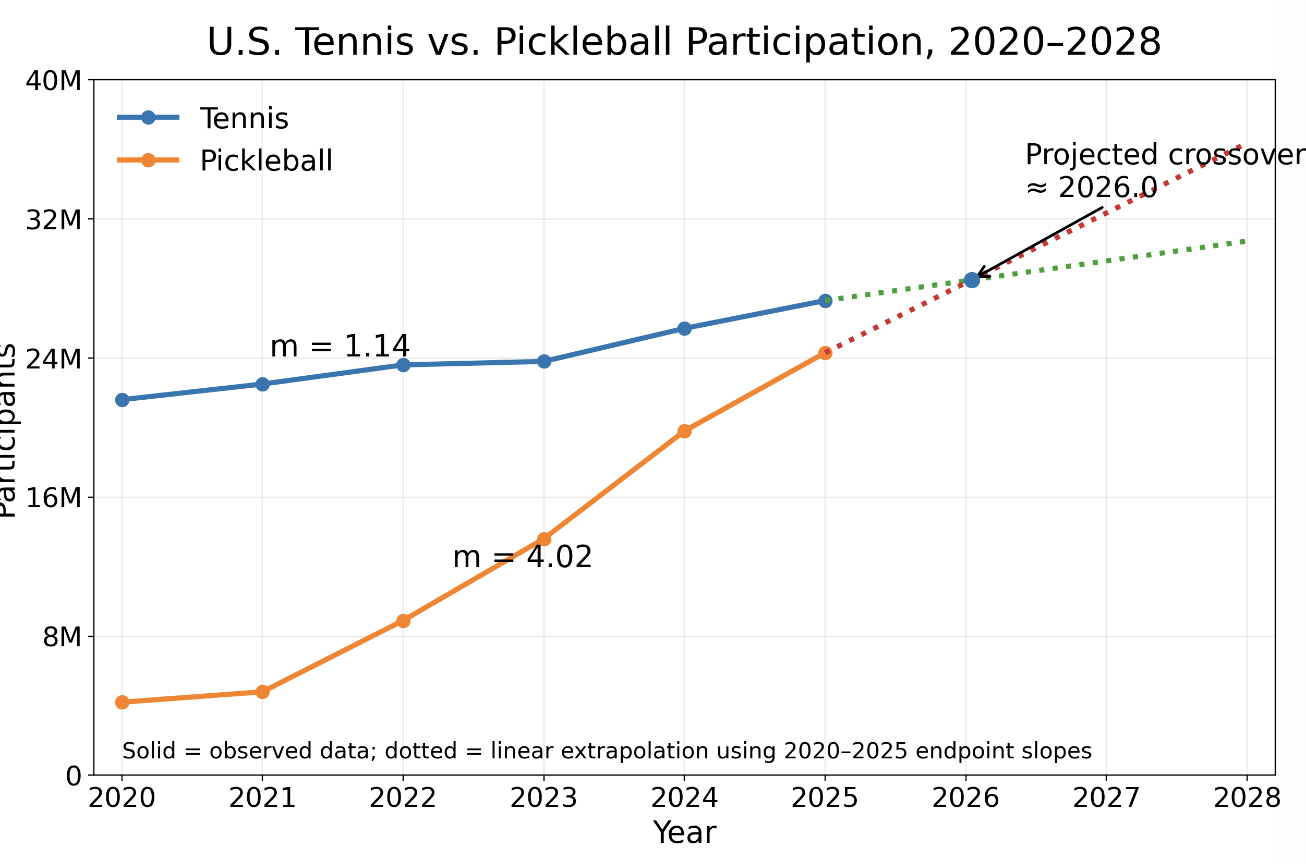
Figure 1. U.S. participation in tennis and pickleball, 2020–2025. Dotted lines extrapolate the 2020–2025 trends through 2028. If those trends continue, pickleball should pass tennis this year. In the graph, m = the slope of the lines, one of the few things I actually remember from school. Graph: ChatGPT. Data: USTA/SFIA.
This game is not just a passing fad. At a certain age, or with certain conditions, sports like basketball and tennis become difficult, if not impossible, to play. There is just a lot of area to cover for people with bad knees, ankles, spines, spleens, etc.
Pickleball isn’t pushing out tennis simply because it is more fun and easier to play. It provides an opportunity for old coots such as myself to get back to playing a racquet sport (I gave up tennis 10 years ago because of injuries but can play pickleball three times per week without needing morphine. At least, not very much.)
Pickleball = Injuries
While the sport is great for otherwise inactive seniors, it brings with it a set of risks, which we must accept if we're going to play. The game has been called "The Orthopedic Surgeon's Best Friend," which makes plenty of sense. Any stop-and-start, fast-moving sport, no matter how much you work out or stretch, is going to result in torn Achilles tendons, hamstring, groin, and calf injuries, etc. These are "acceptable," if not inevitable. But severe eye injuries are neither.
Pickleball eye injuries can be serious.
Pickleball isn't predominantly an old-person sport anymore, although looking at the bunch of corpses I play with, this isn't necessarily obvious. A 2025 JAMA Ophthalmology paper notes that players aged 25–34 are now the largest age group. But we old coots still dominate one category: eye injuries. Seventy percent of the estimated pickleball-related eye injuries occurred in people 50 or older.
Check out this crazy number ----> An average of 30 pickleball courts are being built every day in the US.
Any sport that brings seniors back into the world of athletics is good news, but with a caveat: Seniors are most likely to sustain serious eye injuries, which has prompted me to take action, as shown in the following photo – one that I will surely regret.
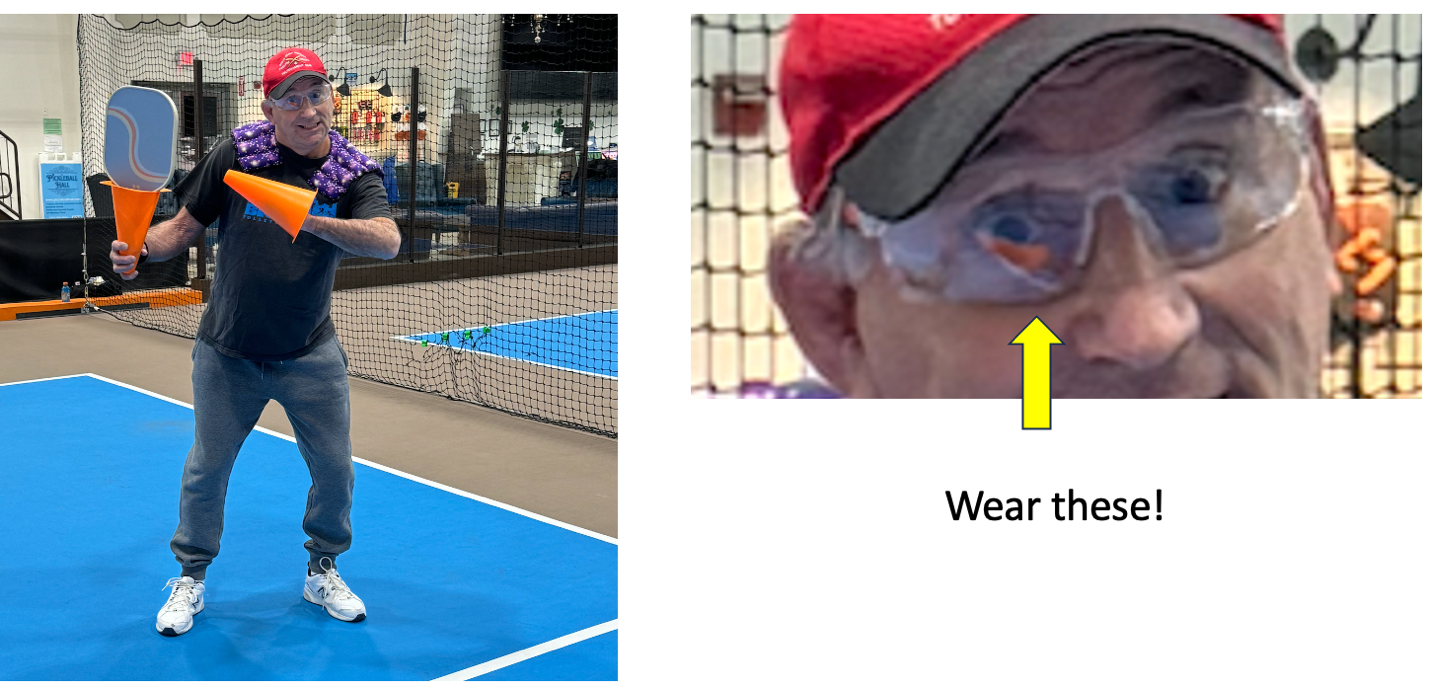
(Left) The J-Man, looking like a flaming jackass, during a recent pickleball lesson. I should note that all of that equipment is legitimate and was used in the lesson, but not as pictured. (Right) Bad-ass NoCry Pickleball Goggles. $15-20 on Amazon and well worth it.
Two factors primarily make eye injuries a real concern: 1) Most of the game is played near the net; 2) The court is small. Pickleball courts are 20 by 44 feet, compared to tennis courts, which are 36 by 78 feet (1) – more than three times the area. Worse still, the distance between players at the net can be as little as 14 feet (2), giving the players (especially those with slower reflexes) very little time to react. So, if some BMF (B = big) launches one at your face from 14 feet away you're a sitting pickle. One pickleball site tells us:
'Most volleys at the kitchen line [the closest you are allowed to get to the net] are somewhere between 30-40 mph. The reaction time at the non-volley zone would be approximately .24 of a second.'
It's not just distance: Ball size.
Andrew G. Lee, MD, of Baylor College of Medicine and Houston Methodist Hospital, recently told MedPage Today:
"The smaller a ball is, the more it can fit into the eye socket without hitting the bone. That's why smaller balls like racquetballs and squash balls are actually more likely to cause direct eye injury than tennis balls, footballs, or baseballs, which are bigger."
Because of the speed with which the sport has caught on, it is difficult to quantify the number of current eye injuries. Rather than focus on data from journal publications (3), which won't be known for years, let's look at an article by Minnesota Eye Consultants. It is eye-opening (sorry):
As you can imagine, many of the eye injuries we see may require surgery depending on the severity. Here are some of the injuries and procedures that have been performed at Minnesota Eye Consultants as a result of pickleball trauma:
- Using sutures to repair eyelid and brow lacerations
- Dislocation of the natural lens, often requiring a new lens and cataract extraction
- Damage to the pupil, resulting in the need to suture the pupil smaller
- Replacing a damaged iris with an artificial iris
- Retinal detachment, leading to retinal surgery
- Total loss of an eye, requiring surgical removal
You don't need to be a mathematical prodigy to realize that if a single clinic in Minnesota has replaced damaged irises, repaired detached retinas, and surgically removed eye(s), the nationwide total of serious eye injuries must be seriously undercounted at the present time.
Bottom Line
Dear Fellow Old Folks, it's fine if you put on your knee, elbow, and wrist braces before going into battle, but the only essential piece of equipment is the goggles. This game is not tennis, where you at least have a little time to get out of the way of a hard shot or overhead slam. In pickleball, a ball in the eye comes out of nowhere, and if it's "on target," there is little you can do about it in 0.24 seconds.
1) Stretch. 2) Goggles on. 3) Go get 'em.
NOTES:
(1) That is the dimension of a doubles court in tennis. A singles court is 27 X 38 feet.
(2) There is a seven-foot area adjacent to the net (called "the kitchen" where (except in certain situations) you are not allowed to enter. This is why players can be as close as 14 feet from each other across the net.
(3) There is a recent article in Nature. It focuses on case studies.

Josh Bloom
Dr. Jonathan (Josh) Bloom, ACSH's Director of Chemical and Pharmaceutical Sciences, earned his Ph.D. at the University of Virginia and completed postdoctoral training at the University of Pennsylvania. During his 20-plus years in drug discovery at Wyeth, his research group discovered the antibiotic Tygacil®, approved in 2005. He holds 25 issued patents and has authored 35 academic papers. Since joining ACSH in 2010, he has written more than 2,000 articles and dozens of op-eds for major newspapers, including The Wall Street Journal and Chicago Tribune.