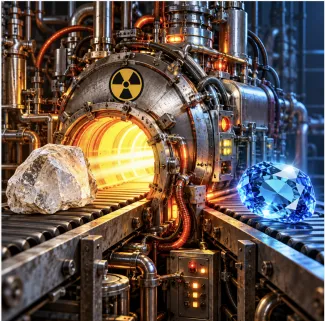
November's traditional birthstone is topaz. When you think of topaz, you probably think of blue. But topaz doesn't usually come out of the ground looking like the brilliant blue stones you see in jewelry stores. In its natural state, it is typically colorless or appears in various pale shades.
Its dirty little secret? Much of that gorgeous blue is produced by irradiating plain old stinky topaz. Strange, indeed.
Before you start hurling your topaz amulets out the window, there's something you should know. Although radiation is used to produce the color, the blue topaz you buy isn't radioactive. [1] Radiation changes the stone in a much more interesting way – one that involves electrons, defects in its crystal structure, and a bit of strange chemistry.
Topaz: More than a pretty rock
Topaz is a naturally occurring mineral with the rather freaky-looking formula Al₂SiO₄(F,OH)₂.
You may have noticed that it contains fluorine – not exactly the most flesh-friendly element on Earth. But there's nothing dangerous about it here. Fluorine locked into the crystal structure of topaz is not hydrofluoric acid, something I've written about recently. It's no more dangerous than the chlorine in table salt is chlorine gas.
In fact, the only obvious way topaz can hurt you is if you mistakenly give it to your wife to celebrate your girlfriend's birthday.
File this away under "too stupid to live."
Topaz isn't necessarily topaz-colored
There really isn't a "topaz color." Impurities and imperfections in the crystal lattice give topaz its various colors by changing which wavelengths of visible light it absorbs.
We've seen the impurity trick before. Pure corundum is colorless, but add a little chromium, and you get ruby. Other impurities give us sapphire. Topaz can play the same game, but it has another trick up its crystalline sleeve: color centers.
Color centers are lattice defects associated with trapped electrons or holes that change which wavelengths of visible light the crystal absorbs and, therefore, the color we see.
Here's where things get interesting. We don't have to wait for nature to create these color centers.
Let's blast topaz with radiation and make it pretty!
Here's how the trick works. Ionizing radiation can "knock" electrons out of their normal states in the crystal, leaving behind electron vacancies known as "holes." Some of these electrons and holes become trapped at defects in the crystal lattice, forming the color centers mentioned above.
And these strange little "holes" aren't just a mineralogical curiosity. They behave like positive charges and, together with electrons, help make transistors, computer chips, LEDs, and solar cells work. No holes, no iPhone. No iPhone, no sports betting.
These color centers absorb particular wavelengths of visible light. What remains is the brilliant blue we associate with commercial blue topaz. Heating the irradiated stone can further modify the color centers, producing different and stable shades of blue.
Radiation hasn't added a blue chemical to the stone or turned topaz into something else. It has changed the electronic structure of defects already present in the crystal. Ruby and sapphire need impurities to dress them up. Blue topaz gets an electronic makeover (Figure 1).
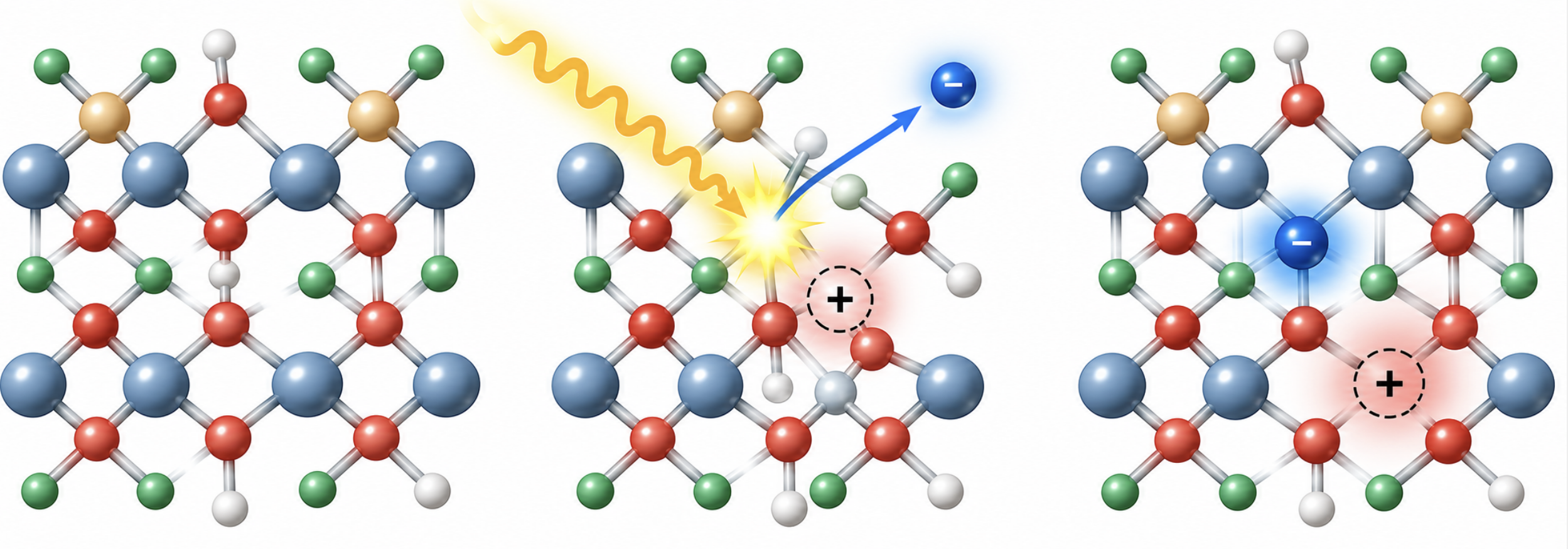
Figure 1. Radiation gives topaz an electronic butt kick. Ionizing radiation knocks an electron out of its usual state, leaving behind an electron vacancy, or “hole,” shown here as +. The electron (−) or hole (+) can become trapped at defects in the crystal, creating color centers that absorb particular wavelengths of light. The lattice shown is schematic.
Depending on the treatment, the result may be the pale Sky Blue, the brighter Swiss Blue, or the dark, saturated London Blue commonly sold today.
In other words, radiation isn't necessarily damaging the gemstone. It's improving the merchandise.
Which raises an obvious question.
Is my topaz radioactive?
During its manufacture, possibly.
Topaz can be irradiated using high-energy electrons or neutrons. Electron irradiation can produce the desired color without significantly activating the stone. Neutron irradiation in a nuclear reactor is different. Neutrons can be captured by atomic nuclei in the stone, producing radioactive isotopes.
This doesn't mean jewelers are handing unsuspecting November babies radioactive necklaces. Reactor-treated topaz must be held and monitored until any induced radioactivity has decayed sufficiently for the stones to meet regulatory requirements before distribution.
And this gives us an important distinction that tends to disappear whenever people hear the word radiation:
Irradiated does not mean radioactive.
A chemically complicated birthday present
November's birthstone manages to pack quite a bit of chemistry into a small piece of jewelry. It contains fluorine but isn't remotely comparable to hydrofluoric acid. Pure topaz is colorless, yet imperfections in its crystal lattice can produce an assortment of colors.
And perhaps most strangely, one of its most desirable colors can be produced by deliberately blasting the stone with radiation.
None of this makes treated blue topaz "fake." The mineral is still topaz. Science has simply altered the behavior of electrons at defects in its crystal lattice, changing the wavelengths of light it absorbs.
Nature made the gemstone.
Physics made it blue.
NOTE:
[1] Neutron-irradiated blue topaz can temporarily become radioactive during treatment. Stones are not released for sale until induced radioactivity has fallen below regulatory limits.

Josh Bloom
Dr. Jonathan (Josh) Bloom, ACSH's Director of Chemical and Pharmaceutical Sciences, earned his Ph.D. at the University of Virginia and completed postdoctoral training at the University of Pennsylvania. During his 20-plus years in drug discovery at Wyeth, his research group discovered the antibiotic Tygacil®, approved in 2005. He holds 25 issued patents and has authored 35 academic papers. Since joining ACSH in 2010, he has written more than 2,000 articles and dozens of op-eds for major newspapers, including The Wall Street Journal and Chicago Tribune.