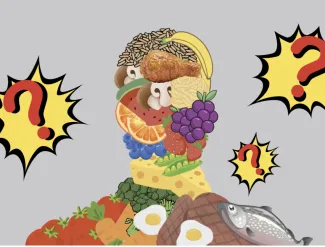
“Wellness influencers” are crawling all over social media platforms. Some, like psychologist Jordan Peterson, who promotes a carnivore diet, or Vani Hari, the self-anointed “Food Babe” who rose to fame with her motto “If you can’t pronounce it, don’t eat it,” lack relevant scientific backgrounds.
The same goes for Anthony William, the “Medical Medium,” whose advice on the miraculous curative powers of celery juice is attributed to the spirit of a departed physician. Dave “Bulletproof” Asprey extols adding butter to coffee, and Bryan Johnson claims that the secret to longevity lies in a strictly plant-based diet, intermittent fasting, and guzzling over a hundred supplements every day. Both lack scientific literacy. David “Avocado” Wolfe espouses a totally raw food diet and believes that the Earth is flat and that solar panels drain the sun’s energy.
Nor is there a shortage of scientists and physicians who promote a plethora of dietary schemes. Dr. Mark Hyman steers us away from gluten and seed oils. Dr. Steven Gundry thinks that lectins are poisons, and Dr. Michael Greger believes that salvation lies in a vegan diet. Neuroscientist Andrew Huberman favors AG1, a green powder supplement. Jessie Inchauspé, the “Glucose Goddess,” claims that health lies in “flattening your glucose curve” by eating foods in the right sequence and by drinking vinegar before meals. Curiously, she has a background in biochemistry.
Dr. Chris van Tulleken targets ultra-processed foods as villains, claiming that the likes of chips, sugary breakfast cereals and chicken nuggets aren’t really foods but are industrially engineered addictive substances designed to look, smell and taste like food. Best to avoid any food that is wrapped in plastic that contains at least one ingredient you would not find in a home kitchen, he says. Harvard nutritional epidemiologist Dr. Walter Willett, the world’s most cited nutrition scientist, advocates the Mediterranean diet while maintaining that not all ultra-processed foods are devils. Whole grain bread and unsweetened yogurt can be healthy.
Clearly, we are now badgered with both sound and unsound nutritional advice on a daily basis, leaving many people perplexed and confused about what they should eat. But trying to unravel the bewildering link between diet and health is not a novel challenge.
Since ancient people realized that food was needed for growth and sustenance, the conclusion that what is eaten can affect health was inevitable. As early as 1500 BCE, as documented in the “Ebers Papyrus,” Egyptian physicians recommended foods such as dates, honey, and castor oil to treat various ailments. However, it is Hippocrates, the 4th-century BCE Greek physician, who gets credit for arguing that diet directly determines health.
The famous quote attributed to him, “Let food be thy medicine, and medicine be thy food,” does not appear in any of the Hippocratic writings, but it does capture the sentiment consistent with his philosophy that finding the right food for a sick person should be a fundamental goal of medicine.
Hippocrates’s treatments were based on philosophy, not science. Foods were chosen on the basis of their hot, cold, wet, or dry properties to remedy imbalances in phlegm, yellow bile, black bile, or blood, the “humors” that were believed to control health. Four centuries after Hippocrates, the Greek-Roman physician Galen beat the drum with even greater fervor on behalf of the humoral theory and incredibly managed to influence medicine for 1,500 years.
Science took a step forward in the 16th century, albeit a weak one, with Venetian nobleman Luigi Cornaro’s book Discourses on a Sober and Temperate Life. Cornaro, who by his own admission had lived a hedonistic lifestyle with excessive eating, drinking, and licentiousness, found himself in poor health by the time he was in his 40s. Something extreme had to be done, and Luigi decided to restrict himself to about 350 grams of food a day and three glasses of wine, which, it seems, was throttling back.
Cornaro documented his efforts in his book, the popularity of which picked up steam when people learned he reportedly lived to the then-astounding age of 102. It is unlikely that he maintained such a low-calorie diet throughout his life, but it is interesting that today there is significant evidence that, at least in animals, a low-calorie diet increases longevity.
There is no evidence that Cornaro’s wine intake contributed to his long life. Current thinking is that the ideal amount of alcohol is none.
Only in the 18th century did science begin to knock on the door of nutrition with greater vigor. Scottish physician James Lind found that citrus fruits prevent scurvy, and French chemist Antoine Lavoisier showed that the body “burns” food similar to a flame burning fuel.
After the turn of the century, William Prout proposed that food could be divided into “saccharine,” “oily” and “albuminous” substances that we now recognize as carbohydrates, fats and proteins. Physiologist Claude Bernard discovered that the juices of the pancreas play a vital role in digestion and also found that nerve impulses control the constriction and dilation of blood. Such discoveries also meant that food faddists now had some science to sprinkle into their schemes.
In America, Sylvester Graham, in his The Science of Human Life, claimed that the nervous system has a finite, limited capacity for stimulation and any overstimulation by meat, alcohol, coffee or spices leads to illness. A vegetarian diet with whole grains was not only the key to health, it would also prevent “impure thoughts” and stop self-gratification, which he believed caused blindness and death.
In England, when undertaker William Banting became so corpulent that he couldn’t tie his shoes, he consulted a physician who had attended Claude Bernard’s lectures on diabetes management. Banting was advised to sharply restrict starch, bread, potatoes, and eat mostly meat, fish, and poultry. Graham would not have approved. Banting managed to lose a substantial amount of weight, and with his 1863 pamphlet, Letter on Corpulence, became the patron saint of the low-carb diet gurus such as Dr. Robert Atkins, who would follow in his footsteps.
One would think that by now the wellness influencers would have exhausted themselves by jumping on every bandwagon that rolls by. Nope. Now they’re off and running with “proteinmaxxing,” “fibermaxxing,” or the “ancestral eating” of raw liver and bull testicles.
What next? Will someone come up with a Twinkie Diet? Oops. Just checked Google. Somebody has.
# Reprinted with permission. Dr. Schwarcz’s original article can be found on the OSS website
May be lightly edited for clarity and accuracy

Joe Schwarcz
Dr. Joe Schwarcz is Director of McGill University's “Office for Science and Society” which has the mission of separating sense from nonsense. He is well known for his informative and entertaining public lectures on topics ranging from the chemistry of food to the connection between the body and the mind.