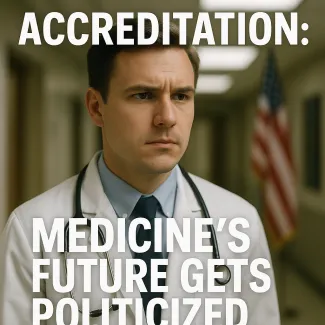
A new accreditation body, claiming to prioritize student outcomes and transparency, has emerged amidst a U.S. healthcare provider shortage. Despite many states enrolling their public universities, the true motivations and potential impact of this body remain questionable.
“You’re so smart, you could be a doctor!”
Being a doctor carries a certain cache in our society. It’s often used as a shorthand for intelligence. There’s a reason for that. There are many educational milestones that providers must achieve, especially in higher education. However, not all educational experiences are equal. Quality varies. This is where accreditation comes in.
Accreditation ensures a certain standard for educational institutions.
“Accreditation” refers to the evaluation of the quality of higher education institutions and their programs. In the United States, accreditation is a major way that students, families, government officials, and the press know that an institution or program provides a quality education.”
Without accreditation, anyone could open any type of school with no expectation of the quality of education provided. Accreditation is the tool we have developed to prevent and combat “diploma mills.” While far from perfect, accreditation organizations have played an important role in ensuring specific educational standards.
There has long been a disagreement and debate about accreditation; not everyone agrees on what are fundamentally the most important aspects of education. Additionally, accreditation standards must be continually updated as technology and knowledge evolve. It’s a moving target and can feel loosey-goosey at times. Could the accreditation process be improved? Almost certainly, and that is a perpetual conversation.
Commission for Public Higher Education
Recently, several states have moved to form a new higher education accreditation body, the Commission for Public Higher Education (CPHE). This new accrediting body will, ostensibly,
“establish rigorous, transparent, and adaptable outcomes-based accreditation standards and practices.”
Additionally, they will “maintain academic quality and operational excellence.” The press release is well-crafted, but delving into the underlying motivation reveals a significantly different picture.
According to the business plan,
“CPHE will be a non-profit organization incorporated in Florida, with 501(c)(3) tax-exempt status under the Internal Revenue Code. The sole member of CPHE will be the Board of Governors of the State University System of Florida as the body corporate.”
In 2025, Florida means Governor Ron DeSantis figures prominently into CPHE. According to USA Today, he has focused on reshaping DEI programs, curricula, and accreditation.
“It’ll upend the monopoly of the woke accreditation cartels. And it will provide institutions with an alternative that focuses on student achievement rather than the ideological fads that have so permeated those accredited bodies.”
Focusing on student achievement sounds great! Cold, hard facts. You either succeed or you don't. Except it begs the question, what are these students succeeding in? DeSantis appears to dislike the current curriculum and wants to ensure that it shifts away from “wokeness.” But what does that mean exactly?
CPHE must publicly state its expectations and values for accreditation. Accreditation bodies often have public-facing documents describing what they expect in education. For the time being, CPHE has no standards; all they have is a business plan. The section labeled “Accreditation Standards, Policies, Procedures & Services” is one figure and one page in length. That is to say, they don’t actually have standards, policies, or procedures.
CPHE stating that they will be transparent and strictly focused on student outcomes is a misdirection; a statement implying that accreditation bodies aren’t already focused on those aspects of education when, in fact, they are. Given that the average person spends little, if any, time immersed in accreditation documents, nor do they seek that experience, CPHE wants you to think that they are pioneering new ground. They’re not. Again, they don’t even have standards, or if they do, they are transparent, in the sense of not being seen, to the public.
“But before voting in favor of the motion, board members repeatedly pushed back, arguing that the plans for starting an accreditor from scratch were half-baked. They raised a litany of questions about how the CPHE would work in practice.” - Inside Higher Ed
Isn’t it a bit strange that multiple states have signed onto a new accreditation body that doesn’t even have educational standards yet? Additionally, Ron DeSantis is at the forefront of this movement. These are red flags about the direction this accreditation body might be heading.
A Thought Experiment
What if this new alternative accreditation body decides that “health freedom” and/or anti-vaccine stances are part of their values? DeSantis recently announced a ban on mRNA vaccine mandates in Florida. What if they refuse to provide accreditation to any school that fails their arbitrary ideological litmus test? While the anti-woke agenda is a dog whistle for people looking for a specific kind of culture war, it's also now inextricably tied to MAHA.
To further the thought experiment, what if we no longer teach evolution in biology classes? Understanding evolution is essential for physicians and other healthcare providers, especially in this time of growing antibiotic resistance, which is literally an evolution happening before our very eyes. What about fluoride? What about supplements? The list goes on.
Florida and Utah already banned fluoride in their water systems. DeSantis has been very public about his feelings about vaccines and vaccine mandates. Imagine a world where providers are taught that vaccines are detrimental to our health and violate our freedom to choose what is best for our health. That is indeed a scary world.
It's not that we can't stand to have a conversation about accrediting bodies and revamping educational standards. As someone who has worked in graduate medical education, I have my wishlist that involves a greater emphasis on learning the scientific method and critical thinking, particularly when it comes to “consuming” scientific information.
However, the thought of breaking off to create an entirely new, untested, and unknown accreditation system, which could potentially compromise the quality of higher education, is incredibly concerning for the future of our healthcare. We run a serious risk of replacing science-based medicine with pseudoscience, charlatans, and wishful thinking. This will not make America better at medicine or our populace healthier.
In the race to fix medical education, the answer isn’t to abandon established standards for a still-empty shell propped up by ideological agendas. Accreditation should evolve, not dissolve into culture wars dressed as reform. If we let political whims rewrite scientific training, the casualties won’t be theoretical—they’ll be patients.

Katie Suleta, DHSc, MPH
Katie Suleta is a regional director of research in graduate medical education for HCA Healthcare. Her background is in public health, health informatics, and infectious diseases. She has an MPH from DePaul University, an MS in Health Informatics from Boston University, and has completed her Doctorate of Health Sciences at George Washington University.