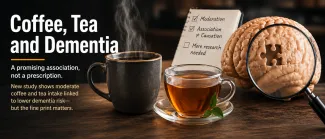
America’s Favorite Stimulant Meets a Growing Fear
While water is the most consumed global beverage, followed by tea, here in the US, at least according to the National Coffee Association, nearly 195 million adults drink coffee, making it our leading beverage. We consume in the range of 135 to 165 mg of caffeine daily (about 1.5 to 2 cups of coffee), primarily from coffee. And for most of us, that is in caffeine’s sweet spot – enough to focus, not sufficient to feel jittery.
Currently, about 10% of the US population is affected by dementia, and researchers suggest that over time, 42% of the population over age 55 will be at risk, with an even greater risk for certain groups, i.e., women and individuals with an established Alzheimer’s biomarker, the APOEε4 variant.
That overlap—an everyday stimulant consumed by millions and a disease that millions fear—helps explain why researchers keep asking whether caffeine might do more than wake us up.
Why Caffeine Seemed Worth Studying
There are plausible biological reasons to ask the question. In the brain, caffeine blocks adenosine receptors, which can influence signaling between nerve cells. Some research suggests it may also affect amyloid, the protein that accumulates in Alzheimer’s disease, while supporting neuroplasticity—the brain’s ability to adapt—and lowering certain markers of inflammation. Coffee and tea also contain antioxidants, which may help reduce oxidative stress. Because caffeine has been linked to improved insulin sensitivity, researchers have wondered whether it could also slow some of the blood-vessel and metabolic injuries that contribute to cognitive decline. None of this proves that caffeine prevents dementia, but it makes the hypothesis biologically plausible.
Given our love of caffeinated beverages, our rising rates of dementia, and a “bioplausable” means for caffeine to be neuroprotective, it is no wonder we have a plethora of studies on the effect of caffeine on the risk of dementia and on the preservation of cognitive function. The newest study adds useful data to the pile—but not a simple prescription.
The new analysis drew on long-term data from women in the Nurses’ Health Study and men in the Health Professionals Follow-up Study. Participants reported how much caffeinated and decaffeinated coffee and tea they drank every 2 to 4 years, and researchers estimated caffeine intake using national averages. They then identified dementia diagnoses through physician reports and death records, while also examining both subjective and objective measures of cognition. The models adjusted for many factors that could confound the relationship, including demographics, lifestyle, diet quality, and existing medical conditions.
- Individuals with the highest intake of caffeinated coffee and tea were 18% less likely to develop dementia than those with the lowest intake.
- Those individuals in the highest intake group had the least subjective cognitive decline, with no difference between caffeinated coffee and tea. [1] They also had better objective
 measures of global cognition, verbal memory, and TICS scores, a telephone-based neuropsychological screening test.
 - These “protective” effects were observed in individuals with the APOEε4 variant, making it an independent factor. Additionally, younger age was associated with greater protection – a not unexpected finding, as dementia increases with age.
The Fine Print Behind the Protective Signal
Now, before running off to your local barista, we should mention some findings that didn’t make the headline news.
Decaffeinated coffee did not show the same protective association. Yet decaf drinkers had lower absolute dementia rates than caffeinated-coffee drinkers, even among occasional drinkers—roughly one to three cups a day. That does not mean decaf is protective; it means the comparison groups may differ in ways that are difficult to fully adjust for.
Objective measures of cognition are particularly difficult to interpret. Researchers suggest that a 2- to 3-point improvement is clinically significant – in the study, the change was 0.11 points. So, we have a statistically significant finding with no clinical utility.
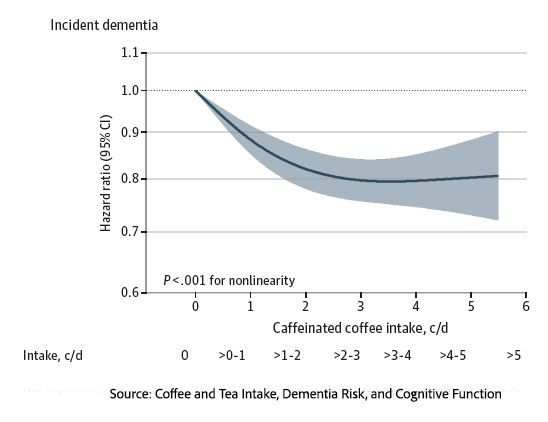
Finally, the dose-response was nonlinear. The lowest risk was observed at a moderate intake—about 2 to 3 cups of caffeinated coffee or 1 to 2 cups of tea per day. Higher intake did not appear to add further benefit. In other words, if there is a protective association, it does not support the idea that more caffeine is better.
Association Is Not Prevention
The strongest claims of the study, such as a pooled 18% reduction in dementia risk for the highest consumers, rely heavily on subjective outcomes, self-reported physician diagnoses, and death certificates. When we pivot to hard, objective neurological data, the signal drastically weakens with an effect size so small that it is clinically irrelevant.
Ultimately, because this is an observational study, it cannot establish causality. Given the lack of robust, statistically significant differences in objective global cognition, we should remain cautious about treating Starbucks as a dispensary of preventive medicine.
[1] Heavy decaffeinated coffee drinkers also had significant subjective declines in function.
Source: Coffee and Tea Intake, Dementia Risk, and Cognitive Function JAMA DOI: 10.1001/jama.2025.27259

Chuck Dinerstein, MD, MBA
Director of Medicine
Charles Dinerstein, MD, MBA, is the Medical Director of the American Council on Science and Health. A vascular surgeon with more than 25 years of clinical experience, he brings a physician's understanding of medical decision-making, an appreciation for scientific uncertainty, and a broader perspective on healthcare economics and policy to his writing.