In early 2025, I wrote about the dismantling of USAID and the impending resurgence of HIV as a result. With USAID effectively gone, the United States has changed how it approaches health-related aid. The guiding framework is the America First Global Health Strategy, which focuses on ensuring that countries contribute a certain share of their gross domestic product to their health systems and on securing US financial interests, such as access to minerals.
The AFGHS lays out plans for bespoke agreements with multiple countries, many of which were receiving aid through the President’s Emergency Plan for AIDS Relief (PEPFAR). While bespoke agreements as a strategy could be effective, the details are really important.
“Our guiding principles in these agreements will include streamlining performance monitoring, reducing non-frontline investment, mobilizing the private sector and faith-based organizations, and requiring increased co-investment from receipt countries for healthcare workers and commodities.”
--America First Global Health Strategy, Bilateral Agreements on Global Health Cooperation
Baked into each agreement is an increase in each country’s investment in its health care system as a percentage of its gross domestic product (GDP), often in excess of 25%. For context, the United States is currently spending about 18% of our GDP on healthcare. For many of our partners, increasing domestic healthcare investments to thresholds that match or exceed 25% of GDP presents a severe economic challenge. Given limited domestic tax bases, many recipient nations are considering export tariffs on primary commodities such as copper and gold. This creates an operational paradox: a strategy designed to secure U.S. commercial access to critical minerals may incentivize partner nations to inflate the costs of those exact resources to fund their state healthcare mandates. Scripps News reports that experts fear the "trade for aid" model raises fear over HIV treatment, hinging it on geopolitical and commercial interests.
The goal had been to have the bilateral agreements signed and executed by the end of 2025, but not all were signed. The most notable and publicly reported has been Zambia, with an April 2026 deadline. With the rapid dismantling of USAID and agreements not yet in place, we’re seeing what we feared: gaps in care.
Gaps in Care
In April of this year, the New York Times published an article on cases of HIV appearing to increase in parts of Zambia. HIV can spread undetected for long periods, since symptoms can take years to develop. The downstream uptick in additional cases will take a while to track, but the fact that we’re already seeing increases is the canary in the coal mine. This is a problem that will continue to unfold over the coming years.
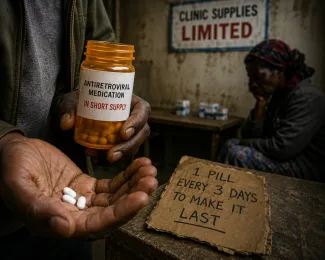
In addition to cases increasing, reporting indicates that access to anti-retroviral medication has been cut off or dramatically decreased.
“They are taking one pill every three days to stretch out the supply. So the virus is being exposed to a less-than-therapeutic dose of the drug and able to more easily select for drug-resistance mutations and overcome the effect of the drug.”
-- Boghuma Titanji, MD, PhD, speaking to CIDRAP at the University of Minnesota
HIV can and does mutate. Subtherapeutic dosing creates an ideal "evolutionary playground" for selective pressure on the virus to evolve resistance to antiretroviral therapy. If a drug-resistant strain of HIV becomes dominant in Zambia, for example, due to these shortages, anyone newly infected will start with a drug-resistant strain. This could render first-line, affordable global HIV regimens obsolete, forcing a shift to more expensive second- or third-line drugs that these countries definitely cannot afford. Unlike Vegas, for infectious diseases, what happens in one part of the world does not stay in that part of the world. If Zambia has a drug-resistant HIV problem, the world has a drug-resistant HIV problem.
This disruption impacts not only those living with HIV but also prevention efforts. According to data tracked by PrEPWatch, distribution of preexposure prophylaxis (PrEP) has plummeted in regions undergoing the transition to bilateral agreements, leaving vulnerable populations without one of our best defenses against infection. This epidemiological regression is a ticking time bomb.
This clinical fallout is not happening in a vacuum. The systemic vulnerability began with the blanket freeze on foreign aid in January 2025, which fractured established PEPFAR procurement buffers. While a humanitarian waiver eventually allowed existing stockpiles to be distributed, the subsequent transition to the AFGHS framework brought structural funding reductions. For example, the draft bilateral memorandum of understanding (MOU) for Zambia revealed a 53% reduction in overall health assistance.
Diseases do not respect boundaries or policy. As the global community learned from the MPox, COVID, the 2014 Ebola outbreak, and others, an uncontrolled viral surge in even a rural area can rapidly become a global health security threat. These bilateral agreements have been slow to implement, and many of the hardest hit nations by HIV have yet to sign, meaning there is still a large gap in funding and, therefore, care.
Depending on how long these agreements take to be signed and what each agreement entails, there will continue to be gaps in care, testing, and prevention, with the virus continuing to claim lives. The resulting surge in viral loads and resistance mutations, for now only a statistical “blip,” presents a quantifiable risk not just to regional populations, but to global biosecurity.

Katie Suleta, DHSc, MPH
Katie Suleta is a regional director of research in graduate medical education for HCA Healthcare. Her background is in public health, health informatics, and infectious diseases. She has an MPH from DePaul University, an MS in Health Informatics from Boston University, and has completed her Doctorate of Health Sciences at George Washington University.