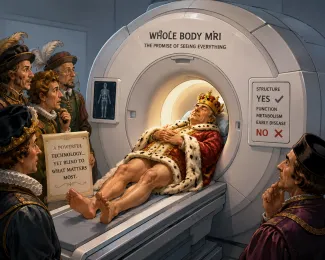
The pursuit of longevity has evolved well beyond eating well and exercising regularly. Among wellness warriors, entrepreneurs, and executives, a new status symbol has emerged: the annual whole-body MRI. Marketed as the ultimate tool for optimizing healthspan, these scans promise to detect hidden disease before symptoms appear, offering reassurance that nothing dangerous is lurking beneath the surface.
The appeal is understandable, yet beneath this compelling narrative lies a more complex reality. While whole-body MRI is an extraordinary diagnostic technology, its strengths are often overstated, its limitations underappreciated, and its role in preventive medicine misunderstood.
What is an MRI
Let me begin with a small confession: while I am as conversant as any vascular surgeon might be with MRI (magnetic resonance imaging) images, my pre-med physics fails me, and I cannot explain how changes in bulk hydrogen proton density, / relaxation times, and tissue water become a spatial map of our bodies.
On the other hand, my practical knowledge of MRI tells me that MRI excels at detecting structural, space-occupying, or water-altering lesions, i.e., solid masses, fluid collections, and structural alterations, frequently amenable to the kind of medicine I practice, surgery; it is inherently insensitive to other diseases.
- Diseases driven by aberrant membrane voltage, ion-channel mutations, or electrical conduction defects that produce no detectable changes on MRI, such as cardiac arrhythmias or seizures
- Early neoplastic transformation whose depth, mass effect, or altered vascular permeability are below the resolution of MRI, rendering them completely invisible.
- Metabolic and endocrine dysfunction, such as diabetes and hyperlipidemia, is characterized by receptor down-regulation, enzymatic deficiencies, or hormonal dysregulation and can remain asymptomatic long before structural end-organ changes become apparent, if at all.
- Diffuse disease without a structural, space-occupying mass, i.e., blood disorders such as chronic lymphocytic leukemia, “inflammation,” or early infectious disease – MRI cannot see pathogens; it sees the host response.
MRI Finds, Not Predicts Disease
These blind spots highlight why whole-body MRI cannot act as a standalone "all-in-one" screening modality. Comprehensive preventive screening continues to rely on combining physical imaging with liquid biopsies (ctDNA), functional tests (ECG, stress testing), endoscopic visualization, and targeted biochemical assays.
Combining these modalities addresses the limitations of using either in isolation. Liquid biopsies and biomarkers serve as a sensitive molecular alarm, flagging abnormal biology. MRI is the targeted searchlight, pinpointing the physical location for intervention. Traditional screening and diagnostic workups are predicated on this combination of alarm and searchlight, backed up by the pioneering work of English mathematician and cleric Thomas Bayes and subsequent statistical research.
Bayes and the math of screening
With apologies for the nuance of his work, for our purposes Bayes showed that our confidence in an idea shouldn't be static but rather a flexible measure that updates with each fresh piece of evidence. In simple terms, you start with a reasonable initial guess and continually refine your level of certainty as fresh information comes to light. The diagnostic power of any scan or screening is governed by Bayes' theorem.
Screening populations, as the wellness warriors advocate, are inherently uncertain. There is background noise, which we term false positives, that can drown out or greatly diminish the signal we seek to identify. Bayes' theorem tells us that when we are suspicious that a disease is present because of subtle or absent symptoms or physical findings, screening can have a powerful positive predictive value, confirming or refuting our suspicions.
When we are dealing with the walking well, where we have little to no concern, the noise-to-signal ratio spikes, and the positive predictive value collapses. In general, only 1 or 2% of healthy adults will have a life-threatening pathology identified, often anecdotally reported as “heroic saves” in wellness marketing. The Bayesian truth in the real world is that there is currently no population-level evidence that routine MRI screening reduces all-cause mortality or extends healthspan in asymptomatic adults.
However, the MRI frequently identifies the dreaded incidentaloma, clinically irrelevant discoveries, and false positives that trigger a significant cascade of downstream events.
When One Scan Becomes a Cascade of Tests
Well-patient screenings are rarely covered by insurance and remain primarily an out-of-pocket expense, frequently ranging from $1,000 to $3,000. However, the subsequent evaluation needed to investigate incidentalomas, which requires more imaging, serial surveillance, medical consultation, and the mandatory assuaging of fears, can quickly accumulate. Some of those additional costs are covered by insurance, adding to rising rates for us all.
Some additional testing carries non-zero risks, especially when more invasive probing is warranted. We now have a substantial body of literature on indolent, slow-growing disease, such as low-grade prostate cancer or in situ breast dysplasia, that may never be a life-altering problem. Yet once known, these conditions have become a source of overtreatment and psychological distress. Studies evaluating screening cascades consistently report marked anxiety and diagnostic distress during the weeks or months spent waiting for secondary imaging, serial monitoring, or tissue biopsy results.
Detection outpaces treatment
These wellness screenings and all the “maxxing” around the quantified self are often wrapped into the concept of precision medicine - catching disease when it is molecularly or anatomically simple and matching it to a highly specific targeted therapy. Screening modalities are proffered as the primary bridge to this approach.
However, the breakdown in the current wellness screening trend occurs when our ability to detect or predict under most circumstances outpaces our ability to precisely intervene. Those incidentalomas effectively transform a healthy individual into a "patient-in-waiting" without offering a clear therapeutic advantage. Without that actionable therapeutic endpoint, screening remains an exercise in risk prediction.
Selling FOMO Instead of Better Health
Executive health programs and longevity clinics use the fear of missing out (FOMO) of healthspan, our healthy years, as a marketing tool, selling low-value, high-Bayesian-noise care as an elite life-saving medical secret. In reality, it is an out-of-pocket luxury commodity where consumers pay significant sums for uncertainty and diagnostic cascades.
Wellness providers monetize the desire for biological longevity and optimization, while the pricing elevates that desire to a virtual signal of status. By framing aging and asymptomatic biology as something to be continuously scanned and tracked, they turn healthcare into a recurring remunerative subscription service.
Most of us, unable or unwilling to spend discretionary income on this “life-extending” care, are not being deprived of a life-saving medical secret; we are protected by evidence-based guidelines that influence coverage and do not fund a costly diagnostic wild goose chase.
MRI is one of medicine's greatest diagnostic achievements—but only when it is used for the job it was designed to perform. It is extraordinarily good at locating structural disease once biology has raised the alarm; it is far less capable of serving as the alarm itself.
The FOMO surrounding these scans misdirects attention away from what actually drives healthspan. For most people, the greatest returns on longevity still come from remarkably ordinary interventions: maintaining fitness, controlling blood pressure and lipids, preventing diabetes, sleeping well, avoiding tobacco, and following evidence-based screening guidelines. Those strategies may lack the glamour of a $3,000 scan, but unlike wellness marketing, they have already proven they can save lives.

Chuck Dinerstein, MD, MBA
Director of Medicine
Dr. Charles Dinerstein, M.D., MBA, FACS is Director of Medicine at the American Council on Science and Health. He has over 25 years of experience as a vascular surgeon.