From Gamble to Certainty
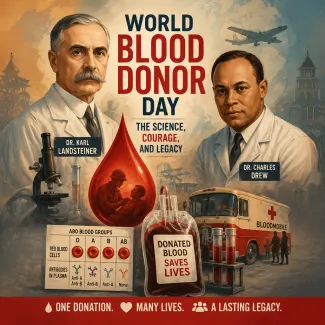
June 14th has been designated by the World Health Organization (WHO) as World Blood Donor Day, and we can take this moment to honor the two scientists responsible for our modern blood banking system. The WHO chose today’s date to commemorate the birthday of Dr. Karl Landsteiner, the Austrian biologist and physician whose discovery of the ABO blood groups transformed blood transfusions from a gamble into a personalized, lifesaving medical procedure.
Landsteiner noticed that when red blood cells from one person were mixed with the liquid portion of another person’s blood, the cells sometimes clumped and sometimes did not. That simple observation revealed a hidden biological code. Red blood cells carry inherited markers, now known as A and B antigens, that determine the four major ABO blood types. The liquid portion of blood contains antibodies, immune proteins that distinguish what belongs in the body from what does not. When the wrong blood type is transfused, those antibodies can attack the donated red cells, causing them to clump and triggering a dangerous transfusion reaction. Landsteiner’s discovery became the basis for blood typing and cross-matching, work that earned him the Nobel Prize in 1930.
But safe transfusion was only part of the problem. To make blood available beyond the bedside, we must consider another physician, Charles Drew, who was early in his career when Landsteiner received his Nobel. He was the physician who brought blood transfusions to us all.
Banking Blood
Charles Richard Drew was born in Washington, DC, and earned an athletic scholarship to Amherst College. A prolonged hospitalization for a football injury, along with the loss of his sister to the 1918 Influenza pandemic, led him to pursue medical school. He attended McGill University in Canada, where Black students had opportunities often denied to them in segregated American institutions. Drew’s work in blood preservation deepened during his doctoral studies at Columbia University and culminated in his dissertation, Banked Blood: A Study in Blood Preservation. Historic events were about to give that research a global reach.
As World War II intensified in Europe, Great Britain faced a catastrophic shortage of blood and plasma to treat casualties. Whole blood was perishable and could not be transported over long distances or for extended periods. Drawing on the work of his thesis, Drew separated whole blood into red blood cells and plasma – both considerably more shelf-stable – using centrifugation and sedimentation, added antibacterial stabilizers, and conducted rigorous bacterial testing. Under his leadership, the program collected over 14,500 donations and shipped more than 5,000 liters of lifesaving plasma saline solution across the Atlantic. He went on to introduce "bloodmobiles," refrigerated mobile donation trucks that transformed blood collection from a localized hospital procedure into a massive public outreach effort, the model for today's national blood donor networks.
Despite Drew’s scientific leadership, the military and the American Red Cross adopted blood policies shaped by racism rather than by biology. Blood from Black donors was first excluded and later segregated, even though Drew argued there was no scientific basis for this. He resigned from his work with the American Red Cross and later criticized the policy directly,
"It is fundamentally wrong for any great nation to willfully discriminate against such a large group of its people. . . . One can say quite truthfully that on the battlefields, nobody is very interested in where the plasma comes from when they are hurt. . . . It is unfortunate that such a worthwhile and scientific bit of work should have been hampered by such stupidity."
Drew died in 1950 at age 45 in a tragic car accident, but the systems he helped build continued to expand. His work helped establish blood banking as a public health infrastructure rather than hospital-by-hospital improvisation. The same insight that guided Drew’s wartime work still shapes transfusion medicine today.
The Evolution: Beyond Whole Blood
A cornerstone of Dr. Drew’s early research was the recognition that whole blood was not always the most effective or efficient treatment for every patient. He discovered that blood plasma was far more stable, had a longer shelf life, and could be safely given to any patient regardless of blood type.
Today, blood banking relies on component therapy: a single donation can be separated into parts, allowing clinicians to give patients the specific blood component they need.
- Packed red blood cells restore oxygen-carrying capacity for patients with severe anemia, major trauma, or blood loss during surgery.
- Plasma, the liquid portion of blood, contains proteins and clotting factors that can help treat shock, burns, and bleeding disorders.
- Platelets are tiny cell fragments that help blood clot and are often essential for patients at risk of dangerous bleeding, including those undergoing cancer treatment or major procedures.
- Cryoprecipitate, a concentrated plasma-derived product, contains specific clotting proteins and can be used for severe bleeding or complex surgical emergencies.
World Blood Donor Day is more than a celebration of giving. It is a reminder that every safe transfusion depends on science, systems, and human generosity. Landsteiner helped reveal how to match blood safely. Drew helped show how blood could be preserved, transported, and made available at scale. Together with generations of donors, clinicians, researchers, and public health workers, their legacies live on each time a donation becomes a lifeline.
Sources: Dr. Charles Drew: A Pioneer in Blood Transfusions
Charles R. Drew (1904-1950): A Pioneer of Blood Banking Cureus DOI: 10.7759/cureus.76181

Chuck Dinerstein, MD, MBA
Director of Medicine
Charles Dinerstein, MD, MBA, is the Medical Director of the American Council on Science and Health. A vascular surgeon with more than 25 years of clinical experience, he brings a physician's understanding of medical decision-making, an appreciation for scientific uncertainty, and a broader perspective on healthcare economics and policy to his writing.