The average laying chicken has a life expectancy of about two years, far greater than that of its brethren, chickens bred for meat, who barely reach chicken “tweenhood” at six weeks, when they “move on.” So for the laying chicken, free-range is indeed more of a lifestyle than for the “broilers,” where, in the words of Michael Pollan, free-range is more of a vacation option than a lifestyle choice. That said, laying chickens begin producing eggs at about five months of age and continue to be egg factories for about a year, after which age results in fewer eggs with more fragile shells, and the layers “move on.”
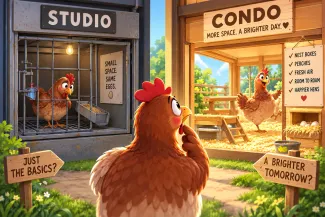
Animal welfare proponents have emphasized the need for a free-range environment, especially compared with battery-cage life, the chicken version of tenements. Battery or unenriched cages are minimal, bare-wire enclosures designed to maximize operational efficiency—with continuous metal feeders, automated overhead watering, and a sloping floor that allows eggs to roll onto a conveyor without assistance. Unlike “furnished or enriched” cages, they have no nest boxes, perches, scratch pads, or litter areas. Battery cages are the studio apartments of layers, with square footage smaller than a single sheet of paper, restricting much natural movement.
The Price of a Better Henhouse
Without a rent-control board like the one in New York City, housing comes at a cost. A study reported in Royal Society Open Science examines the environmental and mortality costs of the housing trade-offs—two factors that are priced into the cost we pay for eggs. Fun fact: as pointed out by the authors, “Eggs accounted for 9% of global average animal protein consumption in 2022,” and laying hens constitute the largest overall population of terrestrial animals kept in cages throughout their lives. Despite efforts to “End the Cage Age” in the UK, EU, and US, intensive cage systems remain the primary housing method in major egg-producing nations, including China, India, and the United States.
The environmental footprint considered all the resources and pollution in egg production: growing the feed, energy (electrical) generation, housing, and manure management, all the same ones we might use in evaluating the ecological footprint of our housing environments. Outcomes of interest included:
- Global warming potential in kilograms of carbon dioxide
- Acidification by air pollutants escaping from manure and chemical emissions from energy use, increasing soil, water, and rain acidity.
- Eutrophication, the excess nitrogen and phosphorus leaking from manure and feed crop fertilizer into waterways, fueling algal blooms
- Land occupation, the physical land area required to produce a kilogram of eggs
Animal welfare was assessed using three objective measures, and the exclusion of more qualitative measures of animal welfare is a distinct limitation. That said, outcomes included:
- Mortality rate during the hen’s laying cycle—a measure of disease outbreaks as well as more hidden welfare issues such as pecking injuries
- Animals affected and subsequently slaughtered, reflecting the total number of hens required to achieve a standard level of egg production.
The Free-Range Paradox
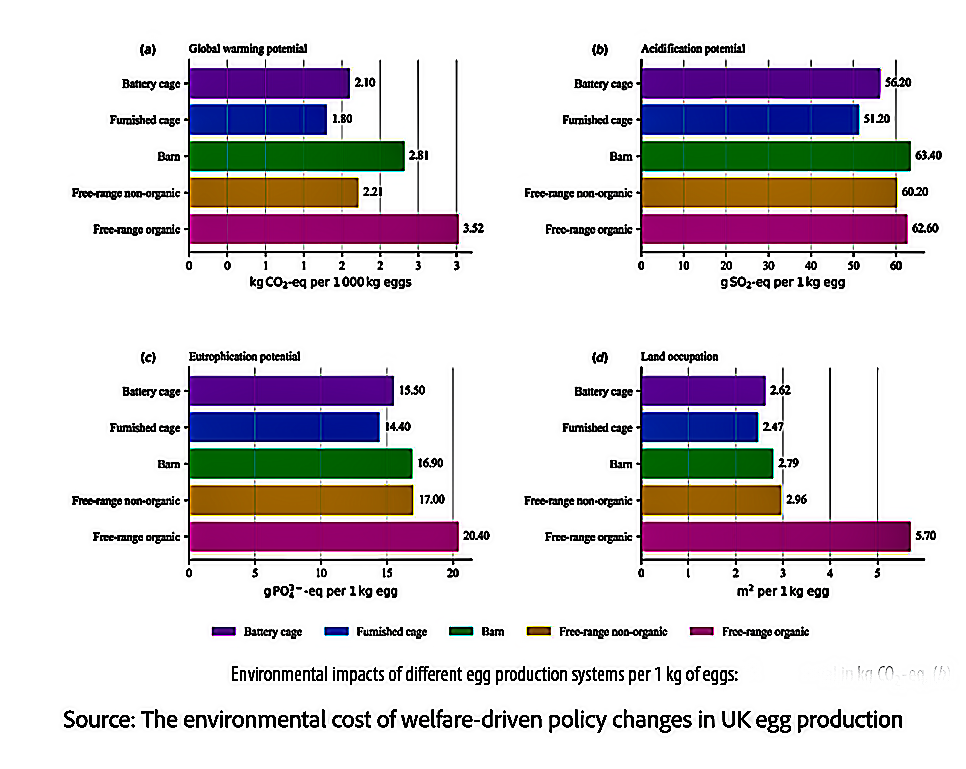 The resulting calculations reveal an unexpected trade-off. Housing modifications designed for animal welfare systematically increased resource consumption, emissions, and overall mortality. Could the drive for better chicken lives result in more chicken deaths?
Feed production drove most environmental impacts. As a result, any drop in feed-conversion efficiency, whether caused by cold weather, exercise, lower dietary nutrient density, or disease, compounds its ecological footprint.
Mortality outcomes were more complex. Outdoor and free-range systems leave hens exposed to pathogens carried by wild birds, such as avian influenza, as well as soil-borne parasites and infectious diseases. They also expose hens to weather extremes. Indoor flocks are more susceptible to bacterial infections and suffer irritation from air pollutants, particularly high ammonia levels from built-up floor litter. High-density uncaged populations are more prone to uncontrolled pecking and cannibalism as the natural social hierarchy is lost at these flock sizes. Cages limit those issues. While cage systems limit behavioral freedom, their physical isolation protects birds from infectious vectors, aggression, and harsh weather—resulting in the substantially lower baseline mortality rates observed in the data. Further complicating matters, organic layers were less productive, requiring a larger population to produce the same number of eggs. This increased their overall flock sizes and contributed additional deaths from both disease and ultimately slaughter.
The best way to care for layers depended heavily on the trade-offs considered. With a strict environmental focus, furnished cages were unequivocally the best option, delivering the lowest greenhouse gas emissions, land footprint, and nutrient pollution. Free-range organic systems performed worst across nearly every ecological metric. When hen welfare is the focus, the trade-off becomes even more critical. Furnished cages minimized total flock deaths and slaughter counts. Free-range systems provided the greatest behavioral freedom but had the worst mortality rates, requiring significantly larger flock sizes.
The Trouble With Easy Choices
Neither the authors nor I are calling for caging hens. As they write, “transitioning to cage-free systems without also improving factors such as mortality and feed efficiency is likely to increase environmental impacts.” The point is not that cages are good or free-range systems bad. It is that improving one thing we value can make another worse.
That is the uncomfortable reality of trade-offs and policymaking. We want hens to behave naturally, fewer animals to die, less land and feed to be consumed, and fewer greenhouse gases and pollutants to be produced. Those goals do not necessarily move together.
Social media prefers choices in black and white: humane or cruel, sustainable or destructive, virtuous or indifferent. Reality is less cooperative. Sometimes the responsible choice is not choosing the “good” side, but deciding which costs we are willing to accept to obtain which benefits. The cost of eggs reminds us that every policy eventually sends us a bill.
Source: The environmental cost of welfare-driven policy changes in UK egg production Open Science DOI: 10.1098/rsos.251830

Chuck Dinerstein, MD, MBA
Director of Medicine
Dr. Charles Dinerstein, M.D., MBA, FACS is Director of Medicine at the American Council on Science and Health. He has over 25 years of experience as a vascular surgeon.