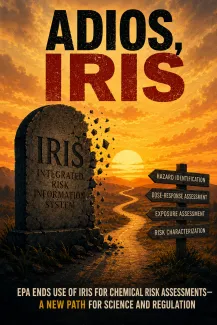
In one of the most consequential institutional changes at the EPA in decades, Deputy Administrator David Fotouhi announced in an internal memo that the EPA will no longer use the Integrated Risk Information System (IRIS) program to develop chemical risk assessments. Instead, risk assessments will be conducted by the individual EPA regulatory program offices, including the Office of Water, the Office of Air and Radiation, the Office of Chemical Safety and Pollution Prevention, and the Office of Land and Emergency Management. While this is an internal change and may not immediately prompt a significant public reaction, its impact is seismic.
Risk assessment at EPA is based on four core elements:
- Hazard Identification
- Dose-Response Assessment
- Exposure Assessment
- Risk Characterization
IRIS is concerned only with the first two elements: determining whether a chemical can cause adverse health effects and assessing the relationship between the magnitude of exposure and the severity of those effects. The regulatory program offices typically carry out the final two elements: estimating the amount of exposure to a chemical and the total risk by combining information from the previous elements.
The memo’s core argument is that the first two elements, currently managed by IRIS, should be returned to the regulatory program offices because they are best equipped to ensure that the health values reflect the statutes of the individual offices. This would return to an earlier EPA, before this function became centralized in IRIS. The memorandum’s downstream impacts require that EPA program offices that previously used IRIS in their regulatory decision-making review how the information was used and determine whether any changes or updates are needed, and that the EPA’s Office of Applied Science and Environmental Solutions, reorganized from EPA’s Office of Research and Development, ensure internal coordination among EPA program offices.
All existing IRIS assessments will remain available to the public, but a disclaimer will be added to the IRIS website clarifying that the IRIS values are not necessarily intended for use as regulatory levels.
Why IRIS Was Created
IRIS was first established in 1985 to provide the EPA with consensus positions on the health effects of chemicals found in the environment. This was necessary because, without it, each EPA office often used its individualized data sources to calculate different health values for the same chemical.
The purpose, role, and power of IRIS fundamentally changed in the 1990s as the process expanded to include developing Toxicological Review documents required by EPA offices to serve as the basis for EPA regulations. However, IRIS is neither statutorily mandated nor subject to the Administrative Procedure Act (APA), which requires agencies to publish proposed rules in the Federal Register and accept public comment.
When Consensus Became Controversy
Currently, IRIS contains assessments for about 570 of the roughly 42,000 chemicals in US commerce. The IRIS process takes decades to complete, leaving the EPA and the private sector without chemical hazard information for most chemicals. Most of the IRIS assessments were completed in the 1980s and 1990s.
IRIS evaluations have been controversial since the 1990s, particularly regarding formaldehyde. The first IRIS assessment of formaldehyde was released in 1990 and 1991; a draft assessment was released in 2010 and finalized in 2024. The final assessment was criticized by the American Chemistry Council, a trade group, for failing to use the best available science and for not incorporating peer-review comments from respected scientific committees.
Another controversial IRIS assessment concerned ethylene oxide. The draft assessment was released in 2006 and finalized ten years later, changing the EPA cancer risk descriptor from “probably carcinogenic to humans” to “carcinogenic to humans” and concluding that ethylene oxide was much more toxic than previously determined. The IRIS toxicity value was again criticized by the American Chemistry Council because it is 19,000 times lower than naturally occurring levels of ethylene oxide in the human body.
These IRIS assessments and others drew Congress's attention because IRIS, a program not authorized by Congress, has a tremendous economic impact on important American industries. In 2017, hearings were held in Congress on IRIS, and two bills, the Improving Science in Chemical Assessments Act and the No IRIS Act, were later introduced calling for the elimination of IRIS, although neither became law.
A Necessary Change, With a Necessary Caution
As I have discussed in a previous publication and in ACSH articles, I believe change is needed in IRIS. In an Agency where the goal should be to use the best science and methods available, IRIS often acted as a choke point, where new, often better information and data went to die. This was because incentives were misaligned; the bureaucracy did not want to start over and redo the years of work it took to develop the original values.
The problem is exacerbated because IRIS’s risk assessments must follow EPA guidance for cancer and non-cancer assessments. The most recent EPA cancer guidelines are from 2005, and the non-cancer guidelines range from 1986 to 1998 [1]. Given their age, these guidelines result in methods that are not aligned with current science and often yield values that defy common sense.
Ending IRIS will allow EPA program offices to use more current science, better data, and methods better suited to their statutory responsibilities. That is a needed correction as IRIS had become a slow-moving choke point rather than a source of scientific clarity. But unless the agency creates a credible mechanism for coordination, it may trade one problem — outdated centralized assessments — for another, inconsistent risk values for the same chemicals across different regulatory programs.
[1] The EPA has set guidelines for specific types of noncancer effects, including mutagenicity (1986), developmental toxicity (1991), reproductive toxicity (1996), and neurotoxicity (1998).