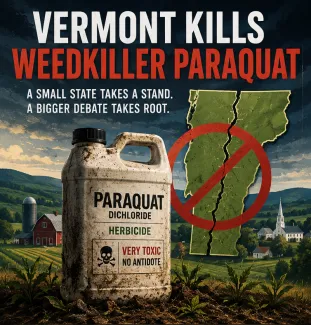
On May 26, 2026, Vermont became the first U.S. state to ban paraquat, a weed-killing pesticide, due to its potential link to Parkinson’s disease. This ban is symbolic rather than practical, as only about 20 farmers in Vermont used paraquat in 2024 (107 gallons). But bills to ban paraquat have been introduced in about a dozen other states, and internationally, paraquat is banned in 74 countries. Why does the U.S. still allow its use when alternatives are available?
What is Paraquat?
Paraquat dichloride, commonly referred to as paraquat or its commercial brand Gramoxone, is used to control weeds. It is popular among farmers because it works quickly, doesn’t leach into groundwater, doesn’t carry over to the next season, and doesn’t injure crop roots below the soil surface. It only kills what it touches, meaning it can be sprayed in an orchard without worrying about uptake into the tree or transfer to the fruit.
However, it is very toxic! One teaspoon can cause death, with no antidote. Paraquat has been responsible for hundreds of thousands of intentional and accidental poisonings worldwide, and its acute toxicity is the reason paraquat has been banned in 74 countries.
A Twisted Path
Paraquat was synthesized in 1882 and initially used as a chemical dye. Its herbicidal properties were discovered in 1955, and by 1961 it was produced industrially in the U.K.
There are no U.S. producers of paraquat. Syngenta was the largest seller of paraquat in the U.S. market, producing it at its U.K. plant. However, Syngenta is stopping production of paraquat this July, leaving China as the world's largest producer of paraquat, even though it bans it domestically.
Paraquat’s regulatory path in the U.S.:
- 1964 – Paraquat registered for use
- 1978 – Paraquat classified as “restricted use” due to its high acute toxicity [1]
- 1997 – EPA completes registration review for paraquat
- 2011 – EPA starts the current 15-year registration review cycle
- 2019 - EPA completes draft human health risk assessment
- 2021 – EPA issues interim registration review decision allowing continued use of paraquat with new control measures
- 2021 – A coalition, including the Michael J. Fox Foundation, sued the EPA to overturn its decision allowing continued use of paraquat
- 2024 – Syngenta submits a new vapor pressure study of paraquat to the EPA, indicating that higher vapor pressure leads to more exposure than previously used in the EPA’s risk assessment
- 2025 – EPA issues a data call-in notice to paraquat manufacturers requesting additional data on vapor pressure, saying it could take approximately four years for EPA to complete its review of these studies
- October 2026 – Statutory deadline for reregistration of paraquat.
Today’s controversy about banning paraquat is not about its acute toxicity; it is centered on a potential link between paraquat and Parkinson’s Disease.
Parkinson’s Disease
As previously discussed by ACSH, Parkinson’s Disease is the second most common neurodegenerative disease in the U.S. (Alzheimer’s remains first), affecting approximately 1 million Americans. Its symptoms include stiffness, tremors, slowness, changes in mood, memory, and thinking, and difficulty eating or sleeping. Age is the most consistent risk factor for Parkinson’s Disease.
The earliest studies on a possible link between paraquat exposure and Parkinson’s Disease date to the 1980s. In its 2019 draft risk assessment for paraquat, the EPA concluded that “for occupational exposure, there is limited, but insufficient epidemiological evidence of a clear associative or causal relationship” and “for non-occupational exposure, there is insufficient epidemiological evidence of a clear associative or causal relationship” for paraquat and Parkinson’s Disease. In its 2021 interim registration review decision on paraquat, the EPA concluded that “the weight of evidence was insufficient to link paraquat exposure from pesticidal use of US-registered products to Parkinson’s Disease in humans.”
Since that time, the relationship has only grown murkier.
An analysis of 21 studies published between 2019 and 2021, using data from the Agricultural Health Study, the largest study of commercial paraquat applicators and their spouses in the US, which included approximately 52,000 private applicators, 4,900 commercial applicators, and 32,000 spouses, found no association between paraquat exposure and Parkinson’s Disease.
However, another recent study reached the opposite conclusion. This study examined 829 Parkinson’s Disease patients and 824 controls in agricultural regions of Central California and found that higher levels of paraquat exposure at home or at work were associated with an increased risk of Parkinson’s Disease.
Alternatives to Paraquat
There was more than 17 million pounds of paraquat used in the U.S in 2018 (the most recent agricultural survey available from the U.S. Geological Survey). As shown in the chart, paraquat use is dwarfed by other pesticides, with glyphosate being by far the most used pesticide in the U.S., with an estimated 287 million pounds applied in 2016, more than three times more than all other pesticides combined. Atrazine is second at about 75 million pounds and 2,4-D is third at about 50 million pounds.
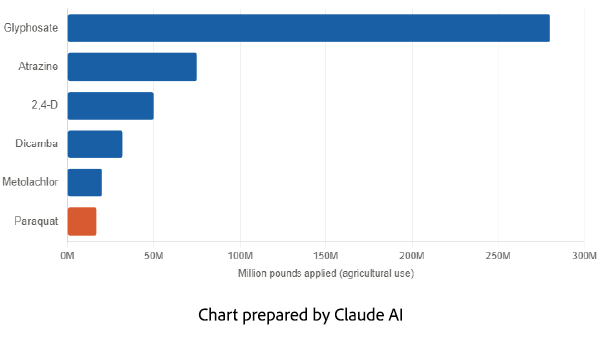
Glyphosate, the most widely used substitute for paraquat, has much lower toxicity than paraquat, but it must be applied at much higher rates, increasing costs. It also causes resistance in weeds, reducing its effectiveness over the long term. There are other, less toxic alternatives to paraquat; however, each comes with its own trade-offs.
No single alternative replicates paraquat’s low cost, rapid contact time for killing weeds, lack of movement through the soil, and the absence of weed resistance. That is why the agricultural lobby argues that a ban would disrupt weed management, particularly in cotton and soybean production in the South. But these arguments are running up against the MAHA movement, which has been pressuring the Administration to do more to ban pesticides, as well as large health nonprofits, such as the Michael J. Fox Foundation, which argue that the health concerns associated with paraquat (Parkinson’s Disease) far outweigh its benefits.
EPA Administrator Lee Zeldin’s January 2026 tweet that the Agency had made the “proactive decision to reassess” paraquat’s safety may have sounded like action, especially with its nod to MAHA’s call for stronger pesticide protections. But so far, it remains just that: a statement. The EPA has not taken new regulatory action on paraquat or begun a new safety assessment.
That gap between words and deeds matters. Vermont’s ban is unlikely to change American agriculture by itself. But it may change the politics of paraquat. If the EPA continues to signal concern without acting on it, more states are likely to fill the vacuum — not because the science has suddenly become simple, but because federal hesitation has made symbolic action look like leadership.
[1] The EPA’s requirements for paraquat as a “restricted use” pesticide include: application only by a certified applicator; no transferring to food, drink, or other containers; it must be kept secured to prevent access by children; no storage in or around residential buildings; and no use around home gardens, schools, recreational parks, golf courses, or playgrounds.

Susan Goldhaber MPH
Susan Goldhaber, M.P.H., is an environmental toxicologist with over 40 years’ experience working at Federal and State agencies and in the private sector, with an emphasis on issues concerning chemicals in drinking water, air, and hazardous waste. Her current focus is on translating scientific data into usable information for the public.