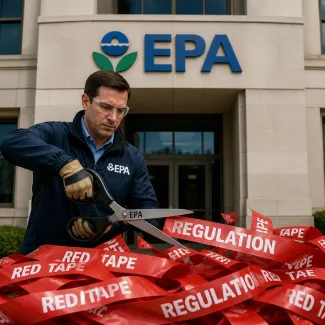
Reporters love an apocalypse, even when they have to invent one. When the Environmental Protection Agency (EPA) moved to roll back greenhouse gas mandates for fossil-fuel power plants last month, the Los Angeles Times ran with this misleading headline: “EPA scraps power plant emissions limits in sweeping rollback.”
The story framed the decision in catastrophic terms, warning readers that the agency “will no longer regulate dangerous planet-warming pollution” from the nation's power sector:
“The Environmental Protection Agency is abandoning federal limits on planet-warming pollution from coal and gas power plants, dismantling most Biden-era climate rules in the name of lowering energy costs. Experts warn the rollback could add up to 5.8 billion metric tons of carbon dioxide emissions by 2050 and trigger hundreds of billions in health damages from pollution-driven disease and premature deaths.”
To put it politely, this is an incomplete explanation of EPA’s revised regulations. Allow me to clarify what actually happened.
First, the EPA did not dismantle regulations on conventional air pollution, which is clear if you just read the agency’s news release announcing the rollback. Criteria pollutants—the soot, sulfur dioxide, nitrogen oxides, and mercury that directly affect human health—remain strictly regulated under the Clean Air Act. The agency simply repealed the previous administration’s 2024 Carbon Pollution Standards, which mandated carbon capture and storage (CCS) technology for long-lived coal and new baseload gas plants.
One of the fundamental problems with the now-repealed rule is that capture technology has never been adequately proven as a nationwide compliance mandate, given the lack of necessary pipeline and storage infrastructure and the prohibitive costs. The LA Times ignores this critical detail, conflating CO2 limits with health-based clean-air safeguards in an effort to produce a juicier headline.
The other fundamental problem is that dire warnings of environmental doom have circulated for decades, yet the most severe projections consistently collapse as their maturity dates come and go. In 1989, for instance, a United Nations official infamously warned that entire nations could be wiped off the map by rising sea levels if the global warming trend were not reversed by the year 2000. "He said governments have a 10-year window of opportunity to solve the greenhouse effect before it goes beyond human control," the Associated Press reported at the time. Two and a half decades after that deadline, observed sea-level rise has continued at a modest rate of a few millimeters per year, rather than the catastrophic inundation once predicted.
The awkward fact many reporters (and even some researchers) don’t want to face is that the science used to justify heavy-handed climate regulations is facing a reckoning. For years, catastrophic forecasts relied heavily on extreme, high-emissions modeling known as RCP8.5, which assumed an implausible, near-tenfold expansion of global coal consumption by 2100.
In a landmark 2026 climate reassessment, leading researchers officially retired those extreme pathways, acknowledging they are no longer plausible given actual energy trends. Ironically, even the LA Times felt it necessary to grapple with this enormous revision in projections of future warming:
“American Enterprise Institute’s Roger Pielke Jr. said changes to the highest-end scenario matter because it was presented as a likely future that could come true if nothing changed. Thousands of scientific studies have been based on that highest warming scenario, called RCP8.5, even though research had already shown it to be improbable.
‘It was always presented as where we were headed absent explicit climate policy,’ even though it was based on out-of-date and incorrect coal-heavy energy theories, Pielke said in an email.”
Put simply, the old worst-case emissions path is now recognized as highly improbable by leading experts—and reluctantly reported by journalists. We’re watching policymakers, the media and the wider public grapple with the complex science climate researchers have been examining for many years. For instance, a 2016 study published in Nature Geoscience discovered that reductions in sulfate aerosols over Europe inadvertently contributed to roughly a half-degree Celsius of warming in the Arctic.
As a January 2018 Scientific American report noted, industrial particulate pollution acts as a reflective shield, masking some warming by bouncing sunlight back into space. It’s just one example of the conclusion that earth’s climate system involves competing forces and natural feedbacks. Recognizing this complexity is a perfectly valid reason to abandon simplistic models and the mistaken policy prescriptions that flow from them, which is why the EPA’s September repeal makes plenty of sense.
Regulatory common sense that respects legal precedent is exactly what Americans should want in federal agencies. Regulatory bodies like EPA have a habit of grasping for more authority and using whatever justification they need to in the process. Following Supreme Court rulings such as West Virginia v. EPA, the federal government is again recognizing that unelected bureaucrats cannot stretch the Clean Air Act to force a wholesale restructuring of American energy grids through de facto retire-or-capture mandates.
America has achieved dramatic reductions in industrial air pollution since establishing fine-particulate standards in 1997, driven by market shifts toward natural gas and targeted technology standards. Forcing the entire grid onto unproven carbon-capture mandates was an unworkable mistake from the start, and EPA is simply acting in accordance with that well-established conclusion.
So, contrary to all the malcontented news coverage, the agency is not gutting pollution regulations so industry can poison the air, nor is it denying the reality of climate change. The federal government is just checking regulatory overreach, anchoring energy policy in statutory law and economic reality rather than perpetual alarmism. That’s a good thing.

Thom Golab
Thom Golab is the President of the American Council on Science and Health. Prior to becoming President in 2019, Mr. Golab joined ACSH as Vice President of Development in May 2017 and has served on the ACSH Board of Trustees since 2012.