A blood clot ended Jalen Hurt’s season, and the search for someone to blame began almost immediately. But the most important questions—what the initial ultrasound showed, what risks were discussed, and how treatment decisions were made—remain unanswered. As a vascular surgeon, I know a bad outcome doesn't necessarily mean someone made a bad call.
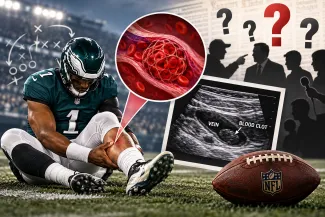
I have been reluctant to opine on Jalen Hurt’s medical condition because, like every other would-be pundit, I know nothing about the events, clinical findings, or judgments. That said, as a vascular surgeon, I know the diagnostic and treatment algorithms. As a survivor of both a deep vein thrombosis and a pulmonary embolism, I may have some insight.
From a Cleat Injury to a Blood Clot
We know he suffered a “cleating” injury to his left calf and sought medical evaluation. Based on their examination, the physicians ordered a venous ultrasound to detect clots in both the superficial and deep venous systems. Superficial clots, especially in the calf, are small and rarely break off to travel to the lungs, causing a pulmonary embolism. Typical management includes elevating the leg to reduce swelling and using over-the-counter pain medications for symptomatic relief. In some instances, when the superficial clot is in the upper thigh and therefore larger, some physicians, out of an abundance of caution, might add an anticoagulant to reduce the risk of the clot enlarging and then breaking off to become an embolism.
Several days later, upon returning to the US, a repeat venous ultrasound detected clots in the deep venous system, and additional testing identified pulmonary embolisms. At that point, Mr. Hurt needed full anticoagulation and leg rest for several days to reduce the risk of further clots embolizing. In his physicians' judgment, the need for anticoagulation meant his season was over. You cannot have a football player being tackled who is at an increased risk of bleeding – it is malpractice and certainly violated the responsibility of the physician to act in the best interest of Mr. Hurt.
What Did the First Ultrasound Really Show?
Taking all the opinions into account, the NFL and the Eagles left one question unanswered: what the exact findings were at the time of the initial venous ultrasound. Our description of the leg veins contains an oddity. The superficial femoral vein is, in fact, deep and a source of pulmonary emboli. For the most part, we have changed the language used to describe these veins as the femoral vein, but I am not sure whether the British report used that language, nor do I know whether the treating physician reviewed the ultrasound with the radiologist. Making that original ultrasound available, with Mr. Hurt's permission, might resolve some of these questions. But his medical record is his to disclose, not ours to demand.
Small Risk, Big Consequences
The second question to consider is whether those superficial clots went on to propagate deeper clots that ultimately were the source of his pulmonary embolisms. Here, we can consider the CALISTO (Comparison of Arixtra in Lower Limb Superficial Vein Thrombosis With Placebo) study, which compared an anticoagulant with placebo in cases of documented superficial venous clots. They reported deep venous thrombosis occurred in 0.2% of those treated with anticoagulants vs 1.2% in those treated with placebo. No one in the trial of roughly 3,000 taking the anticoagulant had a pulmonary embolism, compared with 0.3% in the placebo arm. There were no deaths in either group, nor were there any serious episodes of bleeding. A meta-analysis discussed a higher incidence of deep vein thrombosis of 2.8% and symptomatic pulmonary embolism of 0.5%.
Shared Decisions, Uncertain Outcomes
With these facts in hand, physicians presumably counseled Mr. Hurt. No one was going to allow him to receive anticoagulants and play football; the risk of a serious bleed is too great, although I have no studies to support that conclusion. So the shared decision revolved around the small risk of developing a deep vein thrombosis or a pulmonary embolism. That is a judgment call, and only Mr. Hurt and his physicians can tell us about that conversation.
The Difference Between Accountability and Blame
When a patient develops a complication, it is both tempting and necessary to work backward from the outcome to identify the moment someone might have made a mistake. But that is not how medical decisions are made. They are made looking forward, with incomplete information, competing risks, and a patient whose values and preferences deserve a voice. Shared medical decision-making does not guarantee a good outcome; it provides a framework for choosing among imperfect options.
Physicians should be accountable for their decisions, but accountability requires knowing what those decisions were and the circumstances in which they were made. Being a professional athlete does not make one's medical records or private conversations with physicians public property. Mr. Hurt, and with his permission, his physicians, may choose to share those details, but he owes the public no such disclosure. We live in a culture increasingly quick to shame and blame, where uncertainty is treated as evidence of incompetence and an unfortunate outcome as proof of wrongdoing. Sometimes there is negligence, and sometimes there is simply the unavoidable uncertainty of medicine. The difference matters, especially before we decide who deserves the blame.
Category

Chuck Dinerstein, MD, MBA
Director of Medicine
Charles Dinerstein, MD, MBA, is the Medical Director of the American Council on Science and Health. A vascular surgeon with more than 25 years of clinical experience, he brings a physician's understanding of medical decision-making, an appreciation for scientific uncertainty, and a broader perspective on healthcare economics and policy to his writing.