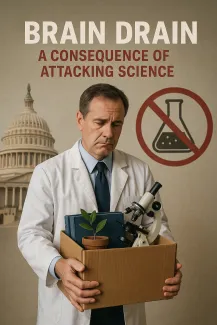
The strategy has been to defund and then attack in the media. These attacks extend beyond the people currently or recently employed in these professions. It also directly cuts off the pipeline of scientists in training. This is no longer just a problem for the people who lost their jobs from the government layoffs; this is now a problem of not having enough scientists in the future.
Most people know that grants fund research, but grants fund more than experiments; they also fund people. For example, in the health sciences when people are accepted into a PhD program, the acceptance is often tied to grant funding. Labs are regularly funded through federal dollars, and openings for new PhD students occur when someone from the lab graduates, allowing the financial support to be shifted to a new student. The grant has a certain amount of money allocated for personnel, including graduate students. The grant then covers tuition and a stipend for the student as they work to advance both their education and the work of the lab.
With the gutting of Health and Human Services grants, for example, many labs had to shut down. People lost their jobs. Graduate students lost their spots in laboratories and therefore the funding for their education. And future graduate students lost their opportunity to even start their training.
The unending barrage of extremely newsworthy events this year included a slew of stories about universities rescinding offers to PhD students. Those federal funding cuts directly killed research but also the pipeline of future researchers. All those would-be graduate students are now faced with the decision of what to do next. So, what are their options?
Some of those aspiring researchers will instead attempt to enter the workforce. All will have college degrees; some may even have a master’s degree. However, they will be entering at a different position than they had originally planned for. They will likely not be qualified for the jobs they had originally identified as their goal. While people can adapt and attempt to be flexible in the types of jobs they seek, the market will be less flexible.
There are only so many jobs available for people within specific fields. With an unexpected influx of people, jobs will be more competitive. These aspiring researchers will be competing with the typical pool of applicants but also with a pool they never anticipated: former government workers. People with years of experience and potentially more education will also be flooding the workforce attempting to find any job they can. This will make getting a foot in the door even harder than it already is for those just starting their careers. This may naturally lead some to wonder about opportunities outside the United States.
Many Americans will seek education and employment abroad. Now that the United States is hostile to specific types of education, such as health sciences research, opportunities to go into those fields may soon be better in other countries. For those students looking to pursue an education and future career in those areas that the United States has gutted, going abroad may be the only option—and the world is noticing. For example, in May 2025, France and the European Union announced intentions to make it easier for American researchers to settle in Europe. According to The Guardian:
“[French president] Macron’s office said the move comes “at a time when academic freedoms face a number … of threats” and when Europe “is an attractive continent.” [A representative from Macron’s office] said: “We are a space where there is freedom of research and no taboo topics.” France is thought to be particularly keen to attract scientists working on health—particularly infectious diseases—as well as climate research and artificial intelligence.”
The number of American scientists expressing interest in going abroad should concern everyone. We are not only losing the established professionals but also those in training and those who want to be in training. “We are witnessing a new brain drain,” said Éric Berton, president of Aix-Marseille Université in France. “We will do everything in our power to help as many scientists as possible continue their research.”
We could also see college and graduate students begin to seek educational opportunities abroad. For example, study abroad programs are traditionally for a specific amount of time (e.g., a semester) where American students can go study in another country. According to Open Door, during the 2022–2023 academic year, about 280,000 American students went abroad. Although these programs are specifically designed to be temporary, many students may now be motivated to stay in the country for longer than originally planned. Some may even settle in the host country permanently. While that may not be as common, it does happen. With the United States government’s active hostility toward certain types of professions, the number permanently settling in other countries may increase.
With few students graduating from universities in America, companies and organizations will likely be forced to make changes to their hiring practices. How will they adapt?
Many companies will seek highly skilled workers from other countries. It’s not uncommon for an organization to sponsor a visa for a highly skilled worker from another country. An H-1B visa “allows employers to petition for highly educated foreign professionals to work in ‘specialty occupations’ that require at least a bachelor’s degree or the equivalent. Jobs in fields such as mathematics, engineering, technology, and medical sciences often qualify.”
Originally created in 1990, Congress puts a cap on the number of H-1B visas available every year. Sponsoring institutions must demonstrate their need for a sponsored worker by filing a labor condition application and informing other employees of their intent to hire an H-1B visa role. It’s a lengthy process that involves lawyers and lots of paperwork, so while common, it’s not a process that happens every day in most organizations.
However, if the number of highly skilled and specialized Americans drops, this practice may become necessarily more common. While Congress puts the cap on the number of H-1B visas annually available, that cap may need to rise in the coming years due to lack of sufficiently trained American workers.
For those worried about immigration and the threat posed to American jobs, gutting scientific funding directly impacts this. Positions that either used to be filled by Americans or would be filled by Americans now won’t be due to the shortage of highly skilled workers. If we aren’t funding new scientists, researchers, and the like to be trained through these grants, then we will have to import talent and skill.
The only other choice for companies is much bleaker. If we don’t import new talent and skilled workers, yet still have a deficit, the only other option is for organizations to stop conducting research. This is a particularly scary scenario; organizations, agencies, and companies that cannot find people with the right training may just stop doing research altogether. This not only stifles scientific research and advancement, but it also gives up our seat as the powerhouse of biomedical and health sciences development in the world.
We will, willingly, cede our place as a world leader to someone else (e.g., China). Companies will export even more jobs and maybe their entire enterprise outside of the United States. Yes, this may be a doomsday scenario, but it’s not outside the realm of possibility. It’s important to entertain the logical conclusion of these research funding–gutting policies because they will have far reaching downstream effects.
Policies have consequences. The dominance of science and research in our culture demands attention. The departure of highly skilled American workers, coupled with a lack of new talent, jeopardizes our standing as a global leader in biomedical and health sciences education and research. This trend has already led to job losses and threatens to diminish research endeavors, presenting a bleak future for aspiring American scientists and the nation.
To save our future, we must save funding for science. We must invest, not divest, in our people and scientific education. We must fight these cuts and fight the demonization of science. Our society depends on it.
This article was originally published in the Skeptical Inquirer’s issue, The Disturbing Attacks on Science, and is used with their permission. The original can be found here.

Katie Suleta, DHSc, MPH
Katie Suleta is a regional director of research in graduate medical education for HCA Healthcare. Her background is in public health, health informatics, and infectious diseases. She has an MPH from DePaul University, an MS in Health Informatics from Boston University, and has completed her Doctorate of Health Sciences at George Washington University.