Senator Lindsay Graham’s death was due to an aortic dissection, an infrequent complication of atherosclerosis or hardening of the arteries. While the mainstream and social media have extensively reported on the initial medical findings, I thought this might be an opportunity to dispel a misunderstanding about atherosclerosis in general.
More Than a Hollow Tube
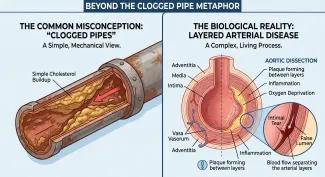
Our arteries consist of three layers: a tough outer layer, the adventitia, a middle layer, the media, which contains smooth muscle cells and other cellular components that allow the arteries to constrict and dilate. Finally, there is the innermost layer, the intima, lined with cells that interact with metabolites, the chemicals and signals in our bloodstream. Like any tissue, the cells need oxygen to generate energy, and they get it from very specialized blood vessels – the vasa vasorum.
What Happens During an Aortic Dissection?
Knowing that the arterial wall has three layers allows us to more easily explain the term dissection in Senator Graham’s death. Simply put, he developed a tear between the intima and media, and the continued pulsating blood got in between these layers, pushing the inner layer towards the center of the artery and eventually obstructing and disrupting blood flow. These kinds of tears are a frequent cause of death in high-impact collisions where a ligament helping to fix the position of the aorta results in a tear and “traumatic” dissection.
Obviously, that was not the case here. The dissection has been reported to have been caused by a combination of atherosclerosis and high blood pressure (hypertension).
Let's spend a moment busting a myth. When most people think of atherosclerosis and fats clogging their arteries, they look to their lived experience to help them understand. The usual metaphor for clogged arteries is clogged pipes or sand being laid down on a riverbed until a once-mighty river becomes just a creek.
Metaphors are useful in guiding thought, but they never fully capture biological realities. With constant use, metaphors often overtake their symbolic meaning and become what we perceive. This is the case with the general public’s understanding of how atherosclerosis works. To some extent, there is truth to this. The process does begin on the innermost surface of the artery, and deposits do build up over time.
A Disease of Living Tissue
Atherosclerosis involves the deposition of fats and calcium at the junction between the intima and the media of the arterial wall. As the plaque, the term physicians use to describe these fat and calcium deposits, builds up over time, it results in parts of the arterial wall losing access to the vasa vasorum and the oxygen it provides. The result is that the plaque breaks down in its inner core. In some instances, the breakdown creates a “cave-in,” and loose debris from the plaque is washed downstream, where it can get stuck in much smaller arteries and cause further damage. In other instances, the cave-in results in a localized dissection, lifting the plaque up, just as a tectonic plate can raise a mountain. These dissections are more limited than the one probably experienced by Senator Graham, but they involve the same underlying mechanism.
When Plaques Fail
Most individuals who suffer a heart attack experience plaque rupture that embolizes debris into smaller heart (coronary) vessels or abruptly narrows or closes off blood flow due to the dissections’ “tectonic” movement. The emergency management of these individuals focuses on clearing blockages and debris-related obstructions. Senator Graham’s dissection occurred in the artery that supplies blood to his entire body. Based on the available information, I would suspect that the dissection involved not only blood flow to his abdomen and lower body but also to his brain and possibly his heart. This is a surgical emergency, and only 50% of patients survive long enough to reach the operating room.
Looking Inside the Plaque
One of the most active areas of investigation today is imaging plaques with ultrasound, CT, and MRI, and using information about plaque composition – how much fat and calcium are present – to predict the risk of rupture. A growing diagnostic test that evaluates the risk of heart disease using CT imaging of the coronary arteries and identifies the degree of calcification is called a calcium score. It offers a less invasive way to determine the need for treatment than cardiac catheterization. Interestingly, physicians seeking to use plaque composition to predict cardiac risk have found that an outer layer of calcium is protective against embolization and dissection. In short, calcium’s role, along with that of LDL-containing lipids, remains a complex biological event that we struggle to diagnose and treat.
The familiar image of cholesterol slowly clogging arteries like rust filling an old pipe is memorable, but biology is rarely that simple. Atherosclerosis is a disease of living tissue—one involving inflammation, oxygen deprivation, cellular death, and structural weakening within the artery wall itself. While Senator Graham's death is a tragedy, it also reminds us that the greatest value of public attention may be in replacing comforting metaphors with a more accurate understanding of cardiovascular disease.
Metaphors are indispensable in science. They help translate invisible biological processes into concepts we can readily understand. But every metaphor eventually reaches the limits of what it can explain. When we forget that a metaphor is merely a guide rather than reality itself, it can obscure as much as it reveals. Good science communication depends not only on finding the right analogy but also on recognizing when it is time to replace an old one with a better one.

Chuck Dinerstein, MD, MBA
Director of Medicine
Dr. Charles Dinerstein, M.D., MBA, FACS is Director of Medicine at the American Council on Science and Health. He has over 25 years of experience as a vascular surgeon.