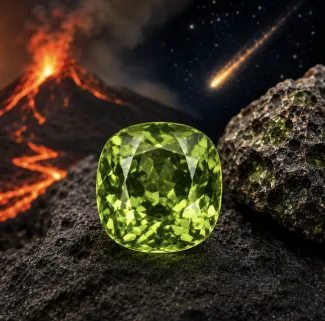
Just in time for you Augustinians, the birthstone for August is peridot. The good news is that it's really beautiful. The better news is that buying one for your special someone probably won't require a second mortgage. Unlike July's ruby, one of the world's most expensive gemstones, peridot ranks among the more affordable traditional birthstones.
Don't let the price fool you
Peridot has one of the most fascinating geological stories of any gemstone. Some crystals formed more than 30 miles beneath Earth's surface before volcanic eruptions blasted them upward. Others traveled millions of miles through space before crashing to Earth inside meteorites. Not many pieces of jewelry can make that claim.
I say, with no mineral-based disrespect intended, peridot is really just olivine—a common mineral composed of magnesium, iron, silicon, and oxygen. Although olivine (no relation to Olive Oyl) is one of the most abundant minerals in Earth's upper mantle, gem-quality crystals are much rarer. Those are called peridot, which sounds more like a French wine than a gemstone.
If you've ever seen photos of green volcanic rocks from Hawaii, you've already seen olivine. Most of it is cloudy, fractured, or otherwise unsuitable for jewelry. Every so often, however, nature gets everything just right, producing clear crystals worthy of a gemstone.
But then there's this. The image on the right isn't a psychedelic gemstone. It's a wafer-thin slice of ordinary olivine viewed under polarized light. The rainbow colors aren't really there. They're optical artifacts created because each crystal is oriented differently with respect to the polarized light. Each brightly colored polygon is an individual olivine crystal.. Each brightly colored polygon is an individual olivine crystal.
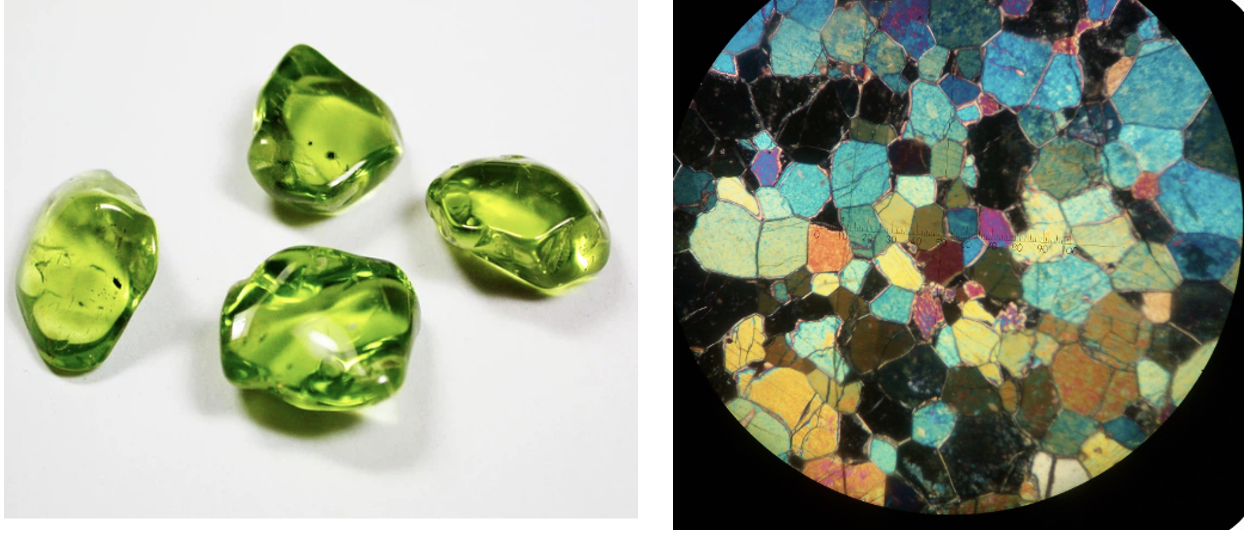
(Left) Gem-quality olivine (peridot). Image: RawPixel. (Right) A thin slice of ordinary olivine viewed under polarized light. WTH? Image: Wikimedia Commons.
The crystal cheats
Ruby, sapphire, and emerald owe their colors to tiny amounts of impurities that sneak into otherwise colorless crystals. Peridot takes a different approach.
Chemists write its formula as (Mg,Fe)₂SiO₄. That's shorthand for saying that magnesium and iron naturally share positions in the crystal lattice. Iron isn't an impurity. It's supposed to be there. So is magnesium.
That distinction matters.
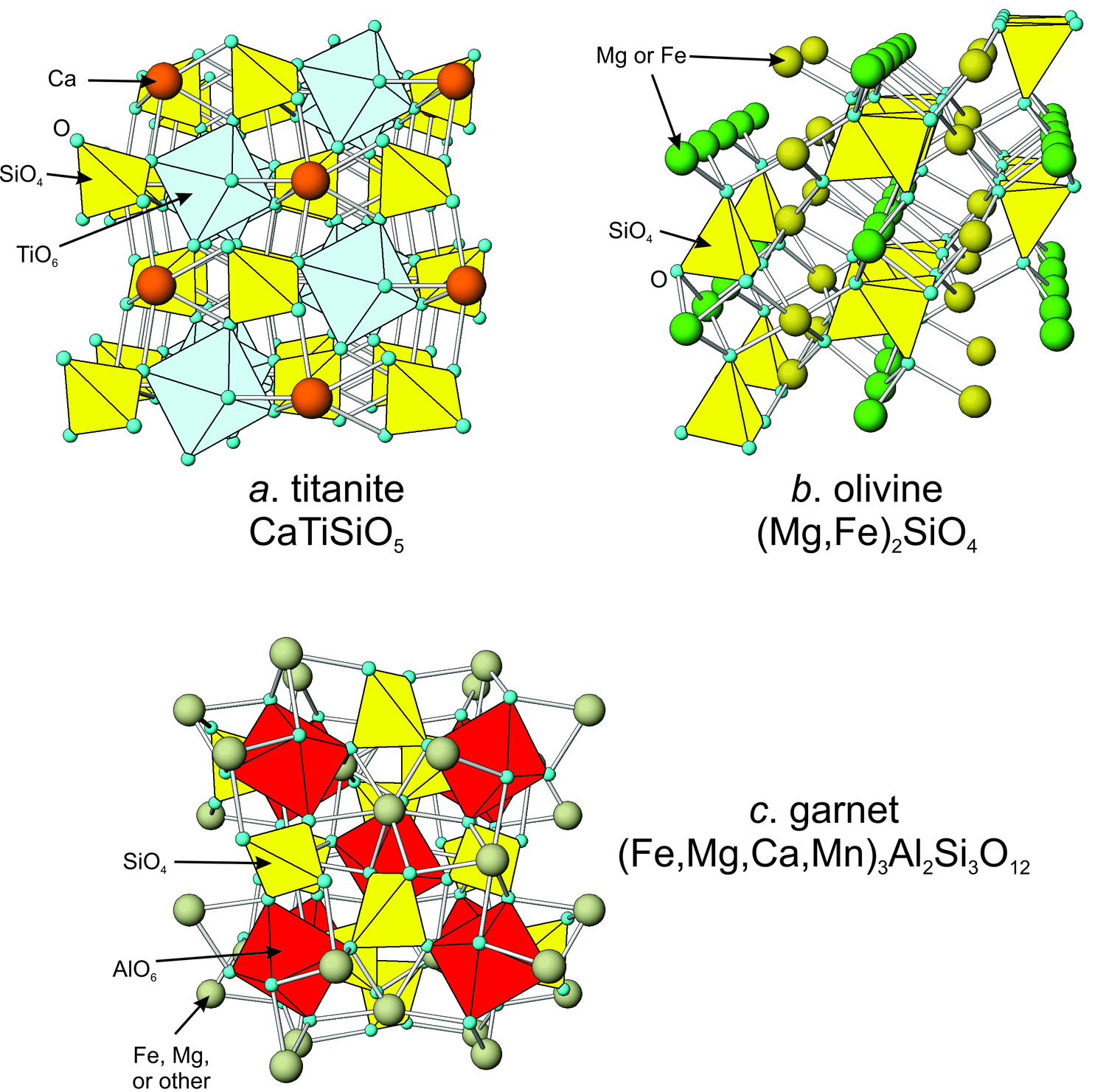
At the heart of the crystal are tiny silicon-oxygen tetrahedra—four oxygen atoms surrounding a silicon atom. Unlike quartz, where these tetrahedra are linked together into a giant three-dimensional framework, olivine's tetrahedra exist as isolated "islands." Mineralogists call this a nesosilicate. Magnesium and iron occupy the spaces between these islands, tying the entire structure together.
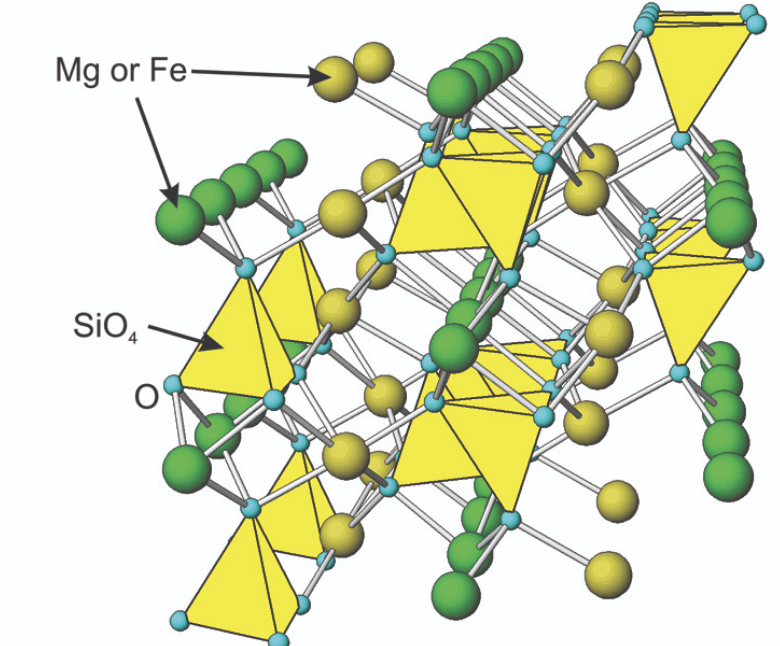
A nesosilicate (island silicate) crystal structure, consisting of Fe, Mg, Si, and O. Image: Open Geology
The iron atoms are responsible for the color. They absorb portions of visible light, leaving the familiar green behind. The more iron present, the deeper the green tends to become. Magnesium, by contrast, helps hold the crystal together, but contributes little or nothing to its color.
In other words, peridot isn't painted green. It grows that way.
That's also why peridot comes in only one color. The shade can range from yellow-green to olive or bottle green, but if it's not green, it isn't peridot.
Straight from the mantle (not Mickey)
Most gemstones form in Earth's crust, where we live.
Peridot often comes from much deeper. Many crystals formed in the upper mantle before rapidly rising magma carried them toward the surface.
The trip had to happen quickly. Had the magma cooled too slowly, the crystals could have reacted with the surrounding rock or partially melted, never making it into a jeweler's display case.
Instead, they survived.
Every polished peridot is a tiny sample of Earth's mantle. No one has ever seen the mantle, and almost certainly no one ever will.
Or from outer space
As if emerging from Earth's mantle weren't strange enough, some peridot has an even more exotic origin.
Rare meteorites called pallasites contain spectacular green olivine crystals embedded in an iron-nickel metal matrix. They probably formed near the boundary between the metallic core and rocky mantle of an ancient asteroid that was shattered billions of years ago. So yes, some peridot really did come from outer space.
Good luck explaining that to your insurance company.
The gem of the sun
Peridot has been prized for thousands of years.
The ancient Egyptians mined it on Zabargad Island in the Red Sea and called it the "gem of the sun." According to legend, miners searched for the crystals at night because they supposedly glowed in lamplight, making them easier to find.
Whether that's true is anyone's guess. Ancient civilizations weren't always meticulous about separating observation from storytelling. Come to think of it, things haven't changed all that much.
An optical oddity
Peridot is strongly birefringent, meaning that light travels through the crystal along two slightly different paths. In larger stones, you can sometimes see a doubled image of the back facets when looking through the gem. Gemologists routinely use this "double vision" to help identify peridot.
This differs from the double vision you guys may experience should you be hit over the head with an ashtray for forgetting your spouse's August birthday. No magic crystal, earthly or otherwise, will prevent the headache.

Josh Bloom
Dr. Jonathan (Josh) Bloom, ACSH's Director of Chemical and Pharmaceutical Sciences, earned his Ph.D. at the University of Virginia and completed postdoctoral training at the University of Pennsylvania. During his 20-plus years in drug discovery at Wyeth, his research group discovered the antibiotic Tygacil®, approved in 2005. He holds 25 issued patents and has authored 35 academic papers. Since joining ACSH in 2010, he has written more than 2,000 articles and dozens of op-eds for major newspapers, including The Wall Street Journal and Chicago Tribune.