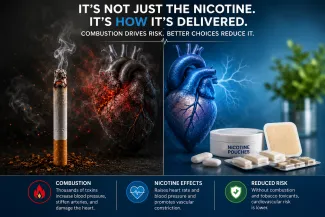
With the Surgeon General’s 1964 statement on tobacco, the global nicotine landscape shifted. Cigarettes remain a major source of nicotine exposure, but they now compete with e-cigarettes, heated-tobacco products, pouches, and medicinal nicotine. Public-health and cardiovascular organizations emphasize that none of these products is risk-free, yet that message leaves another question unresolved: are they equally harmful? The answer matters as smoking declines in some populations, as nicotine products continue to diversify worldwide.
In the last few weeks, the FDA authorized several new nicotine pouches, noting that for existing smokers, “these new products contain lower levels of most harmful and potentially harmful constituents (HPHCs) when compared to other oral and smokeless tobacco products, many of which were too low to be quantified in the new products.”
Researchers writing in Nature Reviews Cardiology argue for a cardiovascular “hierarchy of harm” among nicotine-containing products. That focus is important: a ranking based on cardiovascular effects does not necessarily capture every health risk, including cancer. But it provides a useful framework for thinking about harm reduction. To understand that hierarchy, we first need to see what nicotine does to blood vessels and the heart.
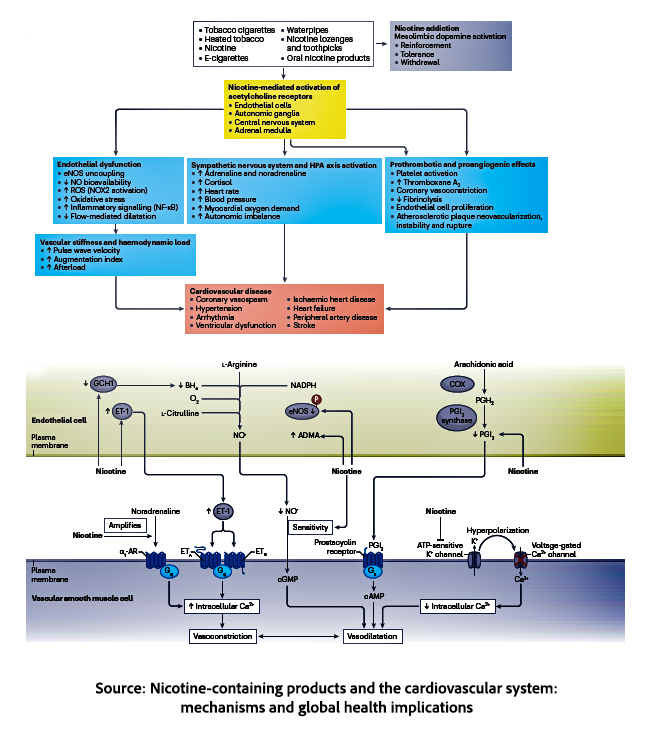
Where Nicotine Does Its Damage
The endothelium, the innermost cellular layer of the arterial wall, plays an outsized role in cardiovascular health. It helps arteries widen and narrow, regulates inflammation and clotting, and influences the development of atherosclerosis. One of its key tools is nitric oxide (NO), a molecule that relaxes the smooth muscle surrounding arteries, helping them dilate and maintain blood flow. NO also helps discourage inflammation, unwanted cell adhesion, and platelet activation. When endothelial function deteriorates, those protections weaken, making endothelial function a validated marker of cardiovascular health.
When nitric oxide falls, blood vessels become less able to dilate and more prone to inflammation and clotting. Oxidative stress, the buildup of reactive molecules beyond the body’s ability to neutralize them, can further reduce NO and damage the vessel wall. Many forces can trigger this process, and nicotine is one of them.
Because endothelial cells turn over relatively quickly, researchers can detect short-term vascular responses to nicotine. Repeated oxidative stress, nitric oxide depletion, and arterial stiffening accumulate in a dose-dependent fashion to sustained endothelial dysfunction. But an important caveat follows: endothelial dysfunction is a reliable signal of vascular injury, not proof by itself that a particular exposure will produce heart attacks, strokes, or other cardiovascular events.
Those vascular changes become easier to understand when we look at what happens immediately after nicotine enters the body.
Nicotine Puts the Cardiovascular System to Work
Nicotine increases heart rate and constricts blood vessels, raising blood pressure. At the same time, the heart's workload increases, and the coronary arteries narrow, reducing blood flow to the heart when demand is higher. The sympathetic nervous system activation responsible for those changes also promotes oxidative stress, fueling vascular inflammation throughout the body.
Nicotine can also act directly on the arterial wall, increasing signals that tighten blood vessels, such as endothelin-1, while reducing protective molecules such as prostacyclin. The balance shifts toward stiffer, more constricted vessels and conditions more favorable to clotting.
The researchers applied these mechanisms to the growing range of nicotine products, asking how different delivery systems change cardiovascular harm. Let’s consider what they found.
Nicotine’s Different Delivery, Different Harm
The key difference among nicotine products is not simply whether they contain nicotine, but what else their delivery systems expose users to.
- Combustible Tobacco Products represent the highest category of harm and toxicity because burning tobacco adds a large mixture of toxic combustion products to nicotine exposure.
- Heated-Tobacco Products: Heating tobacco avoids full combustion and reduces some combustion toxicants, but aerosol emissions still cause substantial endothelial dysfunction, oxidative stress, and arterial stiffness and deliver persistent nitrosamines and heavy metals.
- Electronic Nicotine-Delivery Systems operating without combustion, such as e-cigarettes or vaping devices, present users with fewer toxic compounds and a lower systemic inflammatory burden than combustible cigarettes. However, they still can cause acute and chronic endothelial impairment.
- Smokeless Tobacco Products eliminate combustion and inhalation hazards; however, they contain tobacco-specific nitrosamines and may still cause measurable vascular dysfunction. Because of the very different mode of delivery and intimate contact with the oral mucosa, cancer development is more concerning than cardiovascular risk and speaks to the weakness of the study’s hierarchy, which focuses solely on cardiovascular disease.
- Tobacco-Free Oral Nicotine Formulations and Medicinal Nicotine Replacement Therapies remove both combustion and tobacco-leaf toxicants. What remains more clearly isolates nicotine’s own effects, including sympathetic activation and vascular stress.
But product type alone does not determine exposure: how much nicotine reaches the body, and how often, also matters.
The Dose Matters—But Measuring It Isn’t Easy
If the dose does indeed make the poison, then we also need to know how much nicotine people actually absorb. That is surprisingly difficult to estimate. Researchers use the term “smoking topography” for behaviors such as how often someone puffs, how deeply they inhale, and how much smoke or aerosol they take in during a session, and those patterns vary considerably.
Cigarettes provide a relatively standardized unit of consumption, although smoking behavior still varies from person to person. E-cigarettes are harder to compare because devices, nicotine concentrations, and puffing patterns differ substantially. Waterpipe use adds another pattern, with longer sessions and larger puff volumes. Oral products may make the nicotine content easier to characterize, but the amount actually absorbed can still vary. Product labels, in other words, do not perfectly predict nicotine exposure.
The Hierarchy of Harm
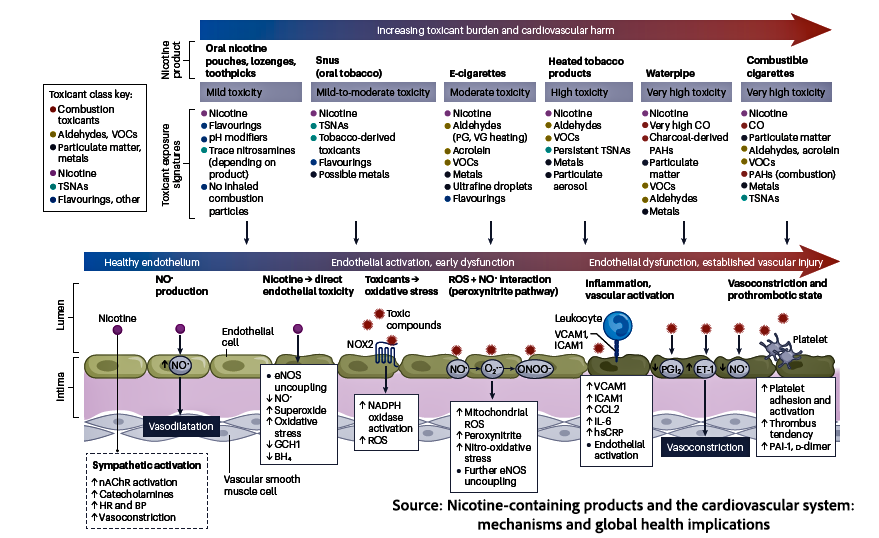
The hierarchy of cardiovascular harm across nicotine-containing products is determined by three factors: how nicotine is delivered, what additional toxicants accompany it, and, above all, whether combustion is involved.
At the apex are combustible tobacco products, including conventional cigarettes and waterpipes, where high-temperature combustion generates a toxic brew alongside nicotine delivery. These compounds provoke profound endothelial dysfunction and carry the highest cardiovascular risks.
Occupying the intermediate tiers of toxicity are heated and aerosol-based tobacco products. Avoiding combustion decreases exposure to many combustion-derived toxicants. Still, their aerosols are not chemically inert: they can contain degradation products, ultrafine particles or droplets, and flavoring-related compounds that trigger endothelial dysfunction.
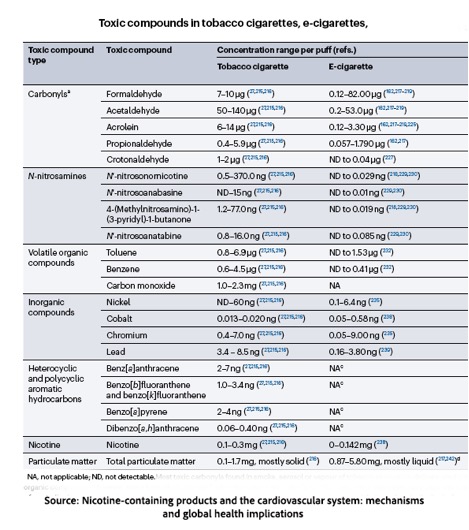
The table comparing cigarette smoke with e-cigarette aerosol illustrates why combustion matters. For many of the listed carbonyls, nitrosamines, volatile organic compounds, and other toxicants, reported concentrations are lower in e-cigarette aerosol than in cigarette smoke. However, levels vary by compound and product. That supports a narrower but important conclusion: avoiding combustion can substantially reduce exposure to many toxic constituents. It does not, by itself, tell us exactly how much long-term cardiovascular risk falls.
At the lower end of the continuum are oral nicotine products, which bypass combustion and inhalation. But this category is not uniform: tobacco-containing products such as snus retain tobacco-specific nitrosamines, whereas tobacco-free nicotine formulations remove that source of exposure. Neither eliminates nicotine’s cardiovascular effects.
No nicotine delivery system, including prescriptions for patches and gum, is risk-free. Nicotine is an independent driver of endothelial dysfunction and, with dosage and duration, vascular injury and cardiovascular risk. The risk reductions associated with complete switching to non-combustible products are clinically large for both cardiovascular and non-cardiovascular outcomes, even though residual nicotine-related vascular effects remain.
The hierarchy of harm provides a more informative way to think about nicotine than the statement that no nicotine product is safe. Both can be true. Nicotine itself is not benign: it alters vascular function, increases cardiovascular workload, and, depending on dose and duration, may contribute to vascular injury. But delivery matters enormously. Combustion adds a substantial toxic burden, while eliminating combustion and inhalation reduces exposure to many of those toxicants. That distinction underpins harm reduction.
Oral nicotine, patches, gum, and vaping should not be confused with abstinence, nor should they be treated as equivalent to smoking. The evidence points not to a choice between “safe” and “unsafe,” but to a continuum of risk—and for people unable or unwilling to give up nicotine, moving down that continuum can still yield meaningful health gains.
Source: Nicotine-containing products and the cardiovascular system: mechanisms and global health implications Nature Reviews Cardiology DOI: 10.1038/s41569-026-01331-6

Chuck Dinerstein, MD, MBA
Director of Medicine
Charles Dinerstein, MD, MBA, is the Medical Director of the American Council on Science and Health. A vascular surgeon with more than 25 years of clinical experience, he brings a physician's understanding of medical decision-making, an appreciation for scientific uncertainty, and a broader perspective on healthcare economics and policy to his writing.