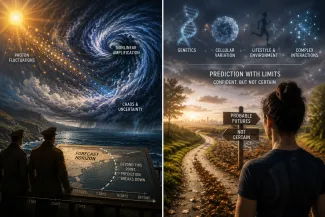
In the movie Pressure, General Eisenhower must time the D-Day invasion based on a forecast predicting a window of tolerable weather over the English Channel. The movie’s tension centers on two meteorologists with very different opinions. Colonel Irving Krick, an American forecaster, trusts historical patterns; James Stagg, his British counterpart, believes that atmospheric systems are dynamic and highly changeable, and that“Atmospheric conditions can never be identical ever.”
Stagg’s prediction proved correct, and increasingly sophisticated models of atmospheric dynamics have extended the useful forecasting window far beyond the roughly 24-hour window available at the time of D-Day. Yet a new study suggests that even perfect forecasting may eventually reach an absolute limit. That raises an intriguing question: might there also be limits to how precisely we can predict an individual human's future?
The Horizon of Prediction
The weather is a complex system of physical variables, including temperature, pressure, humidity, and wind speed and direction, all describing the flow of air and water around the planet. In the classical deterministic picture, if we knew the system’s initial state exactly and understood the laws governing every interaction, its future should in principle follow from its present. Better measurements, greater computing power, and improved meteorological models have indeed steadily extended the useful range of weather forecasts. But determinism does not necessarily mean predictability.
That paradox of something governed by physical laws yet ultimately unpredictable is where chaos enters the story
Weather systems are “chaotic” because small perturbations are amplified into larger ones. Weather variables do not interact in a linear, 1-to-1 manner; they are nonlinear, sometimes amplifying and sometimes diminishing their effect on one another. As a result, infinitesimal errors can, over time, grow large, corrupting the values on which determinism relies. The study asks whether an even deeper source of uncertainty, the Sun's effect, is responsible for that corruption and places an ultimate boundary on prediction.
Sunlight rains down on Earth in photons, the fundamental particles of light. Physics tells us photons have small, “quantum,” fluctuations, slight variations that are transmitted to the smallest components of weather variables, the gas molecules of our atmosphere. The researchers ask whether those microscopic variations can propagate upward through the weather system via turbulent circulation, cloud systems, and regional storm fronts until they saturate the planetary-scale jet streams. In their model, these initially negligible differences grow until they overwhelm the information contained in the atmosphere’s starting state. At that point, no amount of additional computing power can recover the lost predictability.
If the authors are right, weather has a practical forecasting limit, imposed not by imperfect instruments and computers, but by a fundamental characteristic of the system. Beyond a certain horizon, information about the initial state is effectively erased.
The distinction between improving a forecast and eliminating uncertainty is where weather begins to illuminate medicine.
Is human health predictable in the same way?
Like the weather, humans are aperiodic, constantly changing, never the same. Despite what our brains tell us, our cells are changing continuously, from the 5-day turnover of the cells lining our gut to the 2- to 4-week life of our skin cells to the 10-year turnover of the cells in our bones. And just as atmospheric gases interact in a nonlinear way with geography and oceans, our cells and their messengers, tissues, and organ systems are coupled in ways that amplify and diminish. Finally, just like the Sun’s energy animates the weather, we are animated by the energetics of calorie intake, oxygen consumption, and the need to maintain a core temperature. This is not proof that human health is mathematically chaotic in the same sense as the atmosphere. But it does suggest a similar problem: how long does information about our present state remain sufficient to predict our future?
Human biology also contains microscopic sources of variation not from photons but from somatic mutations, protein misfolding, fluctuations in gene regulation, and countless environmental exposures. Most disappear without consequence: cells repair damage, physiological systems compensate, and homeostasis dampens disturbances. Some, however, may persist or interact with other changes until their consequences become clinically visible. The important parallel with weather is therefore not that the mechanisms are identical, but that small uncertainties can enter a complex system whose future state depends on nonlinear interactions we cannot completely observe.
Once prediction is framed this way, Stagg's distinction between confidence and certainty becomes more important than the weather analogy itself.
Confident, but not certain
Back in Pressure, Eisenhower presses Stagg for what he needs for his D-Day decision and what every patient eventually wants from a prognosis: certainty. Is he “absolutely certain”?
Stagg answers:
“No. I'm not certain. I'm confident that the storms will come. I can't be absolutely certain as to when.”
There, in that exchange, is a distinction that runs through medical prognosis. Medicine is often quite good at estimating risk: the probability that an outcome will occur among people with certain characteristics. What patients usually want, however, is something more personal: Will it happen to me? And if so, when? Adding more information can make that probability increasingly individualized. But a more individualized probability is still a probability—not a deterministic prediction.
Physicians’ deterministic predictions are not good
Clinical prognosis shows how quickly individual prediction can become difficult. In one study, 343 physicians estimated survival for 468 terminally ill patients referred to hospice. Only 20 percent of the estimates fell within 33 percent of the actual survival; 63 percent were overly optimistic, and 17 percent were overly pessimistic. Meta-analyses of prognosis in terminal cancer have found similar difficulties. Physicians can make useful short-term judgments, whether someone is likely to survive the next 48 hours, but estimates months into the future become dramatically less reliable. This does not prove that human biology has a fixed prediction horizon like weather. However, it does show how rapidly uncertainty grows when we try to move from population probabilities to the future of one particular person.
What can “precision” actually promise?
Traditional risk estimates begin with reference classes: people of a certain age, sex, medical history, blood pressure, cholesterol level, or other characteristics have some probability of developing a disease. Precision medicine promises to narrow those reference classes by adding information from genomics, biomarkers, environmental exposures, and, increasingly, other molecular data. The hope is clear: the more relevant information we know about an individual, the more precisely we can estimate that individual's risk.
But a more precise risk is not the same thing as a precisely predictable future.
Yet two very different claims lie hidden within "precision". The stronger is deterministic: collect enough information, and we will predict exactly what will happen to an individual, when it will happen, and how every intervention will alter that timeline. The weather analogy gives us reason to be skeptical and makes this goal seem a fool’s errand. More measurements and better models may continually improve prediction without ever making an individual's distant future fully knowable.
Medicine faces a complication that weather forecasters largely do not. A hurricane does not alter its course because it has seen the forecast. Human health, by contrast, is adaptive, behavioral, and sensitive to intervention. Tell someone that their risk of diabetes is high and they may lose weight, exercise, change their diet, or take medication. A useful prediction can help prevent the future it predicts. In medicine, prediction and intervention are entangled.
A prediction horizon, however, does not make prediction useless. A more defensible promise of precision medicine is refined risk stratification: placing a patient into progressively narrower, more informative reference classes and transforming a general population probability or guideline into a more individualized one. That can identify patients more likely to benefit from a particular intervention, avoid ineffective treatments, and reveal risks early enough to act.
Precision medicine, on this view, does not abolish uncertainty. It manages uncertainty more intelligently.
That brings us back to Stagg. The useful forecast was never the one that guaranteed exactly what the atmosphere would do. It was the one sufficiently accurate to make a consequential decision. The measure of a medical prediction may not be whether it tells us the future with certainty, but whether it tells us enough, soon enough, to change it.
Source: A New Approach to Estimating the Limit of Predictability, Advances in Atmospheric Science, DOI: 10.1007/s00376-026-5621-8.

Chuck Dinerstein, MD, MBA
Director of Medicine
Dr. Charles Dinerstein, M.D., MBA, FACS is Director of Medicine at the American Council on Science and Health. He has over 25 years of experience as a vascular surgeon.